Last Updated on 08/09/2026
What the 2026 price change means for you, what a “skip-the-line” ticket actually skips, opening hours, which entrance to use, and how to visit with a licensed guide.
Planning a Louvre visit? Two things changed the calculation this year. Ticket prices split into two tiers on 14 January 2026, and the museum now runs on mandatory timed entry — which means the thing most people pay extra to avoid is already included in the cheapest ticket. Understanding that saves most visitors more money than any booking trick.
On this page: 2026 prices and who pays what, what “skip-the-line” actually skips, what to do if your dates are sold out, which entrance to use, opening hours and closed days, when the Louvre is free, how to get there, what to see inside, guided tour options and how to request a private licensed guide.
OfficialGuides is a marketplace of licensed independent tour guides — not the Louvre’s ticket office, which is ticket.louvre.fr. The two tour links on this page are affiliate links to an authorised reseller; your price is unaffected.
Louvre essentials
Ticket price: €22 for EU/EEA residents, €32 for everyone else, since 14 January 2026.
Free entry: under 18s (any nationality), EU/EEA residents aged 18–25, first Friday of the month after 6:00pm (not July/August), and 14 July.
Opening hours: 9:00am–6:00pm; late until 9:45pm Wednesday and Friday. Closed every Tuesday, plus 1 January, 1 May and 25 December.
Booking: timed entry is mandatory. Every ticket includes a slot — that is the skip-the-line system.
Fastest entrance: Carrousel du Louvre, from 99 Rue de Rivoli or straight from the metro.
Mona Lisa: Denon Wing, Level 1, Room 711 (Salle des États).
Time needed: 3–4 hours for the highlights; 2 hours for the three anchor works.
Official ticket office: ticket.louvre.fr
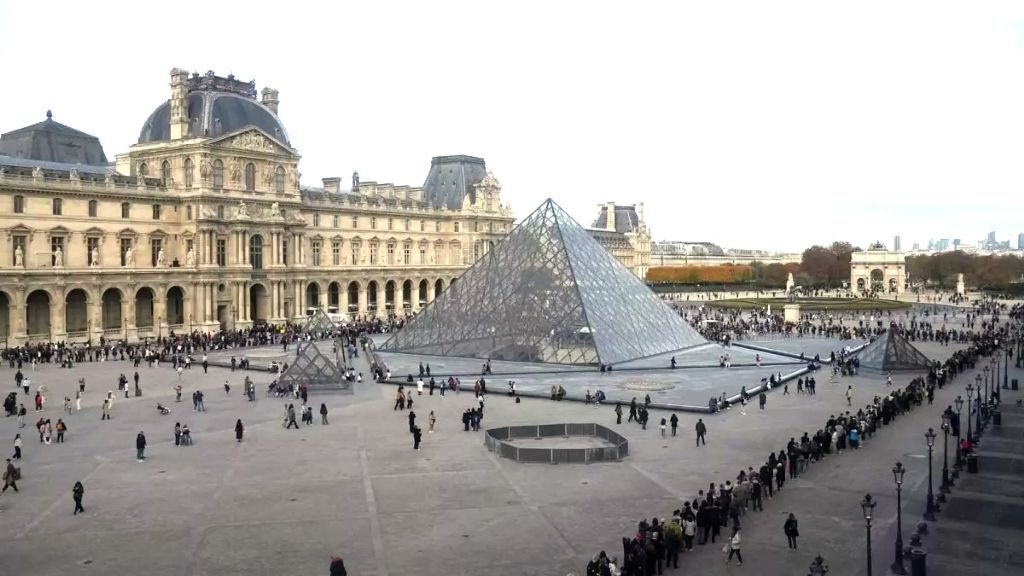 The walk-up ticket line at the Pyramid entrance. Everyone with a booked time slot bypasses this — including everyone who booked at face value on the official site.
Louvre ticket prices in 2026: what changed and who pays what
On 14 January 2026 the Louvre introduced two-tier pricing for the first time in its history. Residents and citizens of the EU and the European Economic Area — which includes Iceland, Liechtenstein and Norway — continue to pay €22. Everyone else pays €32, a 45% increase.
Why it happened. The rise funds a long-term renovation programme announced by President Macron in early 2025, after the museum’s director described visiting the Louvre as a “physical ordeal” and parts of the building as being in very poor condition. The urgency sharpened in October 2025, when thieves took French Crown Jewels valued at around €88 million from the Galerie d’Apollon in a daylight robbery, exposing serious weaknesses in the building’s security. The Louvre is not alone: Versailles, the Musée d’Orsay, the Centre Pompidou and Sainte-Chapelle introduced similar two-tier pricing the same month.
What the standard ticket covers. The entire permanent collection — all three wings (Denon, Sully, Richelieu), every floor, and the 35,000 or so works on display — plus most exhibitions held inside the permanent galleries. Major temporary shows in the Hall Napoléon usually need a separate ticket, typically €4–6 extra.
Who enters free. Everyone under 18, regardless of nationality. EU and EEA residents aged 18 to 25, with valid ID. Also art teachers, some disability categories and their companions. Free entry still requires a reserved time slot — this catches people out constantly.
The price you should expect to pay. €22 or €32, booked directly at ticket.louvre.fr. That is the face value, and the official site is where you should look first. If you see a plain entry ticket advertised well above that figure, you are paying a reseller’s margin, not buying faster access. The next section explains why.
What “skip-the-line” actually skips at the Louvre
This is the part worth reading slowly, because it is where most Louvre budgets leak.
The Louvre runs a mandatory timed-entry system. Every ticket — the €22 one, the €32 one, and even the free ones — is tied to a 30-minute arrival window that you choose when you book. On the day, you go to the reserved-entry lane, not the walk-up queue. That is the skip-the-line system, and it is built into the standard ticket.
So when a third-party platform advertises a “skip-the-line” or “fast-track” Louvre ticket at €40, €50 or €80, it is not selling you faster entry than a €22 official ticket provides. The premium buys something else: a guide, an audio guide, a host who walks you to the Mona Lisa, an evening slot, or simply availability on a date the official site has sold out. Those can all be worth paying for — but decide with your eyes open about which one you are buying.
The one queue nobody skips. Security screening is mandatory and airport-style. No ticket, tour or price tier exempts you. Allow 15 to 20 minutes and arrive slightly before your slot.
When paying more is genuinely rational. Three situations. Your dates are sold out on the official site and a reseller still has inventory. You want a licensed guide, which the Louvre’s own ticket does not include. Or you want an evening slot on a guided tour, when the galleries are at their emptiest and the official late openings have already gone.
If your dates are sold out on the official site
This is the situation most people are actually in by the time they start reading pages like this one. Morning and weekend slots go weeks ahead in season, and the official site simply shows nothing available. Work through it in this order.
First, check the adjacent days. If your Paris dates have any flexibility at all, a Thursday slot often exists when Saturday doesn’t. The official calendar shows a month at a time — look at the whole month rather than the one date you had in mind.
Second, check the late openings. Wednesday and Friday evening slots fill later than mornings, because most visitors don’t think of the Louvre as an evening museum. If you can move your visit to 6:00 or 7:00pm on one of those two days, you will often find availability where the mornings have none — and the galleries are emptier anyway.
Third, check whether you’re eligible for free entry. Under 18, or an EU/EEA resident under 26? Free slots are a separate allocation from paid ones, so they can be open when paid slots aren’t. You still need to reserve.
If none of that works, resale platforms hold separate inventory. Tour operators are allocated their own entry slots in advance, which is why guided tours frequently remain bookable after plain entry tickets have gone. You pay more than face value, and what you’re paying for is availability plus a guide — not faster entry, which your ticket would have included anyway. On a trip where you’ve already committed to flights and hotels, that is usually a rational trade.
Which entrance should you use?
The entrance you choose affects your wait more than the ticket you bought, and almost nobody plans this.
The glass Pyramid is the iconic main entrance — and the slowest, because it is the default for everyone who hasn’t thought about it. Beautiful, busy, and the longest security queue of the three.
The Carrousel du Louvre is the one to use if you have a pre-booked ticket. It is underground, reached from 99 Rue de Rivoli or directly from the Palais Royal–Musée du Louvre metro station without going outside. The security queue here is almost always shorter, and it is the default entrance for most pre-booked tours. In rain or summer heat, this alone justifies the walk.
The Porte des Lions opens directly into the Denon Wing, closest to the Mona Lisa. Its opening hours are limited and change without much notice, so only plan around it if you have confirmed it is open on your day.
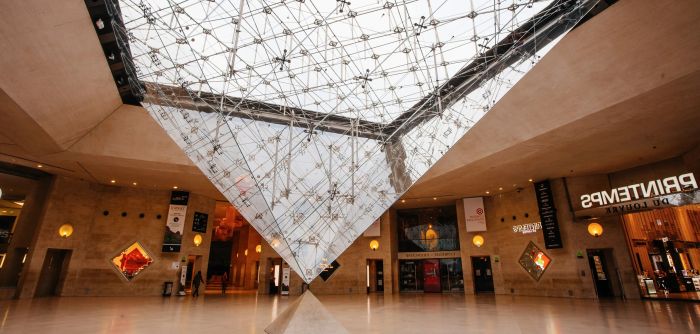 The Carrousel du Louvre entrance, reached from 99 Rue de Rivoli or straight from the metro. Usually the shortest security queue of the three entrances.
Opening hours and closed days
The Louvre is open every day except Tuesday. Standard hours are 9:00am to 6:00pm, with late opening until 9:45pm on Wednesdays and Fridays. Last admission is one hour before closing, and staff begin clearing the galleries 30 minutes before.
| Day | Hours |
|---|---|
| Monday | 9:00am – 6:00pm |
| Tuesday | Closed |
| Wednesday | 9:00am – 9:45pm (late) |
| Thursday | 9:00am – 6:00pm |
| Friday | 9:00am – 9:45pm (late) |
| Saturday | 9:00am – 6:00pm |
| Sunday | 9:00am – 6:00pm |
Also closed on 1 January, 1 May and 25 December. If a public holiday falls on a Tuesday, the museum stays closed as usual — it does not open to compensate.
The best windows. The crush is heaviest between 11:00am and 3:00pm, and worst on weekends from June to September. Two sweet spots: right at 9:00am opening on a Wednesday or Thursday, or after roughly 5:30pm on a Wednesday or Friday late opening, when the day-trippers have gone and the galleries breathe again. April–May and September–October are noticeably calmer than midsummer.
When is the Louvre free?
Beyond the always-free categories, the museum opens to everyone free of charge on the first Friday of each month after 6:00pm — suspended in July and August — and on 14 July, Bastille Day.
The catch is real. Free entry still requires a reserved time slot, and those slots vanish within hours of release. Expect the galleries to be packed on free evenings. If your priority is actually seeing the art rather than saving €22, a paid weekday-morning slot is the better trade.
How to get there
The Louvre sits on the Right Bank in the 1st arrondissement, dead centre in Paris.
🚇 By metro
Lines 1 and 7 stop at Palais Royal – Musée du Louvre, with a direct underground link to the Carrousel entrance — you never go outside. Line 14 stops nearby at Pyramides.
🚌 By bus
Lines 21, 27, 39, 68, 72 and 95 all stop within a short walk. The 72 runs along the Seine right past the museum.
🚕 By taxi or car
Around 15 minutes from central Paris by taxi. There is no on-site parking; the Carrousel underground car park, entered from Avenue du Général Lemonnier, is the nearest option.
🚶 On foot
From most central districts it is a 20 to 40 minute walk along the Seine, through the Tuileries Garden and past the Pont des Arts.
What to see, and how long you need
With more than 35,000 works across eight departments, the Louvre rewards a plan far more than an attempt to see everything. Most first-time visitors get a satisfying visit in three to four hours: the headline works plus one collection that genuinely interests them. If you only have two hours, the three anchors can be done efficiently.
Mona Lisa
Denon Wing, Level 1, Room 711 (Salle des États). Behind bulletproof glass, viewed from about four metres. Most people get 30 to 60 seconds. She is scheduled to move to a purpose-built room under the Cour Carrée around 2031, but remains in Room 711 for now.
Venus de Milo
Sully Wing. The Greek statue of Aphrodite that defined classical beauty for modern Europe, and far easier to actually look at than the Mona Lisa.
Winged Victory of Samothrace
At the top of the Daru staircase, in the most dramatic placement in the museum. You walk up towards her; the effect is deliberate.
Liberty Leading the People
Delacroix’s revolutionary icon, in the Denon Wing’s large-format galleries — the same route as the Mona Lisa, so easy to combine.
Where experienced visitors go instead. The Richelieu Wing holds Napoleon III’s apartments, the Northern European paintings including Vermeer and Rembrandt, and the Mesopotamian collection with the Code of Hammurabi. It carries a fraction of the crowds of Denon. The Egyptian antiquities in Sully are similarly underrated — a lot of visitors end up rating them above the paintings.
One practical thing: opposite the Mona Lisa hangs Veronese’s Wedding at Cana, at nearly 7 by 10 metres the largest painting in the Louvre. Almost nobody sees it, because everyone in the room is facing the other way. Turn around.
Wear comfortable shoes — people routinely log 15,000 to 20,000 steps inside — and download the official Louvre app before you arrive. Its map alone saves a lot of wrong turns in a building that confuses Parisians.
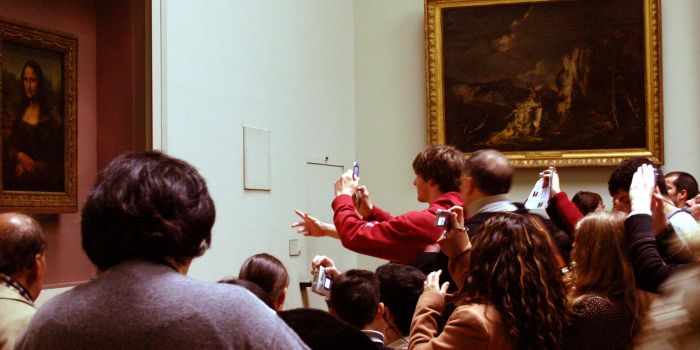 The Mona Lisa in Room 711 of the Denon Wing. Crowds are thickest from 10:30am to 3:00pm.
Visit the Louvre with a private licensed guide
A timed ticket gets you through the door. A licensed private guide turns 35,000 works into the thirty that matter for you — reading the room, sequencing the route, and handling entry so your hours go on looking at art rather than at maps.
As a rough figure, a private licensed guide in Paris costs around €80 to €100 per hour for the group, not per person, with museum entry usually paid separately. For a family or a group of four, that often works out cheaper per head than a semi-private tour — and you set the pace. You book the guide directly, with no agency mark-up in between.
PRIVATE TOUR GUIDE REQUESTOfficialGuides connects you directly with independent licensed guides — not through an agency. Please fill in the form below with your first and last name, phone number (with country code), email address, travel dates, number of persons and the places you would like to visit. Available guides will reply directly with their availability and price.
Guided tour options, compared with the official ticket
For clarity, here is how the entry-only price sits against the guided options. Remember that all of them include the same timed entry — the difference is what comes with it.
| Option | Price |
|---|---|
| Official site, entry only Timed slot included. Book at ticket.louvre.fr — start here, and only look elsewhere if your dates are gone. | €22 EU / €32 non-EU |
| Private licensed guide Roughly €80–100 per hour for the whole group, entry tickets separate. Request one through the form above. | from €80/hr per group |
| Semi-private guided tour (max 6) Entry plus a guide in your language, in a group small enough to ask questions. For a non-EU visitor already paying €32 for entry, the guide itself works out at roughly €117. | from €149 Check availability → |
| Guided evening tour A Wednesday or Friday evening slot with a guide, when the museum is at its emptiest. Against a €32 entry ticket, the guided evening adds about €42. Useful when official late-opening slots are gone. | from €74 Check availability → |
Tour prices are starting figures and vary by date and availability. No ticket or tour, at any price, exempts you from the security screening.
- Also planning the Eiffel Tower or the Palace of Versailles? Note that Versailles introduced two-tier pricing in the same round of changes.
Frequently asked questions
How much does a Louvre ticket cost in 2026?
€22 for EU and EEA residents, €32 for everyone else, following the two-tier pricing introduced on 14 January 2026. Children under 18 enter free regardless of nationality, and EU/EEA residents aged 18 to 25 are free with valid ID. Booking on the official site costs the same as the box office and secures a time slot.
Why did the Louvre raise prices by 45%?
The increase funds a long-term renovation programme announced in early 2025, made more urgent by the October 2025 theft of French Crown Jewels valued at around €88 million, which exposed weaknesses in the building’s security. Several other French sites — Versailles, the Musée d’Orsay, the Centre Pompidou and Sainte-Chapelle — introduced two-tier pricing at the same time.
What does a “skip-the-line” Louvre ticket actually skip?
Nothing that the standard ticket doesn’t already skip. Every Louvre ticket, including free ones, comes with a mandatory timed entry slot, and everyone with a slot uses the reserved lane rather than the walk-up queue. A higher-priced third-party ticket buys a guide, an audio guide, an evening slot or availability on a sold-out date — not faster entry. Nothing skips the security screening.
Do I need to book in advance?
Yes. Timed entry is mandatory and slots regularly sell out in peak season, especially mornings and weekends. Even visitors entering free must reserve a slot. Between April and October, booking several days ahead is much safer than hoping for same-day availability.
What are the Louvre’s opening hours?
9:00am to 6:00pm most days, with late opening until 9:45pm on Wednesday and Friday. Closed every Tuesday, plus 1 January, 1 May and 25 December. Last admission is one hour before closing.
When is the Louvre free to enter?
Free for everyone on the first Friday of each month after 6:00pm, except in July and August, and on 14 July. Under-18s and EU/EEA residents under 26 are always free. A reserved time slot is required either way, and free slots disappear within hours of release.
Which entrance has the shortest queue?
The Carrousel du Louvre entrance, reached from 99 Rue de Rivoli or directly from the Palais Royal–Musée du Louvre metro without going outside. It almost always has a shorter security queue than the glass Pyramid and is the default for pre-booked tickets.
Where is the Mona Lisa?
Denon Wing, Level 1, Room 711 — the Salle des États. She is due to move to a purpose-built room beneath the Cour Carrée around 2031, but remains in Room 711 for now. Opposite her hangs Veronese’s Wedding at Cana, the largest painting in the museum, which most visitors never notice.
How long should I spend at the Louvre?
Three to four hours suits most first-time visitors: the headline works plus one collection. The three anchors — Mona Lisa, Venus de Milo and the Winged Victory — can be covered in under two hours if you move efficiently.
Is the Paris Museum Pass worth it for the Louvre?
The pass covers Louvre entry, but you still have to reserve a timed slot through the Louvre’s own system, and pass slots are a limited allocation that goes early. It pays off only if you are visiting several covered sites in a short window. For a single Louvre visit it is not cheaper than a €22 or €32 ticket.
Can I bring a bag or a suitcase?
Large bags and suitcases are not admitted. Anything bigger than cabin size must be left elsewhere; smaller bags go through the free cloakroom after security. Tripods and selfie sticks are not permitted in the galleries.
Are temporary exhibitions included?
Most exhibitions inside the permanent galleries are. Major shows in the Hall Napoléon usually require a separate ticket, typically €4–6 extra, and may not be covered by the Paris Museum Pass.
Booking your visit
Start at ticket.louvre.fr for entry at face value with a time slot included. If your dates are sold out, or if you want a guide rather than just a ticket, the options above are worth comparing.
OfficialGuides connects independent licensed guides with travellers — directly. If you’re a licensed guide working in Paris and would like your profile listed on this page, contact us here to join our platform →
This page is also available in: العربية · 简体中文 · Čeština · Nederlands · Français · Deutsch · Ελληνικα · Magyar · Italiano · 日本語 · 한국어 · polski · Português · Română · Русский · Español · Svenska · Türkçe