Last Updated on 31/08/2026
English Speaking Licensed Guides and Private Tours in Chengdu
How to explore Sichuan with a certified local guide — pandas, mountains, and a language barrier someone else handles.
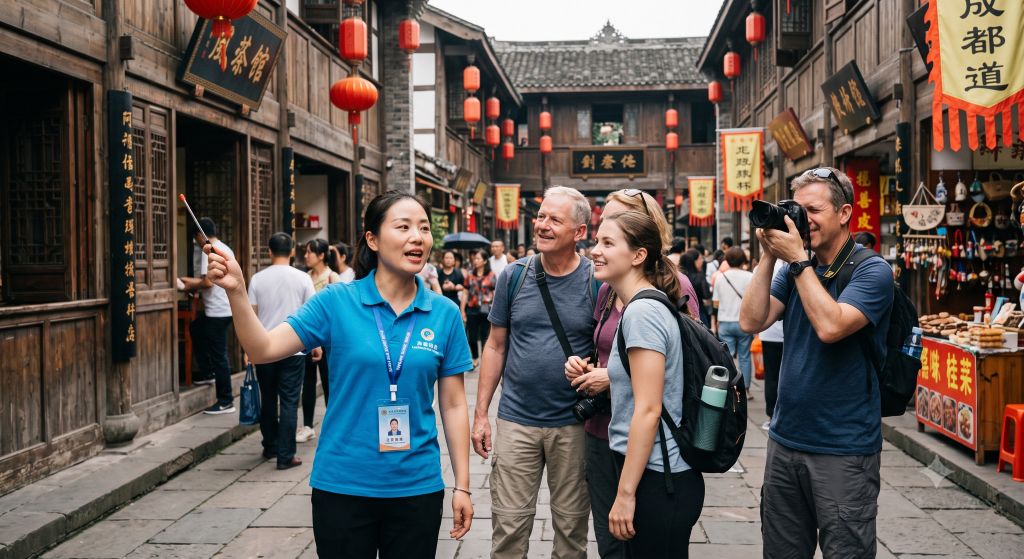
Chengdu is the gateway to Sichuan — the giant panda base, the Leshan Giant Buddha, the bronze masks of Sanxingdui, and the lakes of Jiuzhaigou, all within reach of one city. It is also a place where English signage thins out fast and the apps you rely on at home do not work. The smartest way to see it is with a licensed local guide you contact directly — no agency, no commission, no shopping-stop detours.
Chengdu is one of those cities where a guide changes the trip rather than decorating it. Sichuan holds five UNESCO World Heritage sites, a 2,300-year-old irrigation system that still waters the plain, a Bronze Age civilisation nobody had heard of until 1986, and the best food in China — and almost none of it is explained in English on site. A licensed English speaking guide handles the context, the tickets, the transport, and the language, and shapes the days around what you actually came for. Our platform connects you directly with certified, independent tour guides in Chengdu — you contact them, agree on the itinerary, and arrange everything yourself. No booking system, no commission, no agency.

Chengdu Research Base of Giant Panda Breeding
Licensed English Speaking Tour Guides in Chengdu 👇

Amy X.
Cadi
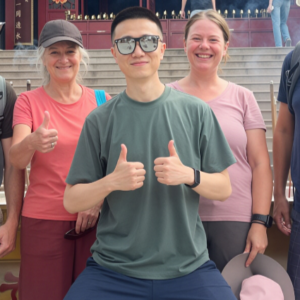
Check each profile for offered tours, languages, and specializations. You can send a message or voice note directly through the chat button on each profile.
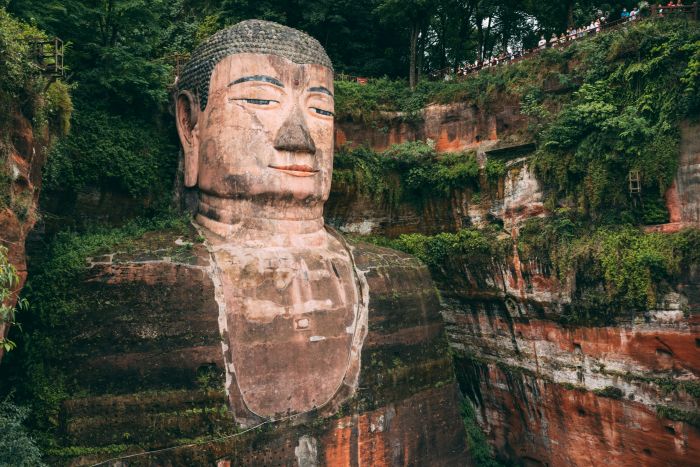
The Leshan Giant Buddha, 71 metres tall and 1,200 years old
Why Hire a Licensed Tour Guide in Chengdu?
In China, tour guiding is a licensed profession. The credential is the Tour Guide Certificate (导游证), issued by the Ministry of Culture and Tourism after candidates pass the National Tour Guide Qualification Examination — a written exam covering tourism law and policy, Chinese history, culture and geography, plus an oral examination in the language the guide intends to work in. Foreign-language guides sit an additional language test.
Here is the fact that matters most to you, and it is the opposite of the situation in most countries: English speaking guides in China are genuinely scarce. There are more than 800,000 licensed guides nationwide, but roughly 90% work in Mandarin, and only around 80,000 operate in inbound tourism at all. Guides who can work in English, French, German or Spanish are in structural short supply — which is why they book out early in Chengdu, and why “I’ll find someone when I arrive” is a worse plan here than almost anywhere else.
The shopping-stop problem. China’s Tourism Law prohibits operators from forcing tourists into commission-paying shops, but the practice has been persistent enough that the law had to name it. Cheap group tours have historically funded low headline prices through jade showrooms, tea “ceremonies” and silk factories that eat hours of your day. An independent licensed guide you hire and pay directly has no such incentive.
Ask to see the certificate before your tour begins. Every guide profile on this page also displays a licence number you can check against the card.
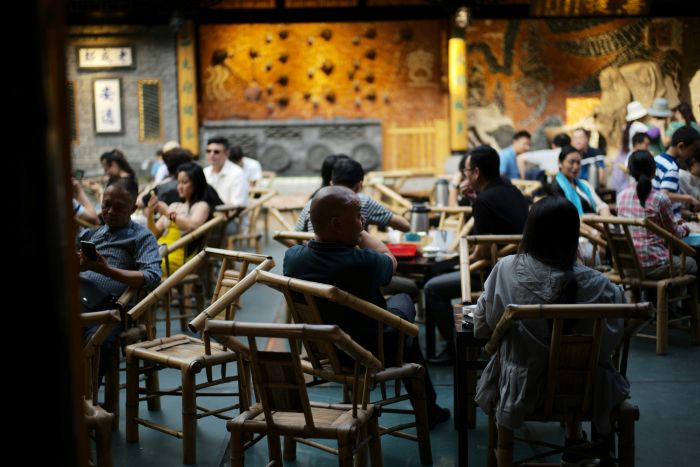
A Chengdu teahouse — the city’s real institution
What Types of Private Tours Can You Book from Chengdu?
Giant Panda Tours
The Chengdu Research Base of Giant Panda Breeding north of the city, or the quieter Dujiangyan base. Timing is everything here — the animals are active early and asleep by mid-morning. Your guide gets you there for opening, not for the coach-tour hour.
Leshan & Mount Emei
The Leshan Giant Buddha, 71 metres of Tang-dynasty stone carved into a cliff at a river confluence, and Mount Emei, one of China’s four sacred Buddhist mountains, rising to 3,099 m at the Golden Summit. A UNESCO pair, and the classic Sichuan two-day trip.
Sanxingdui & Ancient Shu
Bronze masks with protruding eyes, a 4-metre tree, and a civilisation nobody knew existed until farmers dug into it in 1986. Sanxingdui is an hour from Chengdu; the Jinsha Site Museum in the city holds the rest of the story. The single strangest thing in China, and badly under-visited.
Jiuzhaigou & Huanglong
Turquoise terraced lakes in a Tibetan valley, and the calcite pools of Huanglong at 3,500 m. Both are UNESCO sites, both are far, and both cap daily visitor numbers with passport-name ticketing booked in advance — which is exactly the kind of thing a guide should be handling.
Food & Hotpot Tours
Chengdu was named a UNESCO City of Gastronomy in 2010, the first in Asia. A food tour covers hotpot, mapo doufu, dan dan mian, fuqi feipian and the numbing bite of Sichuan pepper — plus a guide who can tell the kitchen how much heat you actually want.
Family & Custom Tours
Tours designed for families with children, seniors, or groups with specific interests. Chengdu is an unusually easy Chinese city for families — pandas, flat terrain, a mild climate — and a private guide adjusts the pace, the walking, and the spice level to your group.
Sample Private Tour Itineraries from Chengdu
Pandas at Opening, Then Old Chengdu
Leave your hotel before dawn to reach the Panda Base for opening. The first ninety minutes are the whole point: this is feeding time, the animals are awake and outside, and the crowds have not arrived. Move through the enclosures in reverse of the coach-tour route. Then return to the city for Wuhou Shrine and the Three Kingdoms, and finish with tea in People’s Park — bamboo chairs, a bottomless cup, and the ear-cleaners working the tables.
Dujiangyan, Mount Qingcheng & the Panda Base
Drive to the Dujiangyan Irrigation System, built in 256 BC without a dam, still watering the Chengdu plain 2,300 years later, and arguably the most quietly astonishing engineering site in the world. Continue to Mount Qingcheng, birthplace of religious Taoism, for a walk through the temple forest. Add the Dujiangyan Panda Base — smaller and calmer than the Chengdu one — on the way back. A UNESCO double, and far less crowded than Leshan.
Day Trip to the Leshan Giant Buddha
Take the high-speed train south, then continue by road to Leshan. The Buddha was begun in 713 and took ninety years to finish; the drainage channels cut into its hair and ears are the reason it is still standing. See it from the river by boat for the full scale, then climb the cliff stairs beside it. Add the Oriental Buddha Park or Wuyou Temple if you have the legs. Back in Chengdu by evening. If you can spare a second day, continue to Mount Emei rather than returning.
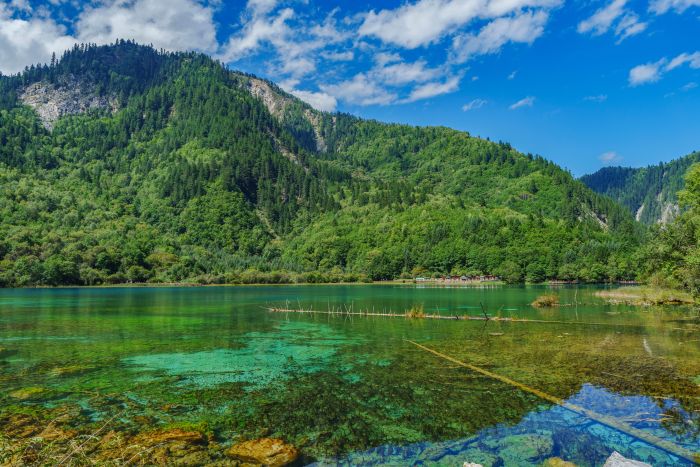
Jiuzhaigou, northern Sichuan
Beyond the City: The Sichuan Loop with One Licensed Guide
Nobody comes to Chengdu only for Chengdu. The province holds five UNESCO World Heritage sites, and a Chinese guide licence is national rather than city-bound — so one licensed guide can accompany you across the whole province, from the panda base to Jiuzhaigou, rather than handing you to a new stranger at every stop. Over a week of long drives, altitude and timed-entry tickets, that continuity does more work than people expect.
Dujiangyan & Mount Qingcheng (60 km, 1 hour): A joint UNESCO site and the easiest serious day trip from the city. Li Bing’s irrigation works are still in operation after 2,300 years — this is not a ruin, it is infrastructure.
Sanxingdui (40 km, 1 hour): The bronze masks of a Shu civilisation that left no written record and appears in no Chinese history. The new museum hall opened in 2023 and the site is still being excavated. Pair it with the Jinsha Site Museum inside Chengdu, which holds the later chapter of the same story.
Leshan (130 km, 1.5 hours by high-speed rail plus road): The largest stone Buddha in the world, carved into the cliff where three rivers meet, specifically to calm the water. It worked, arguably — the rubble from the carving filled the currents.
Mount Emei (160 km, 2 hours): One of the four sacred Buddhist mountains of China, topped by the Golden Summit at 3,099 m. Monasteries, a cable car, cloud seas, and monkeys with a documented lack of respect for handbags. Usually done as an overnight with Leshan.
Jiuzhaigou & Huanglong (430 km, 8–9 hours by road, or a short flight to Jiuzhai Huanglong airport): The lakes everyone has seen a photograph of, in a Tibetan valley in the far north of the province. Both parks cap daily visitor numbers and require advance, passport-name booking; Huanglong sits above 3,500 m and altitude is a real consideration. Not a day trip under any circumstances — plan three days minimum, and let your guide handle the ticket window.
Mount Siguniang (230 km, 4 hours): Alpine valleys and a 6,250 m peak on the edge of the Tibetan plateau, and the most accessible high-mountain scenery from Chengdu. Access rules in western Sichuan’s Tibetan prefectures do change from time to time — ask your guide to confirm the current position before you commit to a route.
Suggested pacing. Three days covers Chengdu, the pandas, and Leshan comfortably. Five to seven days opens the province: Chengdu and pandas (1–2 days) → Dujiangyan and Qingcheng (1 day) → Leshan and Emei (2 days, overnight) → Sanxingdui (half day) — or swap the last two for Jiuzhaigou if the lakes are why you came. Ask your guide to build around your flights rather than a fixed template.
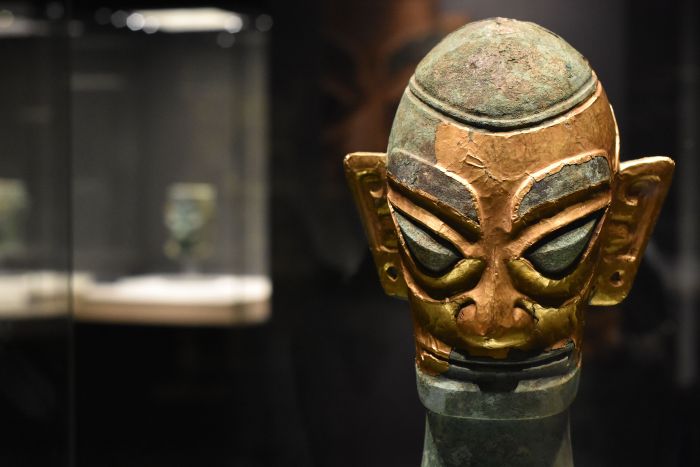
Sanxingdui — a civilisation with no written record
More Private Tours from Chengdu
Beyond the main loop, Chengdu is a good base for several shorter trips with a private guide and vehicle:
Chongqing (300 km, 1.5 hours by high-speed rail): A different world — a vertical megacity of 30 million, hotpot even fiercer than Chengdu’s, and the Dazu Rock Carvings, another UNESCO site, nearby.
Langzhong Ancient City (220 km, 3 hours): One of the four best-preserved ancient towns in China, and one almost no foreign visitor reaches. Ming and Qing courtyards, and vinegar you will be encouraged to drink.
Bifengxia (140 km, 2 hours): A gorge and panda base near Ya’an, quieter than Chengdu’s and set in genuine forest.
Xiling Snow Mountain (95 km, 1.5 hours): Skiing in winter, hiking in summer, and the mountain Du Fu wrote about from his cottage in Chengdu.
Huanglongxi & Anren (40–60 km, under an hour): Two very different old towns — one touristic and photogenic, one built around the Jianchuan Museum Cluster, a private museum complex on 20th-century Chinese history that is unlike anything else in the country.
Seeing the Pandas Properly: What Nobody Tells You
Most visitors come to Chengdu for the pandas, and a large share of them get it wrong in the same way, so this is worth spelling out.
Pandas sleep. They are awake and eating in the early morning and asleep for most of the rest of the day. Arrive at 10:00 and you will see distant grey lumps in trees. Arrive for opening and you will see them eating a metre away from you. The difference is not marginal — it is the difference between the trip you imagined and a photograph of a sleeping rock.
The coach tours arrive mid-morning. This is the single strongest argument for a private guide in Chengdu: not expertise, timing. A guide with a car gets you through the gate at opening; a group tour physically cannot.
There is more than one base. The Chengdu Research Base is closest and busiest. Dujiangyan is smaller, calmer, and combines with the irrigation system. Bifengxia near Ya’an is the quietest and set in real forest. Ask your guide which fits your day rather than defaulting to the famous one.
Holding a panda is not a thing. Photo-holding programmes have been suspended for years, and anyone offering one should be treated with suspicion. Volunteer and keeper programmes at some bases involve preparing food and cleaning enclosures — genuine, well worth doing, and not the same as a cuddle.
Season matters. Cubs are typically born in the late summer months, so the nursery is at its best from roughly September onwards. Pandas are also more active in cool weather; a grey January morning is better viewing than a hot July one.
Before You Fly: Visa, Payments and Apps in China
Three things catch people out in China, and all three are fixable in an evening before you leave.
The visa position depends entirely on your passport, and it has changed enormously. China’s unilateral 30-day visa-free programme now covers roughly 77 countries, including most of Europe, Japan, South Korea, Australia, New Zealand, the Gulf states and Türkiye — with the UK and Canada added in February 2026. If you are on that list, you need nothing but a passport, an onward ticket and the Digital Arrival Card. Ignore everything written about transit visas; it does not apply to you.
If you hold a US passport, it does. The United States is not on the 30-day visa-free list, but Americans are covered by the separate 240-hour (10-day) visa-free transit programme, which includes 55 nationalities and — importantly for this page — names Chengdu as a designated entry port. The conditions are specific: you must hold a confirmed onward ticket to a third country (a return to your origin does not qualify), you must enter and exit through designated ports, and the 240-hour clock starts at 00:00 on the day after you arrive. Within it you can travel across the permitted provinces. For anything longer or simpler, Americans need a standard L visa. Immigration rules move quickly here — verify with China’s National Immigration Administration before you book.
Your bank card is not the problem it used to be — but cash is. China runs on Alipay and WeChat Pay, and both now accept foreign Visa and Mastercard. Install and link a card before you fly, because setup on airport wifi with a Chinese verification SMS you cannot receive is a miserable way to start a holiday. Cash still works legally but many small vendors genuinely will not have change.
Your apps will not work. Google Maps is unusable for navigation in China; Amap (高德) or Baidu Maps are what everyone actually uses, and Amap has an English mode. Google, WhatsApp and Instagram are inaccessible without a VPN, which must be installed before arrival — you cannot download one once you are there.
Tickets are tied to your passport. Major sites, museums and high-speed rail use real-name ticketing: your passport number is the ticket. Jiuzhaigou and Huanglong go further with daily visitor caps and advance booking that sells out in season. This is the least glamorous and most valuable thing a local guide does for you.
How Much Does a Private Guide in Chengdu Cost?
Private guide fees in Chengdu are charged per group, not per person. This makes a private guide good value for couples, families, or small groups. Here is a general price range:
| Tour Duration | Typical Cost (per group) |
| Hourly rate | €20 – €30 |
| Half-day (4 hours) | €70 – €110 |
| Full-day (8 hours) | €110 – €180 |
Note that the hourly rate is not simply multiplied out. Most guides apply a reduced day rate for longer engagements. Multi-day trips to Emei or Jiuzhaigou are quoted as a package, and the guide’s own accommodation and meals on the road are normally added — ask for this to be itemised.
These rates cover the guide’s professional service only. Site entry — the panda base, Leshan, Emei, Jiuzhaigou — is paid by the visitor, and the two national parks in the north are expensive by Chinese standards once the shuttle bus is included. The cost of a private vehicle and driver is quoted separately for anything outside the city, though for Leshan and Chongqing the high-speed rail is often faster and cheaper than driving. Ask your guide for a complete breakdown before confirming.
What Is Included When You Hire a Private Guide?
Pre-tour communication. Your guide discusses your interests, physical condition, altitude tolerance and priorities before the tour day. This matters in Sichuan: Emei’s Golden Summit is above 3,000 m and Huanglong above 3,500 m, and the difference between those and Chengdu’s flat 500 m is not academic.
Ticket and booking assistance. Passport-name booking, daily caps, sold-out windows, and Chinese-only reservation platforms. This is unglamorous and it is the single most useful thing a local guide does for a foreign visitor here.
No shopping stops. No jade showroom, no tea ceremony sales pitch, no silk factory. You hired a guide, not a route through a retail funnel.
Full flexibility. Want another hour with the pandas? Want to skip Jinli’s souvenir lane and sit in a real teahouse instead? Want to eat somewhere with no English menu? A private tour adapts on the spot.
Insider recommendations. Your guide knows which hotpot place locals queue for, which teahouse has not been renovated for tourists, and which Sanxingdui hall to see first before the tour groups reach it.
No commission, no middleman. You communicate and pay the guide directly. OfficialGuides is a marketplace that connects travelers with licensed guides — it is not a travel agency and does not sell or promote tours.
Private Guide or Group Tour — Which Is Better?
Both have their place, but in Chengdu the argument is unusually one-sided, and it is not about money.
A group panda tour costs €30–€60 per person and arrives at the base mid-morning, because that is when a coach can plausibly collect twelve hotels. By then the pandas are asleep. You will have paid less and seen less, and no amount of guiding expertise fixes it. A half-day private guide at €90, split across a family of four, is €22 each — and gets you through the gate at opening.
Add the shopping-stop history of cheap group tours in China, and the sums get worse rather than better.
For solo travellers on the long runs to Jiuzhaigou, where vehicle cost dominates, a group tour may still make sense. For everything within a day of Chengdu, a private English speaking guide is the obvious choice.
If you are also planning to visit other cities, our platform features licensed guides in Istanbul, Barcelona and private tours in Rome as well.
Explore the Culture and Gastronomy of Chengdu
Chengdu was designated a UNESCO City of Gastronomy in 2010, the first city in Asia to receive it, and the claim holds up. Sichuan cooking is not simply hot — the defining sensation is málà, the numbing tingle of Sichuan pepper against chilli heat, and it is a texture as much as a flavour. A private food tour covers hotpot, mapo doufu, dan dan mian, fuqi feipian, and the street snacks of the old lanes — with a guide who can tell the kitchen exactly how much heat you want, which is not a request the menu offers.
The city’s other institution is the teahouse. Bamboo chairs, a lidded cup refilled indefinitely, mahjong, and the ear-cleaners with their tuning forks — People’s Park on a weekday afternoon is the most Chengdu thing in Chengdu, and it costs about the price of a coffee. Add Sichuan opera and its bianlian face-changing, a technique still guarded as a state secret, and you have an evening that has nothing to do with pandas.
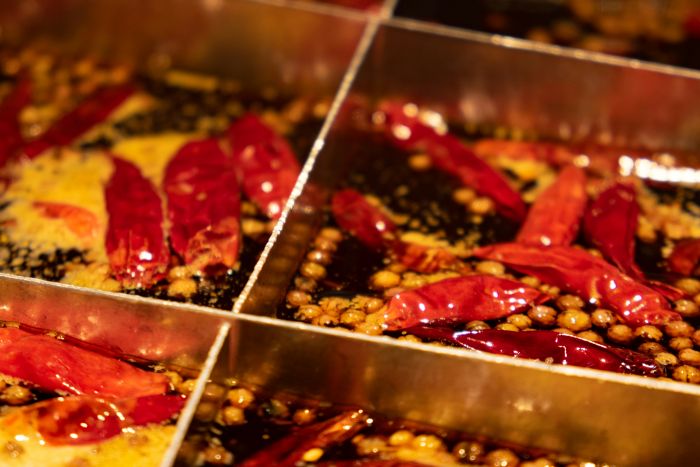
Chengdu hotpot — the city’s other reason to visit
Frequently Asked Questions
How does OfficialGuides work? Is it a travel agency?
No. OfficialGuides is a marketplace that connects travelers with independent, licensed tour guides. You browse guide profiles, send a message or voice note through the chat button, and arrange everything — including itinerary, schedule, and payment — directly with the guide. There is no booking system, no commission, and no agency involved.
How much does a private tour guide in Chengdu cost?
Licensed private guides in Chengdu typically charge between €20 and €30 per hour per group. A half-day tour (4 hours) usually costs €70–€110, and a full-day tour (8 hours) ranges from €110–€180 — longer engagements generally carry a reduced day rate. These are group rates: the fee stays the same whether you are 1 person or 6. Site entry and vehicle costs are additional, and multi-day trips to Emei or Jiuzhaigou are quoted as a package.
Do I need a visa to visit China?
It depends on your passport, and the rules changed substantially recently. China’s unilateral 30-day visa-free programme now covers around 77 countries, including most of Europe, Japan, South Korea, Australia, New Zealand, the Gulf states and Türkiye, with the UK and Canada added in February 2026 — those travellers need only a passport, an onward ticket and the Digital Arrival Card. The United States is not on that list; US citizens either obtain an L visa or use the separate 240-hour visa-free transit programme. Verify with China’s National Immigration Administration before booking, as the list is revised periodically.
Can I use the 240-hour visa-free transit to visit Chengdu?
Yes — Chengdu is one of the designated entry ports for the 240-hour (10-day) visa-free transit programme, which covers 55 nationalities including the United States and the United Kingdom. The conditions are strict: you need a confirmed onward ticket to a third country (returning to your country of origin does not qualify), you must enter and exit through designated ports, and the 240-hour clock starts at 00:00 on the day after you arrive. Within the period you can travel across the permitted provinces. If you already qualify for 30-day visa-free entry, you do not need this programme at all.
What is the best time to see the pandas?
Opening time — this matters more than the season. Pandas eat in the early morning and sleep through the middle of the day, so arriving at 10:00 means watching distant grey lumps in trees. A private guide with a car gets you through the gate at opening; a coach tour structurally cannot. By season, cubs are usually born in late summer so the nursery is best from around September, and pandas are more active in cool weather than in the summer heat.
Can I hold or cuddle a panda in Chengdu?
No. Photo-holding programmes have been suspended for years, and anyone offering one should be treated with suspicion. Some bases run volunteer or keeper programmes that involve preparing food and cleaning enclosures — these are genuine, worthwhile, and can be arranged in advance, but they are not a cuddle. Ask your guide what is actually available at each base rather than trusting a listing you found online.
Is Jiuzhaigou a day trip from Chengdu?
No. Jiuzhaigou is roughly 430 km from Chengdu — 8 to 9 hours by road, or a flight to Jiuzhai Huanglong airport. Both Jiuzhaigou and nearby Huanglong cap daily visitor numbers and require advance booking tied to your passport, and Huanglong sits above 3,500 m where altitude is a real factor. Plan a minimum of three days, and let your guide handle the booking window — it sells out in season.
Do I need cash in China, or will my card work?
China runs on Alipay and WeChat Pay, and both now accept foreign Visa and Mastercard. Install the app and link your card before you fly — setup on arrival, on airport wifi, with a verification SMS you may not receive, is a bad start. Cash remains legal tender but many small vendors will not have change. Also install Amap or Baidu Maps for navigation, since Google Maps is unusable in China, and set up a VPN before departure if you need Google, WhatsApp or Instagram.
Can one guide take me around the whole province?
Yes. Chinese tour guide certificates are national rather than city-bound, so one licensed guide can accompany you from the Chengdu panda base through Leshan, Emei, Sanxingdui and on to Jiuzhaigou. Over a week of long drives, altitude and timed-entry tickets, that continuity is one of the strongest arguments for a private guide here. Ask for the guiding fee, transport, and the guide’s own accommodation on the road to be quoted separately.
How do I verify that a guide is officially licensed?
Licensed guides in China hold a Tour Guide Certificate (导游证) issued by the Ministry of Culture and Tourism after passing the National Tour Guide Qualification Examination, including an oral examination in the language they work in. Ask to see the card before your tour begins. Each guide profile on this page also displays a licence number you can check against it. Note that English speaking guides are in structural short supply in China — around 90% of the country’s licensed guides work in Mandarin — so book earlier than you would elsewhere.
Ready to Explore Sichuan?
Browse the guide profiles above, check availability, and start a direct conversation — no agency fees, no middleman.
Request a Free Quote
Share your tour details using the form below and receive a personalized quote from our Chengdu guides.
Note: OfficialGuides is a marketplace that connects travelers with licensed tour guides; it is not a travel agency and does not sell or promote tours. Read the disclaimer and privacy policy
This page is also available in: 简体中文