Last Updated on 17/07/2026
Hire a Licensed Guide in Amman — and See Jordan Properly
How to explore Jordan with a certified local guide — from the Citadel to Petra, at your own pace, with someone who knows the country.
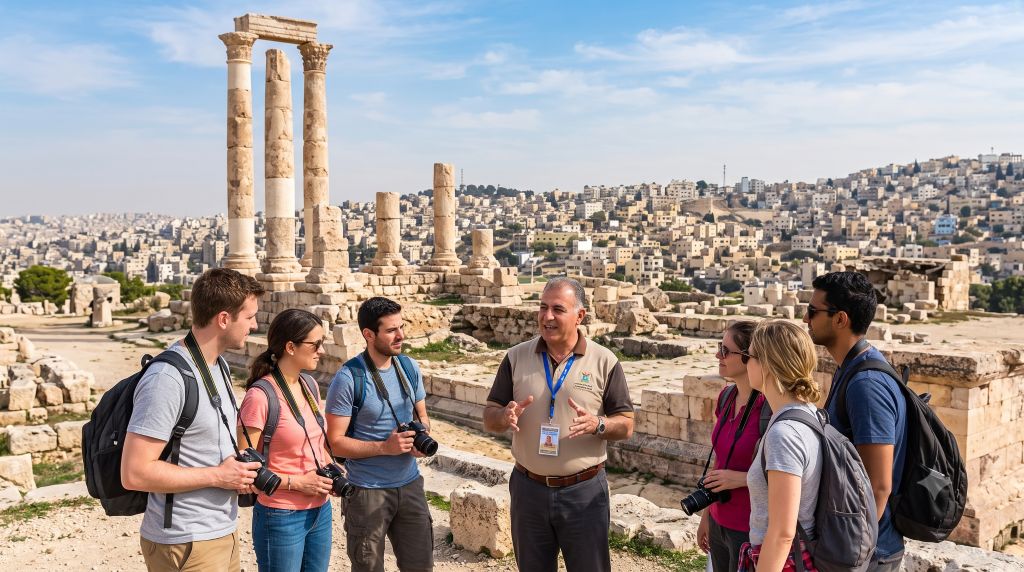
Amman is the base camp for one of the most concentrated countries on earth — the Citadel and the Roman Theatre in the city itself, and within a few hours Jerash, Mount Nebo, Petra, Wadi Rum and the Red Sea. The most practic way to see it is with a licensed local guide you contact directly — no agency, no commission. If you ara just 1 person would rather book a ready-made tour package, you can also book a full-day Petra and Little Petra trip from Amman here.
Jordan is one of those countries where a knowledgeable guide changes the entire trip. The Amman Citadel, the Roman Theatre and the Jordan Museum stack Ammonite, Roman, Byzantine, Umayyad and modern layers on top of each other — and beyond the city, Petra and Jerash are simply too large and too unlabelled to read on your own. A licensed English speaking guide explains the context, handles the logistics across long desert drives, and shapes the days around your interests. Our platform connects you directly with certified, independent tour guides in Amman — you contact them, agree on the itinerary, and arrange everything yourself. No booking system, no commission, no agency.
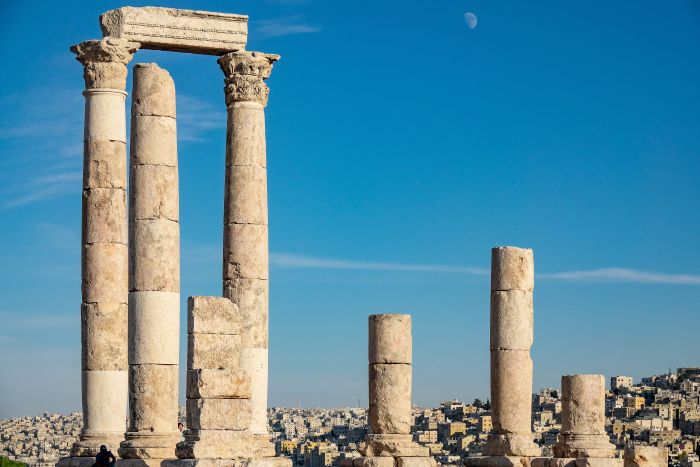
The Temple of Hercules, Amman Citadel
Licensed English Speaking Tour Guides in Amman 👇
Yousef M. K.
Check each profile for offered tours, languages, and specializations. You can send a message or voice note directly through the chat button on each profile.
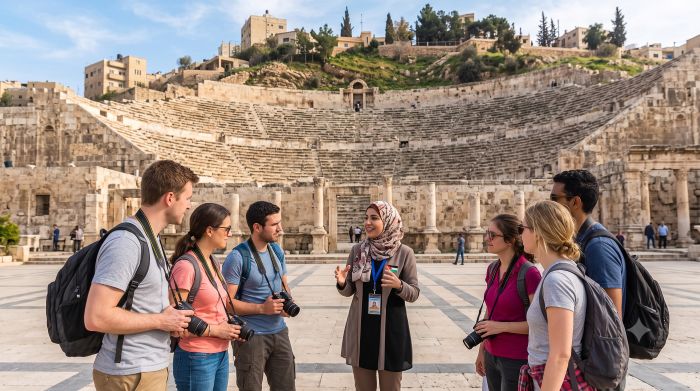
The 2nd-century Roman Theatre in downtown Amman (AI illustration)
Why Hire a Licensed Tour Guide in Amman?
In Jordan, tour guiding is a licensed profession. Permits are issued by the Ministry of Tourism and Antiquities (MOTA) through its Tourism Professions Directorate, and the requirements are strict enough to filter out anyone treating guiding as a side job.
To be licensed, an applicant must hold Jordanian nationality and a national number, be at least 20 years old, be in good health as certified by an accredited medical centre, and have a clean criminal record. The educational floor is a first university degree or its equivalent, or at minimum a tour guide services diploma from a recognised college. MOTA can grant narrow exceptions for speakers of foreign languages the market needs, but only down to a completed Tawjihi (high school) certificate.
The examinations are where most candidates fall away. Applicants must pass a written and oral language test with a minimum score of 80% in the language they intend to guide in, then a personal interview requiring at least 70%, and finally the ministry-organised guiding course and its examination, held at Ammon Applied University College in Amman. In 2025 the Jordanian Cabinet approved a new Tour Guide Services Regulation that further formalises classification levels, the obligations of licensed guides, and the narrow circumstances in which temporary permits may be issued.
The practical consequence for you is simple: when a guide in Jordan tells you they are licensed in English, that is not a self-assessment. It is an 80% pass mark on a state examination.
Ask to see the licence before your tour begins. Every guide profile on this page also displays a licence number you can check against the card.
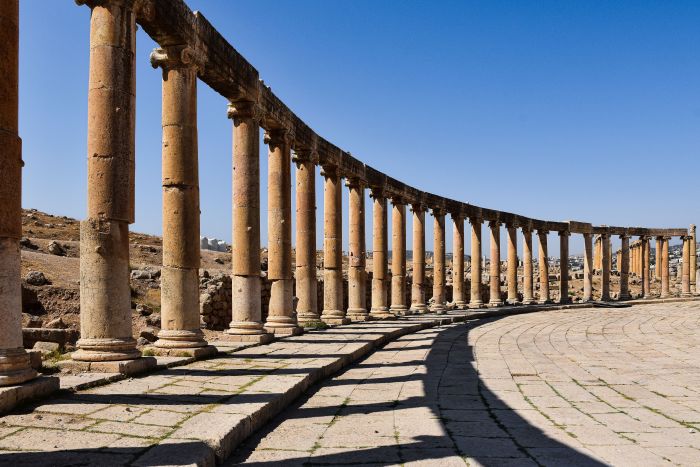
The Oval Plaza at Jerash, one hour north of Amman
What Types of Private Tours Can You Book from Amman?
Amman City & Citadel Tours
The Citadel with its Temple of Hercules and Umayyad Palace, the Roman Theatre, the Jordan Museum (home to the Dead Sea Scrolls and the 9,000-year-old ‘Ain Ghazal statues), and the souks of downtown Al-Balad. A half-day that makes sense of a city most visitors treat as an airport.
Petra Tours
The Nabataean capital carved into rose-red sandstone — the Siq, the Treasury, the Royal Tombs, the Theatre, and the 800-step climb to the Monastery. Doable as a long day trip from Amman, but far better with an overnight in Wadi Musa.
Wadi Rum Desert & Bedouin Camps
The valley of the moon — sandstone monoliths, Nabataean inscriptions, Lawrence of Arabia’s campaign ground, and the location for The Martian and Dune. Jeep safaris, camel treks, and overnight camps under some of the clearest skies anywhere.
Jerash & the Roman Decapolis
One of the best-preserved Roman provincial cities anywhere: Hadrian’s Arch, the colonnaded Oval Plaza, the cardo with its original chariot ruts, the South Theatre, and the Temple of Artemis. An hour from Amman, and often combined with Ajloun Castle.
Biblical Jordan: Mount Nebo & Madaba
Mount Nebo, where Moses is said to have looked out over the Promised Land, with the Memorial Church and its Byzantine mosaics. Nearby Madaba holds the 6th-century mosaic map of the Holy Land, and the Jordan Valley holds the Baptism Site at Bethany Beyond the Jordan.
Aqaba & Red Sea Diving
Jordan’s only coastline, and a genuinely world-class one: the Cedar Pride wreck, the Japanese Garden reef, and the underwater military museum. Warm, calm, and divable year-round. Your guide handles the trip and the sites on land; the diving itself is run by licensed dive centres.
Sample Private Tour Itineraries from Amman
Amman: Citadel, Roman Theatre & Downtown
Start on Jabal al-Qal’a at the Citadel, where the Temple of Hercules, a Byzantine church and the Umayyad Palace sit within a few hundred metres of each other, with the whole city spread out below. Descend to the 2nd-century Roman Theatre and the Odeon. Walk through Al-Balad, the downtown souks and the spice merchants, and finish on Rainbow Street in Jabal Amman. Optional add-on: the Jordan Museum for the Dead Sea Scrolls.
Jerash, Mount Nebo & Madaba
Drive north to Jerash for the Roman city: Hadrian’s Arch, the Oval Plaza, the cardo, the South Theatre and the Temple of Artemis. After lunch, head south to Mount Nebo for the view Moses is said to have been given over the Jordan Valley and, on clear days, as far as Jericho and the hills of Jerusalem. Finish in Madaba at the Church of St George to see the 6th-century mosaic map — the oldest surviving cartographic depiction of the Holy Land. A long day, but the three sites sit naturally on one loop.
Day Trip to Petra
Depart Amman early on the Desert Highway (roughly 3 hours each way) to reach Petra with a full day on site. Walk the 1.2 km Siq to the Treasury, continue along the Street of Facades to the Theatre, the Royal Tombs and the Colonnaded Street. With energy left, take on the Monastery — around 800 rock-cut steps, and worth every one. Return to Amman in the evening. Ask your guide honestly whether an overnight in Wadi Musa suits you better; most will tell you it does.
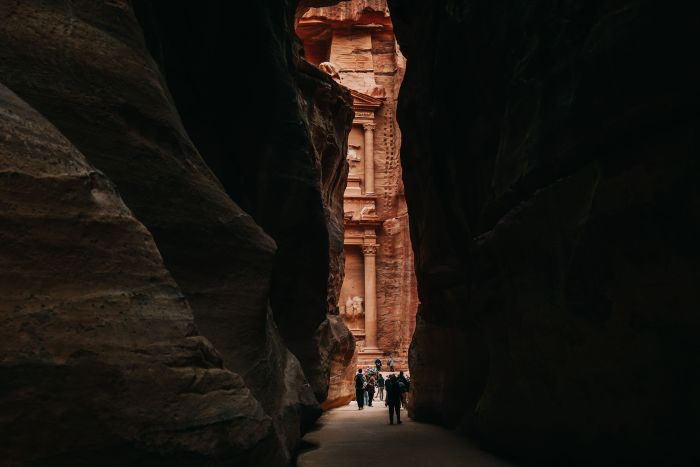
The Treasury, first glimpsed at the end of the Siq
The Classic Jordan Loop: Petra, Wadi Rum & Aqaba from Amman
Most visitors who land in Amman are really planning a line down the country and back. Because a Jordanian guide licence is national rather than city-based, one licensed guide can accompany you for the entire route — Amman, Jerash, Mount Nebo, Petra, Wadi Rum and Aqaba — rather than handing you to a new stranger at each stop. Over four or five days of long drives and big sites, that continuity is worth more than most people realise.
Jerash (48 km, 1 hour): The easiest win in Jordan. A Roman provincial city preserved well enough that you walk on the original paving, chariot ruts included. Half a day, easily combined with Ajloun Castle, a 12th-century Ayyubid fortress built to watch the Crusaders.
Mount Nebo & Madaba (50 km, 45 minutes): The memorial to Moses on the ridge above the Jordan Valley, and the Byzantine mosaic map at Madaba. Both sit on the northern end of the King’s Highway, the old scenic route south — worth taking at least once instead of the Desert Highway, even though it adds hours.
Petra (240 km, 3 hours by the Desert Highway): The reason most people come. A day trip works; an overnight in Wadi Musa works far better, because it lets you enter at opening time before the crowds and the heat, and lets you see Petra by Night, when the Siq and Treasury are lit by candles. Note that Petra by Night runs only on certain evenings, is ticketed separately, and is not covered by the Jordan Pass — you also need a valid daytime ticket to attend.
Wadi Rum (320 km, 4 hours): A protected desert of sandstone and granite monoliths where the Nabataeans left inscriptions and Lawrence ran his campaign. Standard practice is a jeep safari of 2–4 hours plus an overnight in a Bedouin camp. Important: your Jordan Pass covers the protected area entry, but the jeep tour and the camp are separate costs. Wadi Rum sits naturally between Petra and Aqaba, so almost nobody visits it on its own.
Aqaba (330 km, 4 hours — or a 45-minute flight): Jordan’s Red Sea port and its dive capital. The Cedar Pride, a freighter deliberately sunk in 1985, sits in accessible depths; the Japanese Garden is a soft coral reef reachable from shore; and the underwater military museum has tanks, an anti-aircraft gun and a helicopter placed on the seabed. Water temperatures stay comfortable all year.
A word of honesty about Aqaba diving. It is not a day trip from Amman — four hours each way leaves you no water time, and flying makes it a very expensive single dive. Treat Aqaba as the end of a loop with a night or two, or the start of one. And be clear about roles: a licensed tour guide is not a diving instructor. Your guide handles the route, the land sites and the logistics, and can point you to reputable dive centres; the dives themselves are run by their own certified staff. Anyone in Jordan who offers to both guide you and take you underwater is selling you something they are not licensed to sell.
Suggested pacing. Three days is the compressed version and is mostly car. Five days is the comfortable version: Amman and Jerash (1 day) → Mount Nebo, Madaba and the King’s Highway (1 day) → Petra (1–2 days, overnight) → Wadi Rum (1 day, overnight in camp) → Aqaba, then fly back to Amman. Ask your guide to build the route around your flight times rather than a fixed template.
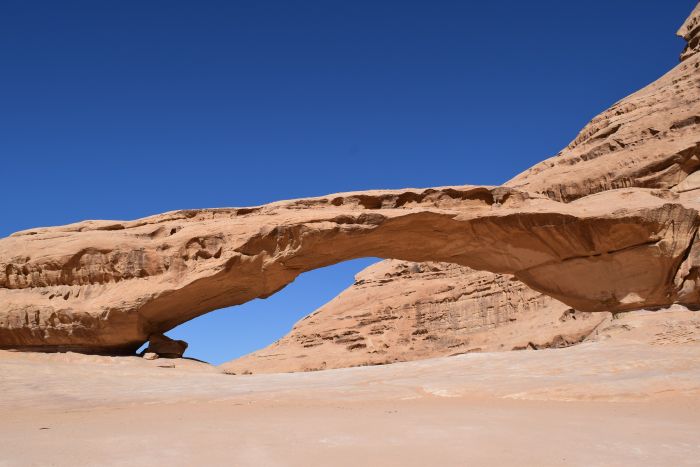
Wadi Rum, the valley of the moon
More Private Tours from Amman
Beyond the classic loop, Amman is an excellent base for several shorter excursions with a private guide and vehicle:
The Dead Sea (55 km, 1 hour): The lowest point on the surface of the earth, at roughly 430 metres below sea level. A half-day float, usually combined with a resort day pass.
Bethany Beyond the Jordan (50 km, 1 hour): The Baptism Site on the east bank of the Jordan, recognised by UNESCO. Access is controlled and visits are escorted, so a guide who knows the schedule matters here.
The Desert Castles (1–4 hours east): Qasr Amra with its startling Umayyad frescoes, Qasr Kharana, and Qasr Azraq, where Lawrence wintered in 1917. A very different Jordan — empty, early Islamic, and almost unvisited.
Umm Qais (110 km, 1.5 hours): Roman Gadara, built in black basalt, looking out over the Sea of Galilee and the Golan. One of the best views in the country.
Karak Castle (140 km, 2 hours): A vast Crusader fortress on the King’s Highway, and a natural stop on the drive south to Petra rather than a trip in its own right.
The Jordan Pass and Petra Tickets: What You Need to Know Before You Fly
This is the single most consequential thing to get right about a trip to Jordan, and it has to be done before you arrive.
The Jordan Pass is an official Ministry of Tourism product that bundles entry to more than 40 sites — including Petra, Jerash, Wadi Rum and the Amman Citadel — with a waiver of the 40 JOD visa-on-arrival fee. There are three tiers, and the only difference between them is how many days you get at Petra:
Jordan Wanderer — 70 JOD (one day at Petra)
Jordan Explorer — 75 JOD (two days at Petra)
Jordan Expert — 80 JOD (three days at Petra)
The arithmetic is not subtle. A one-day Petra ticket alone costs 50 JOD, and the visa on arrival costs 40 JOD. That is 90 JOD before you have entered a single other site. The Wanderer pass is 70 JOD and includes both, plus Jerash, plus Wadi Rum, plus everything else. For almost every visitor, the pass pays for itself at the airport.
Two conditions matter. The pass must be purchased online before you arrive — buying it after landing means you have already paid the visa fee and it is not refunded. And the visa waiver requires a minimum consecutive-night stay; this requirement has changed over time, so check the current rule on the official site before you buy. The pass is tied to your passport and cannot be shared.
Petra ticket prices without the pass are worth understanding on their own, because of one rule that catches people out:
50 JOD — one day, for visitors staying at least one night in Jordan
55 JOD — two consecutive days
60 JOD — three consecutive days
90 JOD — one day, for visitors not staying overnight in Jordan
Free — children under 12
That 90 JOD line is the day-tripper rate, and it is deliberate. If you are crossing from Israel or arriving on a cruise call and returning the same day, Petra costs you almost double. Multi-day tickets must be used on consecutive days — you cannot take a rest day in between.
What the pass does not cover: Petra by Night, jeep tours and overnight camps in Wadi Rum, and the exit fee at land borders. Ask your guide to walk you through which tier fits your itinerary before you buy — it takes five minutes and routinely saves people a hundred euros.
Long Layover at Queen Alia? Private Transit Tours from AMM
Queen Alia International Airport is Royal Jordanian’s hub, and a large number of travellers pass through it with time to fill between connections. A private guided transit tour is the most reliable way to use that window, because the constraint is not the sightseeing — it is immigration, the 35 km drive into the city, and getting back with margin.
A licensed guide meets you in arrivals, works backwards from your check-in deadline, and builds the route to fit. A realistic 6-hour layover covers the Citadel, the Roman Theatre and downtown Amman with a meal. With 10 hours or more, Jerash becomes possible, or the Dead Sea. Petra is not realistic on a layover — three hours each way plus a meaningful visit needs a minimum of ten hours on the ground, and that is before the traffic.
For groups, guides can arrange a private vehicle with driver matched to your party: a sedan for couples, a minivan for families, a minibus or coach for larger parties. One person coordinates the whole thing.
One critical point: to leave the airport you must clear immigration. Most nationalities can obtain a visa on arrival at Queen Alia, but eligibility varies and a Jordan Pass will not waive the fee unless you meet the minimum-stay requirement — which a layover does not. Confirm your visa position before booking anything, and tell your guide your airline, arrival time and departure time when you message them.
How Much Does a Private Guide in Amman Cost?
Private guide fees in Jordan are charged per group, not per person. This makes a private guide excellent value for couples, families, or small groups. Here is a general price range:
| Tour Duration | Typical Cost (per group) |
| Hourly rate | €20 – €30 |
| Half-day (4 hours) | €70 – €110 |
| Full-day (8 hours) | €120 – €190 |
Note that the hourly rate is not simply multiplied out. Most guides apply a reduced day rate for longer engagements, so a full day works out cheaper per hour than two short blocks. Multi-day trips to Petra and Wadi Rum are quoted as a package, and the guide’s own accommodation and meals on the road are normally added to it — ask for this to be itemised.
These rates cover the guide’s professional service only. Site entry — Petra, Jerash, Wadi Rum, the Citadel — is paid by the visitor, and in almost every case the Jordan Pass is the cheaper route. The cost of a private vehicle, driver, fuel and tolls is quoted separately for any trip outside Amman, and the distances in Jordan make this a real line item rather than an afterthought. Ask your guide for a complete breakdown before confirming.
What Is Included When You Hire a Private Guide?
Pre-tour communication. Your guide discusses your interests, physical condition, heat tolerance and priorities before the tour day. This matters more in Jordan than most places: Petra is 4–8 km of walking on uneven rock, and the Monastery climb is not for everyone. The itinerary is built around you, not a fixed script.
Jordan Pass advice. A good guide will tell you which tier to buy, and when, before you book them. It costs them nothing and saves you real money.
Full flexibility. Want another hour in the Siq? Want to skip Karak and reach Petra before the light goes? Want to sit in the shade for twenty minutes in July? A private tour adapts on the spot.
Insider recommendations. Your guide knows which mansaf is worth the detour, which viewpoint over the Treasury is reachable without a scramble, and which Bedouin camps are actually run by Bedouin.
No commission, no middleman. You communicate and pay the guide directly. OfficialGuides is a marketplace that connects travelers with licensed guides — it is not a travel agency and does not sell or promote tours.
Private Guide or Group Tour — Which Is Better?
Both options have their place, and in Jordan the deciding factor is usually time rather than money.
A group day trip from Amman to Petra typically costs €60–€90 per person, and the schedule is fixed: you leave when the bus leaves, you get the hours on site the operator allocates, and you return when the slowest person returns. A full-day private guide at €150 plus a vehicle, split across a group of four, lands in comparable territory — with a route built around you and no waiting.
For solo travellers, a group tour is often more economical, particularly for the long Petra and Wadi Rum runs where the vehicle cost dominates. But for couples, families, or anyone who wants to be at the Treasury at 6:30 am rather than 10:00 am with everyone else, a private English speaking guide in Amman is the obvious choice.
If you are also planning to visit other cities, our platform features licensed guides in Istanbul and Barcelona as well.
Explore the Culture and Gastronomy of Amman
Amman is not only a staging post. A private food tour takes you through the downtown souks, the falafel counters that have been running since the 1950s, the knafeh shops where the queue tells you everything, and the spice merchants of Al-Balad. Mansaf — lamb cooked in fermented dried yoghurt and served over rice — is the national dish and a genuine cultural event rather than a menu item; eating it properly, with the right hand, standing, is worth having someone explain first.
Jordan is also one of the most layered small countries anywhere. In a single day you can stand in a Roman theatre, an Umayyad palace, a Byzantine church and a Crusader castle — and a guide who can connect Ammonite to Nabataean to Roman to Umayyad turns a series of ruins into one continuous argument.
For families, a private guide adjusts the pace, the walking distances and the storytelling — and in Jordan that also means managing heat, water and shade, which between May and September is not a detail.
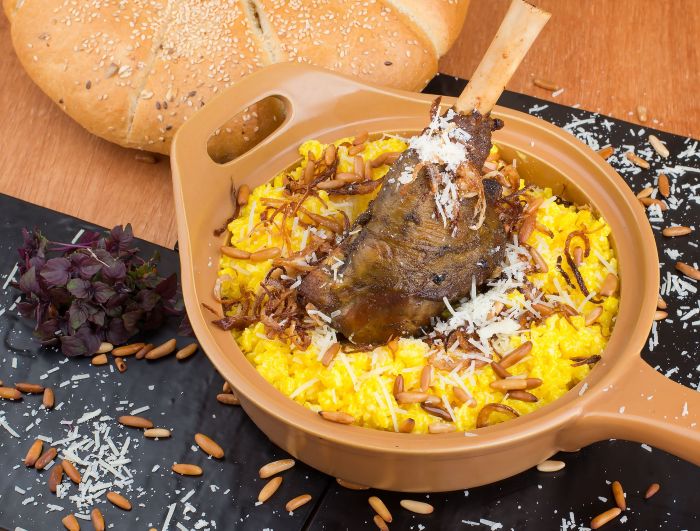
Mansaf, the national dish of Jordan
Frequently Asked Questions
How does OfficialGuides work? Is it a travel agency?
No. OfficialGuides is a marketplace that connects travelers with independent, licensed tour guides. You browse guide profiles, send a message or voice note through the chat button, and arrange everything — including itinerary, schedule, and payment — directly with the guide. There is no booking system, no commission, and no agency involved.
How much does a private tour guide in Amman cost?
Licensed private guides in Jordan typically charge between €20 and €30 per hour per group. A half-day tour (4 hours) usually costs €70–€110, and a full-day tour (8 hours) ranges from €120–€190 — longer engagements generally carry a reduced day rate. These are group rates: the fee stays the same whether you are 1 person or 6. Site entry and vehicle costs are additional, and multi-day trips to Petra or Wadi Rum are quoted as a package.
Should I buy the Jordan Pass?
For almost every visitor, yes — and it must be bought online before you arrive. A one-day Petra ticket costs 50 JOD and the visa on arrival costs 40 JOD, totalling 90 JOD. The Jordan Wanderer pass costs 70 JOD and covers both, plus entry to over 40 other sites including Jerash, Wadi Rum and the Amman Citadel. The three tiers (Wanderer 70 JOD, Explorer 75 JOD, Expert 80 JOD) differ only in how many days you get at Petra. The visa waiver requires a minimum consecutive-night stay, so check the current rule on the official site.
How much does it cost to enter Petra?
Without a Jordan Pass: 50 JOD for one day, 55 JOD for two consecutive days, and 60 JOD for three — but only if you are staying at least one night in Jordan. Visitors not staying overnight in the country pay 90 JOD for a single day. Children under 12 enter free. Multi-day tickets must be used on consecutive days. Petra by Night is ticketed separately and is not included in either the standard ticket or the Jordan Pass.
Can I visit Petra as a day trip from Amman?
Yes, but be realistic about it. Petra is roughly 240 km from Amman — about three hours each way on the Desert Highway — so a day trip runs 12 to 14 hours door to door and gives you around five hours on site. That is enough for the Siq, the Treasury, the Royal Tombs and the Colonnaded Street, but not the Monastery. An overnight in Wadi Musa lets you enter at opening time before the heat and the crowds, and lets you see Petra by Night. Most guides will tell you the overnight is worth it.
Can a guide take me diving in Aqaba?
No — and be cautious of anyone who says otherwise. A licensed tour guide is not a diving instructor. Your guide can arrange the trip to Aqaba, cover the land sites, and recommend reputable dive centres, but the dives themselves are run by certified dive staff at those centres. Also note that Aqaba is not a day trip from Amman: it is roughly 330 km, about four hours each way by road, or a 45-minute flight. Plan at least one night, ideally as part of a loop with Wadi Rum.
Can one guide take me across the whole country?
Yes. Jordanian guide licences are issued nationally rather than per city, so a single licensed guide can accompany you from Amman through Jerash, Mount Nebo, Petra, Wadi Rum and down to Aqaba. Over a four or five-day loop with long drives, that continuity is one of the strongest arguments for hiring a private guide here. Ask for the guiding fee, the vehicle, and the guide’s own accommodation on the road to be quoted separately.
When is the best time to visit Jordan?
March to May and September to November are the comfortable seasons. Summer is very hot, particularly at Petra, Wadi Rum and the Dead Sea, where shade is scarce and the walking is long — if you travel in July or August, plan early starts. Winter in Amman and Petra is cooler than people expect, with rain and occasional snow at altitude; Aqaba stays warm year-round, which is why it fills up in January.
How do I verify that a guide is officially licensed?
Licensed guides in Jordan hold a permit issued by the Ministry of Tourism and Antiquities through its Tourism Professions Directorate, granted only after a written and oral language examination (minimum 80%), a personal interview (minimum 70%), and the ministry’s own guiding course and examination. Ask to see the licence before your tour begins. Each guide profile on this page also displays a licence number you can check against the card.
What languages do the guides speak?
The guides listed on this page are English speaking professionals. In the Jordanian system a guide is licensed for a specific language, having passed a written and oral examination in it at 80% or above — so a guide certified in French, German, Spanish or Italian has cleared the same bar in that language, not merely picked it up. Check individual profiles for available languages, or use the chat button to ask about a specific one.
Ready to Explore Jordan?
Browse the guide profiles above, check availability, and start a direct conversation — no agency fees, no middleman.
Request a Free Quote
Share your tour details using the form below IF YOU CAN NOT REACH THE GUIDES THROUGH THEIR PROFILES ON THIS PAGE;
This page is also available in: العربية
Note: OfficialGuides is a marketplace that connects travelers with licensed tour guides; it is not a travel agency and does not sell or promote tours. Read the disclaimer and privacy policy
This page is also available in: العربية