Last Updated on 22/09/2026
How to plan your days in Dubai with a private English speaking guide — what actually fits into a half-day, a full day and a day trip beyond the city, with realistic timings and prices in AED.
Dubai does not reward wandering. The distances are real, the best sites run on timed entry, and half the city closes its outdoor doors between June and September — which is why a private Dubai city tour with a local guide is less a luxury here than a planning tool. Below are the routes that actually work — half-day and full-day city tours, the desert, and day trips to Hatta and Abu Dhabi — with honest timings and prices. If you want to skip straight to the people, meet the guides and message them directly. For the attractions that sell out their timed slots, you can secure entry in advance — Burj Khalifa At the Top tickets here, and a full list of Dubai attraction tickets is here.
Our platform connects you directly with independent guides in Dubai. You choose the route, message the guide, and settle the programme and the fee between you — no agency markup, no commission. Every guide listed holds a current Dubai Tour Guide Licence; if you want to understand how that credential works and how to check it, see our Dubai attraction tickets is here page.
Book a Private Tour with a Dubai Guide
All guides below work in English, and many in a second or third language. Message them directly to discuss dates, group size and which of the routes on this page fits your time in the city.

Ameer K. W. - En

Aasim J. - En

Muhammad S. - En
We welcome licensed, professional guides in any language. If you hold a valid DET tour guide licence, join our network here →
Sample Private Tour Itineraries in Dubai
Each route below is a starting point, not a fixed product. Your guide will reshape the order, the pace and the stops around your interests, the season and what time your day actually begins.
Half-Day · 4 hours · Walking + Vehicle
Old Dubai City Tour: Al Fahidi, the Creek & the Souks
The route that makes the rest of the city legible. Begin in the Al Fahidi Historical Neighbourhood, the coral-and-gypsum quarter of wind towers built by Persian merchants in the early 1900s, with a stop at the Coffee Museum or one of the courtyard galleries. Walk down to the Dubai Creek and cross to Deira on an abra — the wooden water taxi that still costs a couple of dirhams and carries more commuters than tourists. On the far bank, the Spice Souk and the Gold Souk, where your guide’s real job is explaining how the trade works rather than pointing at it. Finish at the textile souk or Al Seef. Best done early morning; the souks are hot and slow by midday.
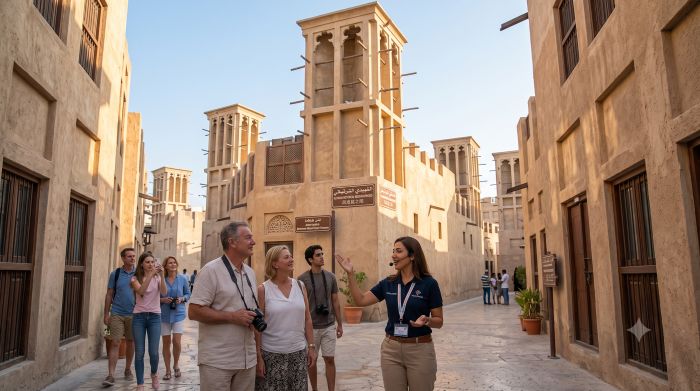
Al Fahidi — the wind-tower quarter that survived the city’s rebuild, and the natural starting point for any Old Dubai route.
Half-Day · 4–5 hours · Vehicle
Modern Dubai City Tour: Downtown, the Palm & the Marina
The skyline half-day. Start at Downtown Dubai for the Burj Khalifa — the observation deck runs on timed slots, so this anchors the whole schedule — then the Dubai Mall and the fountain lake. Continue past the Museum of the Future and Sheikh Zayed Road’s tower canyon, stop for the Dubai Frame and its glass-floored bridge, then drive out along Jumeirah for the Burj Al Arab viewpoint, onto Palm Jumeirah for Atlantis, and finish at Dubai Marina or Bluewaters. Run this as an afternoon and you can end with the evening fountain shows.
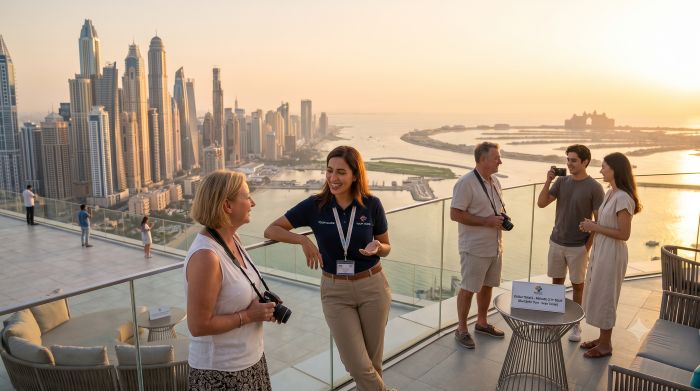
Dubai Marina and Palm Jumeirah — the western end of the modern half-day, best reached in the last hours of light.
Half-Day · 4 hours · Walking + Vehicle
Emirati Culture Tour: Jumeirah Mosque & a Local Meal
The counterweight to the skyline. Jumeirah Mosque is the one mosque in Dubai that opens its doors to non-Muslim visitors, through the Sheikh Mohammed Centre for Cultural Understanding’s guided session — roughly 75 minutes, Saturday to Thursday, starting at 10:00, with registration on the door beforehand and no visits on Fridays. Pair it with a seated Emirati cultural meal at the Centre in Al Fahidi, where questions about religion, dress and daily life are the entire point of the format. Add the Etihad Museum or a coffee house in Al Seef to fill out the morning. Modest dress required: shoulders and knees covered, headscarf for women.
Full Day · 8 hours · Vehicle
Full-Day Dubai City Tour: Old City to the Skyline
The single best use of one day, and the most requested route on this page. Morning in the old city — Al Fahidi, the abra crossing, the Spice and Gold Souks — while the temperature still allows walking. Lunch in Bur Dubai or Al Seef. Afternoon through the modern city: Jumeirah, the Burj Al Arab viewpoint, Palm Jumeirah, the Marina, then back inland to Downtown for a late-afternoon Burj Khalifa slot and the fountain shows after dark. It is a long day and it works, but only with a vehicle and a guide handling the timed entries.
Afternoon–Evening · 6 hours · 4×4
Private Desert Safari Tour: Dunes, Camel Ride & Camp Dinner
Booked privately rather than as a shared coach run, the desert becomes a genuinely different experience. Afternoon pick-up, a drive to the red dunes of Lahbab or the protected Al Marmoom Desert Conservation Reserve, dune driving in a 4×4, a short camel ride, and a stop for sunset over the ridge. Then a Bedouin-style camp for a grilled dinner, Arabic coffee, henna and live music — or, if you would rather skip the entertainment programme, a quieter conservation-reserve option with wildlife spotting, falconry and stargazing instead. Dune driving is optional and can be dropped entirely; see the desert safari safety section below before you book.
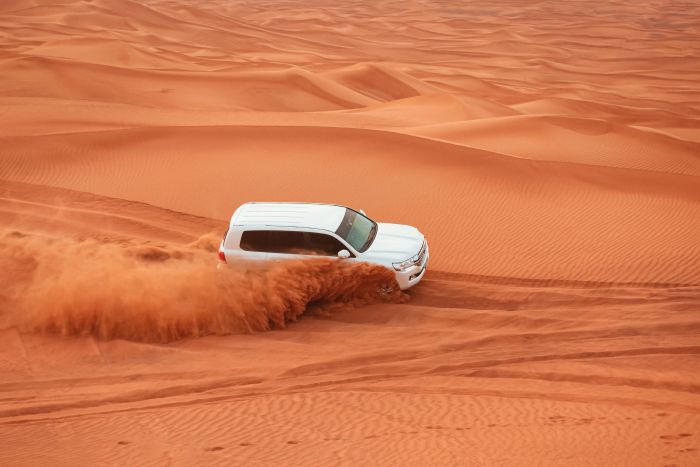
The red dunes south of the city — an hour from Downtown, and the reason most itineraries keep an afternoon free.
Full Day · 8–9 hours · Vehicle
Hatta Day Trip: Mountains, Dam & Heritage Village
Dubai’s mountain exclave, about 90 minutes inland through the Hajar range. The Hatta Dam holds a turquoise reservoir between bare rock walls where you can take out a kayak or pedal boat; the Hatta Heritage Village reconstructs a pre-oil mountain settlement with watchtowers and a restored fort; and Hatta Wadi Hub adds mountain biking, zip lines and via ferrata for anyone travelling with teenagers. Add the Hatta Honey Bee Garden or the hilltop viewpoint on the way back. Bring your passport — the route can pass close to the Omani border, and crossing rules change. A cool-season day trip; not advisable in high summer.
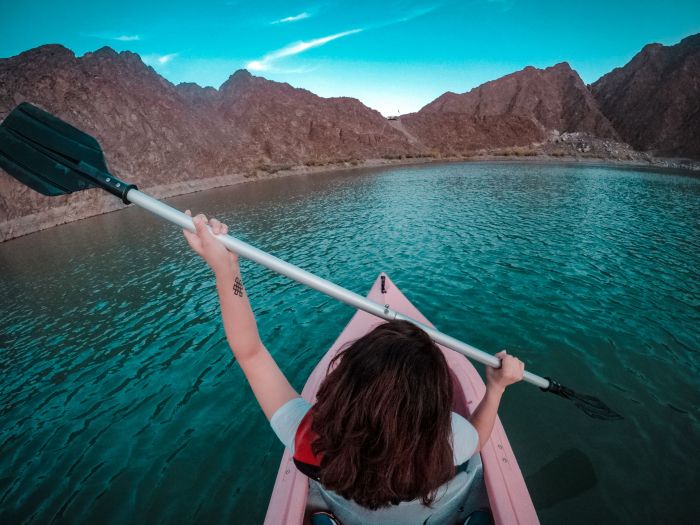
The Hatta Dam reservoir — ninety minutes from Downtown and a completely different emirate from the one on the postcards.
Full Day · 10 hours · Vehicle
Abu Dhabi Day Tour from Dubai: Grand Mosque, Qasr Al Watan & the Louvre
The UAE capital sits about 90 minutes down the E11, and this is comfortably the most popular day tour out of Dubai. The day is built around the Sheikh Zayed Grand Mosque — 82 domes, the world’s largest hand-knotted carpet, open to visitors seven days a week with an online access pass and a strict dress code. Add Qasr Al Watan, the working presidential palace opened to the public, and the Louvre Abu Dhabi under Jean Nouvel’s perforated dome on Saadiyat Island — note it closes on Mondays, which quietly ruins more itineraries than anything else in the UAE. Families often swap the Louvre for Ferrari World or Warner Bros. World on Yas Island. One practical point: guiding is licensed emirate by emirate, so ask whether your Dubai guide also holds an Abu Dhabi licence — see the guides page for how that works.
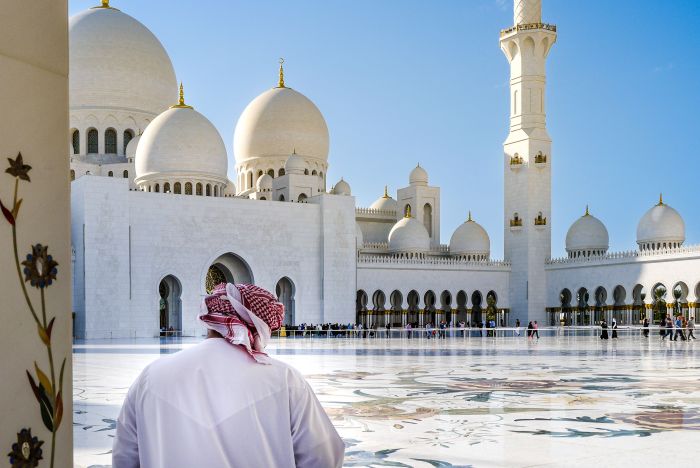
Sheikh Zayed Grand Mosque, Abu Dhabi — ninety minutes from Dubai and the anchor of every capital day tour.
Short · 5–6 hours · Vehicle · Airport pick-up
DXB Layover Tour
Dubai is built for long connections, and a guide can turn a dead six hours into the best part of the trip. Meeting at the terminal, a compressed loop of the old city and the Downtown skyline, and a return to the airport with a deliberate margin. The two things to settle before you book: your minimum connection time — anything under seven hours is tight — and whether your nationality can enter on arrival or needs a visa in advance. Send your flight numbers, terminals and layover length and the guide builds backwards from the check-in deadline.
Half-Day or Full-Day Dubai City Tour?
The most common planning question we get, and the answer depends less on budget than on how many days you have in the city.
A half-day Dubai city tour — four to five hours — covers one half of the city properly. Either the old creek-side town or the modern skyline, not both. It suits travellers with a packed schedule, an afternoon free before a dinner reservation, or anyone who has already seen part of Dubai on a previous trip. It is also the right choice in summer, when four hours is genuinely as much outdoor time as the climate allows.
A full-day Dubai city tour — eight hours — is the only format that shows you the contrast, and the contrast is the entire point of this city. Souks in the morning, skyline in the afternoon, fountains after dark. If you have exactly one day, take the full day. If you have three, split it into two half-days and keep an evening free for the desert.
What does not work is bolting the desert, Hatta or Abu Dhabi onto a full city day. Each of those is a day trip in its own right, and any guide who agrees to combine them is selling you a drive-by.
Cruise Tours and Shore Excursions in Dubai
Dubai is one of the Gulf’s two main cruise hubs, and it is unusually well set up for a short port day.
Most ships berth at Port Rashid (Mina Rashid), at the Hamdan bin Mohammed Cruise Terminal — the world’s largest single covered cruise terminal, fully climate-controlled, and a genuine advantage in this climate. A second berth operates at Dubai Harbour Cruise Terminal, next to Bluewaters and Palm Jumeirah, at the opposite end of the city. Check your ticket: which terminal you dock at changes the whole shape of the day. Port Rashid puts you around fifteen minutes from the heritage quarter; Dubai Harbour puts you next to the Marina and the Palm instead.
What fits in a port day. A five-hour call from Port Rashid comfortably covers Al Fahidi, the abra crossing and the souks, plus a drive through Downtown with a Burj Khalifa stop. Six to seven hours stretches to Jumeirah, the Palm and the Marina, or a compressed afternoon desert run. From Dubai Harbour, reverse the order: modern Dubai first, old city second. An Abu Dhabi day tour is possible on a long call but leaves no margin, and most guides will talk you out of it.
How it works. Your guide meets you at the terminal with a name sign, plans the return for at least an hour before all-aboard, and keeps the vehicle with the group the whole time rather than working to a coach schedule. Send your ship name, berth time and all-aboard time when you first message — that is the only information needed to build the day.
Season and a caveat worth knowing. The Arabian Gulf cruise season runs in winter, roughly October or November through April; summer sailings are rare because the heat deters fly-cruise passengers. Deployment in this region has been unusually volatile recently — several lines have withdrawn or reshaped their Gulf programmes at short notice while others remain committed — so confirm your call date directly with your cruise line rather than assuming last season’s schedule still stands.
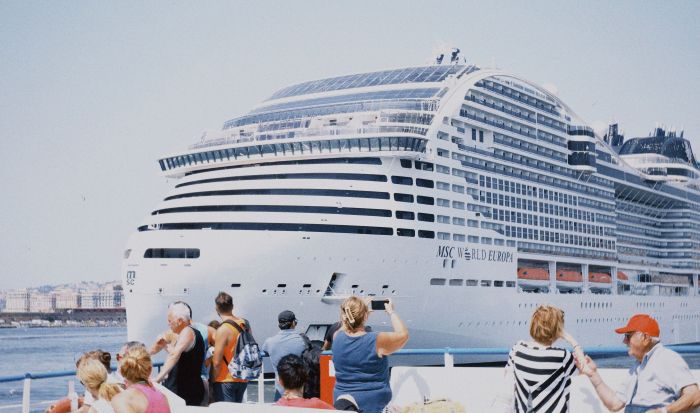
Port Rashid — fifteen minutes from the old city, which is why Dubai port days work better than most.
How Much Do Private Tours in Dubai Cost?
The figures below are indicative totals for a private tour with a licensed English speaking guide plus a vehicle and driver, for 1 to 6 travellers. They are per group, not per person. Larger parties needing a Sprinter or minibus, and multi-day arrangements, are quoted on request.
| Private tour | Duration | Fee (per group) |
|---|---|---|
| Old Dubai city tour: Al Fahidi, Creek & Souks | 4 hours | AED 800 – 1,250 |
| Emirati culture tour & Jumeirah Mosque | 4 hours | AED 800 – 1,250 |
| Modern Dubai city tour: Downtown, Palm & Marina | 4–5 hours | AED 900 – 1,400 |
| DXB layover tour | 5–6 hours | AED 1,100 – 1,700 |
| Cruise shore excursion (Port Rashid or Dubai Harbour) | 5–6 hours | AED 1,200 – 1,800 |
| Private desert safari tour with dinner | 6 hours | AED 1,300 – 2,000 |
| Full-day Dubai city tour: old city to skyline | 8 hours | AED 1,500 – 2,400 |
| Hatta day trip: mountains & heritage village | 8–9 hours | AED 1,700 – 2,500 |
| Abu Dhabi day tour from Dubai | 10 hours | AED 1,900 – 2,900 |
Not included: attraction tickets (Burj Khalifa At the Top runs roughly AED 180 off-peak and AED 250 at sunset, the Museum of the Future around AED 160, the Dubai Frame around AED 50), meals, and gratuities. VAT at 5% applies to tourism services in the UAE — ask for a VAT-inclusive total. Salik road tolls and parking are usually absorbed into the vehicle cost, but confirm it. Guiding in a language other than English typically adds 15–35%. If you want the guide only, without a vehicle, hourly and half-day guiding rates are on our Licensed Private Tour Guides in Dubai page.
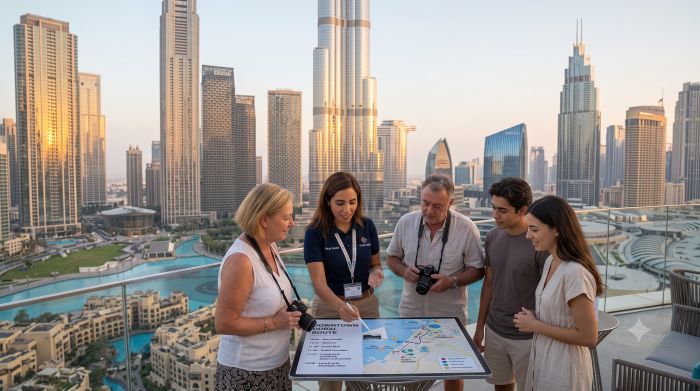
Tour fees in Dubai are quoted per group with the vehicle included — which is what makes the private option work for families. (Editorial illustration)
The Most Luxurious Tours and Experiences in Dubai
Dubai is a city where the ceiling on spending is essentially theoretical, and a good private guide is genuinely useful at this end of the market — not to sell you anything, but to sequence the bookings, hold the reservations and tell you honestly which of these is worth the money and which is a twelve-minute photograph.
The headline experiences, with realistic 2026 market ranges:
| Experience | Typical price | Worth knowing |
|---|---|---|
| Helicopter tour over the Palm and Burj Khalifa | From ~AED 700 pp (12 min shared); ~AED 2,400+ for the 30-minute Grand Tour; private charters from ~AED 3,500 | The Palm and the World Islands only read as shapes from the air. Twelve minutes goes faster than you expect. |
| Seaplane flight | From ~AED 1,100 pp (35–40 min) | More airtime than a helicopter, fewer landmarks. A good second aerial trip, not a first. |
| Hot air balloon over the desert at sunrise | ~AED 1,100–1,350 pp shared; ~AED 2,200–3,500 for a private basket | Desert, not city — it does not fly over Downtown. Cool-season only, pre-dawn start, falconry add-ons available. |
| Private yacht charter from Dubai Marina | ~AED 400–700 per hour for a day boat; ~AED 2,400–4,500 for 3 hours; AED 6,400–12,000+ for a full day | Minimum two to three hours. VAT usually added on top; ask for the inclusive figure. |
| Burj Khalifa: The Lounge, Level 154 | Several times the standard At the Top ticket | The world’s highest lounge, with an outdoor terrace and canapés. Fast-track through every level. |
| Skydive over Palm Jumeirah | ~AED 2,200 for a tandem jump | The Palm drop zone books out weeks ahead in high season. Weight and weather restrictions apply. |
| Private desert camp with butler service | From ~AED 4,000 per group | Exclusive camp, private chef, falconry and stargazing with no shared entertainment programme. |
| Helicopter transfer to Abu Dhabi | Roughly AED 35,000 one way for up to four | Saves ninety minutes each way. Almost nobody needs this; a few people want it. |
Beyond the activities, the luxury end of a Dubai itinerary is mostly about where you eat and sleep. Dubai has had its own Michelin Guide since 2022, and the starred rooms book out well ahead. Suites at Atlantis The Royal, the Burj Al Arab, the Armani Hotel inside the Burj Khalifa, Bulgari Resort on Jumeirah Bay and One&Only The Palm occupy the top of the market, and a well-connected guide can often get a table or a viewing where a booking form cannot. Supercar drives on desert roads, private access at Ferrari World, and gold-leaf everything are all available and all exactly as advertised.
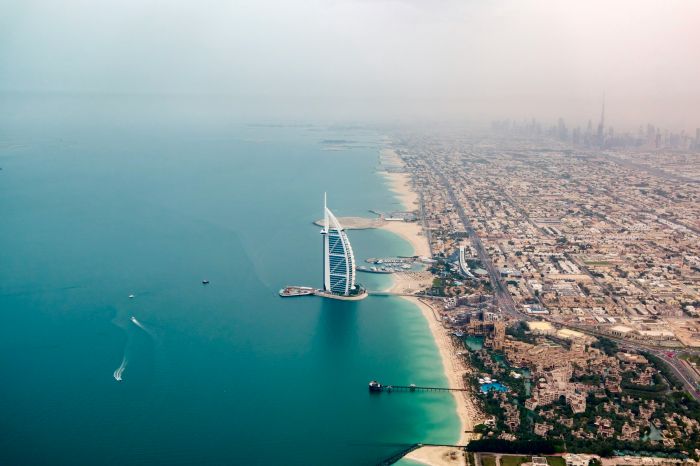
Palm Jumeirah from the air — the one Dubai landmark that genuinely does not work from the ground.
Transport, Vehicles and Hotel Pick-Up
Dubai is a driving city and the itineraries above assume a vehicle. Deira to Dubai Marina is around 35 kilometres, and doing that on taxis while a guide waits is both slower and rarely cheaper than including transport in the tour.
One local difference worth knowing before you compare quotes: in Dubai the guide and the driver are normally two different people. Commercial passenger transport requires its own permit, so the standard arrangement is a licensed guide travelling with you in a vehicle operated by a licensed chauffeur — not the driver-guide model you may have used in Ireland or Iceland.
Typical vehicles are a saloon or Lexus for one to three travellers, a Toyota Previa or Mercedes Vito for four to six, a Hiace or Sprinter for seven to fourteen, and a coaster or minibus above that. Desert routes use a 4×4 Land Cruiser or Nissan Patrol. All are air-conditioned, which in this climate is not a comfort note but a planning requirement.
Hotel pick-up is included from anywhere in Dubai city and the main hotel districts. Pick-ups from Sharjah, Ajman or Abu Dhabi hotels are possible with a supplement and an earlier start.
When to Visit: High Season, Heat and Sea Temperature
Season shapes the itinerary here more than almost anywhere else in the world, so this table is worth reading before you choose your dates.
| Month | Air high / low | Sea | What it means for touring |
|---|---|---|---|
| January | 24° / 15°C | 22°C | Peak season. Perfect for full days on foot; evenings genuinely cool. |
| February | 26° / 16°C | 22°C | Peak season, the coolest sea of the year. Best month overall for walking routes. |
| March | 29° / 18°C | 24°C | Excellent. The city’s small annual rainfall mostly lands now. |
| April | 33° / 21°C | 26°C | Warm but workable with an 08:00 start. Ideal sea temperature. |
| May | 38° / 25°C | 29°C | Hot. Outdoor seasonal attractions start closing for summer. |
| June | 40° / 28°C | 32°C | Very hot. Indoor itineraries and evening programmes only. |
| July | 41° / 30°C | 33°C | Extreme. The sea is bath-warm and offers no relief. |
| August | 41° / 31°C | 33°C | Extreme and the most humid month. Cheapest, emptiest, hardest. |
| September | 39° / 28°C | 33°C | Still extreme, humidity easing towards the end. |
| October | 35° / 24°C | 31°C | The turn. Outdoor attractions reopen; full days become possible again. |
| November | 30° / 20°C | 28°C | Arguably the best month: warm air, warm sea, high season just starting. |
| December | 26° / 17°C | 25°C | Peak season, peak prices. Book guides and hotels well ahead. |
High season is November to March. Everything outdoors is open, the full-day routes make sense, and this is also the most expensive and most crowded period — the best guides commit weeks ahead, and Christmas and New Year rates are in a category of their own.
Summer, June to September, regularly exceeds 40°C with high humidity, and the sea offers no cooling at 33°C. Tours still run and can be genuinely enjoyable, but the shape changes completely: early mornings, indoor sites in the middle of the day, and outdoor sections pushed past sunset. Any guide who proposes a midday souk walk in August is not planning your day seriously. In exchange you get low prices, no queues and hotel rates that are a fraction of January.
Ramadan shifts the rhythm rather than closing the city. Daytime hours are quieter, some restaurants stay shut until sunset, mosque access may be restricted, and the evenings — iftar, night markets, souks alive until 2am — are extraordinary. Tell your guide if your dates fall in Ramadan and the whole itinerary gets rebuilt around the evening.
Seasonal outdoor attractions such as Global Village and Dubai Miracle Garden typically run from around October to May and close for the summer, so check dates before you build a day around them.
Is a Desert Safari Safe? 4×4 Dune Driving and Camel Riding
This is the most common question about Dubai tours and the one most operators answer with marketing rather than information. The honest version:
4×4 dune driving. With a licensed operator this is a controlled activity, not an improvised one. Drivers hold a specific desert-driving certification, vehicles are modified 4x4s with roll cages and reinforced suspension, tyres are deflated at the edge of the sand for grip, convoys stay in radio contact, and routes are pre-planned rather than explored. Seatbelts are worn for the entire run, and serious injuries are rare — the common complaints are motion sickness and a bruise from the door on a sharp turn.
Who should skip the dune driving. The ride produces sudden vertical drops and sideways slides. It is not appropriate during pregnancy at any stage, and it should be avoided by anyone with a serious back, neck or spinal problem, a heart condition, or recent surgery. Very young children and frail elderly travellers are also better off skipping it. This does not mean skipping the safari — you can go straight to the camp by road and rejoin the group there, and on a private tour that is trivially easy to arrange.
Reducing the risk of a bad experience. Tell your guide before pick-up if you want a gentler drive; intensity is adjustable and good drivers do it without being asked twice. Do not eat a heavy meal beforehand. If you are prone to car sickness, sit in the front and watch the horizon. Note that desert camps sit 30 to 45 minutes from the nearest hospital and have no on-site medical facility — a fact worth weighing if you have a known condition.
Camel riding. The rides offered at desert camps are short, slow and led on foot by a handler, and the animal is not being steered by you. The riskiest moments are mounting and dismounting: a camel rises back legs first, so you are pitched forward and then sharply back. Hold the saddle handle, lean back as it stands and forward as it kneels, and listen to the handler. Not advisable during pregnancy or with back problems. Children normally ride with an adult or with the handler leading throughout.
On the animals themselves. Welfare standards vary between camps. A well-run operation keeps camels in shade with water, works them in rotation, and does not overload them; if a camp looks otherwise, say so and skip it — your guide can choose a different one. Standard health advice around dromedaries also applies: wash your hands after contact, and avoid unpasteurised camel milk.
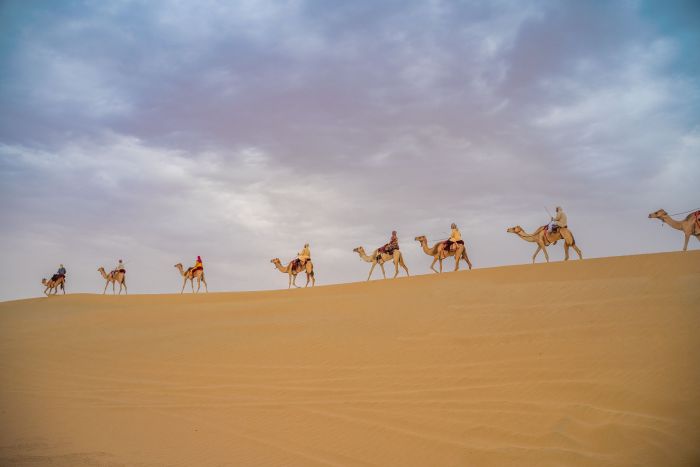
Camel rides at desert camps are short and handler-led — the only tricky moments are getting on and getting off.
What to Know Before Your Tour
Dress. Dubai is relaxed in malls, hotels and beach areas, but modest dress is expected in heritage districts, souks and mosques — shoulders and knees covered, and a headscarf for women at Jumeirah Mosque and Sheikh Zayed Grand Mosque.
Photography. Photograph freely at landmarks, but never photograph people, especially local women and families, without clear permission. Government buildings, ports and military sites are off limits.
Friday. Friday midday prayers reshape the schedule between roughly 12:00 and 14:00, and some sites — including the Jumeirah Mosque visitor programme — do not operate on Fridays at all.
Heat and water. Your guide should carry water. Ask. In summer the difference between a good tour and a miserable one is almost entirely shade, timing and hydration.
Tipping. Not obligatory. AED 50–100 per group for a half-day and AED 100–200 for a full day is generous locally, with something separate for the driver.
Alcohol. Available in licensed hotels and restaurants, not in public. Public intoxication is treated seriously.
Which Private Tour Should You Choose?
First visit, one day only: the full-day Dubai city tour. It is long, but it is the only route that shows you both cities and makes the contrast land.
First visit, two or three days: split it — Old Dubai one morning, Modern Dubai another afternoon, and the desert on the evening in between.
Travelling with children: the modern city tour plus an aquarium or the Dubai Frame, and a private desert safari with the dune driving dropped. Keep outdoor time to mornings and evenings.
Second or third visit: Hatta, Al Marmoom, Alserkal Avenue and the neighbourhood food routes — the parts of the emirate that never appear on a first trip.
Cruise or layover: the port and airport routes above, built backwards from your departure time rather than forwards from your arrival.
Celebrating something: pair a short city tour with one of the experiences in the luxury section — the helicopter at golden hour or a private desert camp are the two that consistently justify the money.
Frequently Asked Questions About Private Tours in Dubai
How much does a private tour in Dubai cost?
A private tour with an English speaking guide, vehicle and driver for 1–6 travellers typically runs AED 800–1,400 for a half-day, AED 1,500–2,400 for a full-day Dubai city tour, and AED 1,900–2,900 for a full-day Abu Dhabi trip. These are per-group totals, not per person. Attraction tickets, meals and 5% VAT are separate, and guiding in a language other than English adds roughly 15–35%. For guide-only rates without a vehicle, see our licensed guides page.
What can you see on a one-day Dubai city tour?
One well-planned day covers the old city — Al Fahidi, the abra crossing, the Spice and Gold Souks — in the morning, and the modern city — Jumeirah, Palm Jumeirah, the Marina and Downtown with a Burj Khalifa slot — in the afternoon and evening. That is roughly eight hours with a vehicle. Adding the desert, Hatta or Abu Dhabi to the same day does not work; each of those is a day in itself.
Is a private Dubai city tour better than a shared bus tour?
A shared coach city tour costs a fraction of the private version and visits broadly the same landmarks, so for a solo traveller or a couple watching the budget it is a perfectly sensible choice. What you trade away is control: a fixed route, a long hotel collection loop at the start, photo stops on someone else’s clock, and no way to skip a site or linger at one. From three or four travellers upwards the per-person gap narrows sharply. In summer the private version is also materially more comfortable, because the whole day can be rebuilt around the heat rather than run to a printed schedule.
Is dune bashing safe, and who should avoid it?
With a licensed operator it is a controlled activity: certified desert drivers, modified 4x4s with roll cages, deflated tyres, radio convoys, pre-planned routes and mandatory seatbelts. Serious injuries are rare; motion sickness is the usual complaint. However, the ride creates sudden drops and sideways slides, so it is not safe during pregnancy at any stage and should be avoided by anyone with serious back, neck or heart conditions, or recent surgery. You can still join the safari — travel to the camp by road and skip the dune section. Tell your guide in advance and the intensity can also simply be dialled down.
Is camel riding safe in Dubai?
The camel rides at desert camps are short, slow and led on foot by a handler, so the animal is never under your control. The only genuinely awkward moments are mounting and dismounting, because a camel rises back legs first and pitches you forward then back — hold the saddle handle, lean back as it stands and forward as it kneels. It is not advisable during pregnancy or with back problems, and children usually ride with an adult. Wash your hands afterwards and avoid unpasteurised camel milk, which is standard health advice around dromedaries anywhere.
Is a private desert safari worth it compared with a shared one?
If you want the standard dune driving and camp dinner and do not mind sharing a vehicle, the shared version is considerably cheaper. A private safari is worth the difference in three cases: you want to control the intensity of the dune driving or skip it entirely, you want a quieter conservation-reserve experience with wildlife and stargazing instead of the entertainment programme, or you are travelling with young children, elderly parents or anyone who needs the timing to be flexible.
Can I do Abu Dhabi as a day tour from Dubai?
Yes — it is about 90 minutes each way on the E11, and a 10-hour day comfortably covers Sheikh Zayed Grand Mosque, Qasr Al Watan and either the Louvre Abu Dhabi or Yas Island. Two planning points: the Louvre is closed on Mondays, and the Grand Mosque requires an online access pass and modest dress. Because guiding is licensed emirate by emirate in the UAE, confirm that your guide is licensed for Abu Dhabi or will arrange a licensed colleague there.
Can a guide meet my cruise ship at Port Rashid?
Yes. Most ships berth at the Hamdan bin Mohammed Cruise Terminal in Port Rashid, roughly fifteen minutes from the heritage quarter, and some use Dubai Harbour next to the Marina instead — check your ticket, because it changes the shape of the day. Your guide meets you at the terminal with a name sign and plans the return for at least an hour before all-aboard. Send your ship name, berth time and all-aboard time when you first message. Gulf cruise deployment has shifted a lot recently, so confirm your call date with the cruise line as well.
Can a guide take me on a tour during a Dubai layover?
Yes. A guide can meet you at DXB and run a compressed city route, returning you with a deliberate margin before check-in. Allow a minimum of about seven hours between flights to make it comfortable, and check in advance whether your nationality gets a visa on arrival — the tour is only possible if you can legally leave the airport.
When is the high season, and is summer too hot for tours?
November to March is high season: 24–30°C by day, everything outdoors open, and the highest prices of the year. June to September regularly exceeds 40°C with heavy humidity. Tours still run, but the itinerary inverts — early mornings, indoor attractions through the middle of the day, outdoor sections after sunset. Summer is also the cheapest and least crowded time to visit, which is a real trade-off rather than a consolation prize.
How warm is the sea in Dubai, and can you swim year-round?
Yes, year-round. The Arabian Gulf ranges from about 22°C in January and February to 33°C from July to September. Winter water is refreshing rather than cold and perfectly swimmable; midsummer water is close to bath temperature and provides no relief from the heat, which surprises most first-time visitors. April, May, October and November give the best balance of comfortable air and comfortable water.
What are the most luxurious tours you can book in Dubai?
The headline experiences are a helicopter flight over Palm Jumeirah and the Burj Khalifa (from around AED 700 per person for twelve minutes, with private charters from about AED 3,500), a sunrise hot air balloon over the desert (around AED 1,100–1,350 per person, or AED 2,200–3,500 for a private basket), a private yacht charter from Dubai Marina (roughly AED 2,400–4,500 for three hours), The Lounge at Burj Khalifa Level 154, a tandem skydive over the Palm at around AED 2,200, and a private desert camp with a chef and falconry from about AED 4,000. Dubai has also had its own Michelin Guide since 2022, and a well-connected guide is often more useful for a table than a booking form.
Are attraction tickets included, and how far ahead should I book?
Tickets are usually not included, because Burj Khalifa prices in particular swing with the time slot — many guides will pre-book timed entries and add the cost to the invoice, which is worth asking for. Book the tour itself three to six weeks ahead in the November-to-March season, earlier over New Year, Eid or a major exhibition, and a week or two is usually enough in summer.
Are private tours in Dubai suitable for families with young children?
Very much so, and the climate makes the case stronger here than in most cities. A private tour lets you schedule around naps and meals, keep outdoor time short, choose stroller-friendly routes and stop when someone has had enough. Guides commonly swap the architectural history for falcons, pearl divers and the world’s tallest building, and will drop the dune driving section of a desert safari on request.
Ready to Plan Your Days in Dubai?
Browse the guide profiles above, tell them which route fits your dates, and agree the plan directly — no agency fees, no middlemen.
Image note: photographs on this page show the locations described and are not images of specific tours or of the guides listed above. Where a photograph is not available, an illustration is used and labelled.
Note: OfficialGuides is a marketplace connecting travellers with licensed guides; it is not a travel agency and does not sell or promote tours. Prices, opening days and seasonal dates shown are indicative market information, not offers, and should be confirmed before booking. Read Full Disclaimer and Privacy Policy
Request a Free Quote
Share your tour details using the form below and receive a personalized quote if you can not reach the guides on this page.