Last Updated on 28/07/2026
Licensed English Speaking Guides and Private Tours in Marrakech
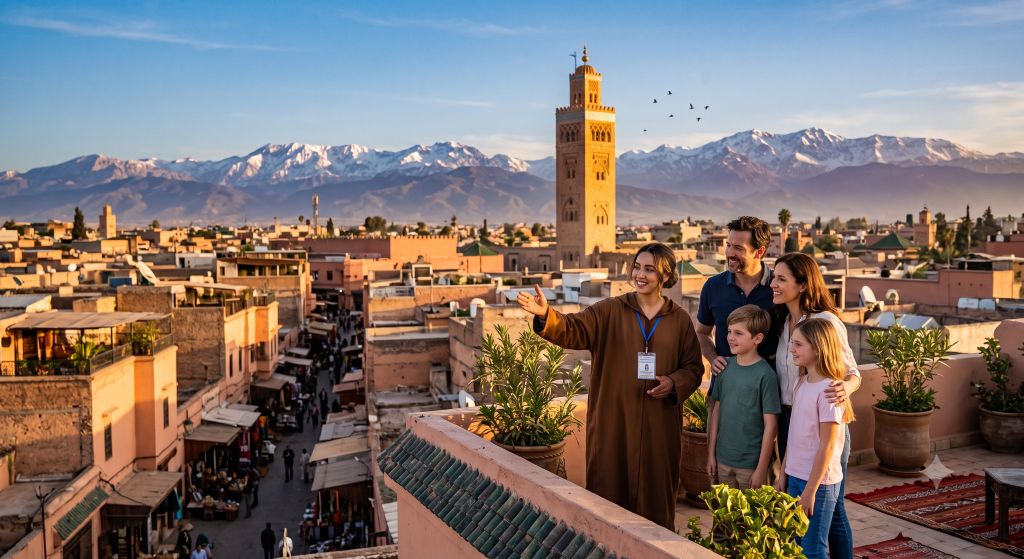
How to explore Marrakech with a certified local guide — read the medina, avoid the commission trail, and get out to the Atlas, the Agafay and the coast without wasting a day.
Marrakech actively resists being read. The medina is a thousand years of unsignposted alleys, the souks are organised by trade rather than by map, and a stranger offering directions is usually working on commission. A licensed local guide is the difference between seeing the city and being walked through a shopping circuit. On this page: worked routes for a Marrakech city tour, the five day trips worth taking, what a private guide actually costs in dirhams, why the Agafay is not the Sahara, and how to deal with faux guides. For monuments on timed entry you can book Marrakech attraction tickets here.
We connect you directly with licensed, independent guides. You message the guide, agree the programme and the fee, and arrange everything between you — no agency markup, no commission.
Licensed Tour Guides in Marrakech 👇
Mohamed M. - En
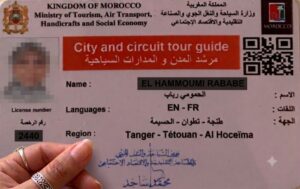
Every licensed guide in Morocco carries a numbered card naming their category and languages.
Why Hire a Licensed Guide, and the Two Categories
Guiding in Morocco is regulated by Law 05-12, amended four times since it came into force. A guide holds an agrément — a state authorisation earned through an accredited tourism diploma or a professional examination, and since January 2022 issued by the regional representative of the tourism authority rather than from Rabat. Training covers Moroccan history, Islamic art and heritage regulation, with a written exam and an oral interview. The medina is a UNESCO World Heritage site and Jemaa el-Fna is on UNESCO’s intangible heritage list — yet almost nothing in either is labelled on site.
The part no booking site mentions: the law recognises two separate categories, and a guide holds one, not both.
Guide des villes et circuits touristiques — for the medina, palaces, tombs, souks and museums.
Guide des espaces naturels — legally required for mountains, valleys, gorges and national parks, trained through mountain institutions such as the CFAMM at Tabant.
So your medina guide cannot legally take you into the High Atlas. A day combining the two needs a nature-category guide or a handover between two professionals — a normal arrangement, and a better sign than a guide who claims to cover everything. The rule has teeth at altitude: since December 2018 the Imlil–Toubkal trail has required a certified guide, with police checkpoints outside Aremd, at Sidi Chamharouch and at the refuges.
How to verify: ask to see the card — photograph, guide number, category and authorised languages. Morocco publishes no open public database, so this is the practical check.
Faux Guides in Marrakech: How the Approach Actually Works
Unofficial guides are the most-searched anxiety about this city, so here is the mechanical version rather than the scare story.
The classic approach is a friendly stranger near Jemaa el-Fna or a souk entrance who tells you the way you are walking is closed, that the tanneries are only open today, or that a Berber market is finishing shortly. You are then walked to a shop that pays commission on whatever you buy — added to your price.
None of this is dangerous. It is a business model, and it runs on politeness. The defences are unglamorous: decline clearly and keep walking, never accept unsolicited directions, never follow anyone to a “special” workshop, and if you already have a licensed guide, say so. Walking with one is the most effective deterrent there is, and a large part of what you are paying for.
Marrakech City Tours: What Fits in a Half-Day and a Full Day
Half-Day · 4 hours · Walking
Medina City Tour: Palaces, Tombs & Souks
The route that makes the rest of the city legible. Bahia Palace for late-nineteenth-century craftsmanship at its most confident, the Saadian Tombs sealed for three centuries and reopened in 1917, the ruined El Badi Palace, and the Ben Youssef Madrasa — the most concentrated zellij, carved cedar and stucco in Morocco. Then the souks, organised by trade, finishing at Jemaa el-Fna. No vehicle required: the medina is closed to cars.
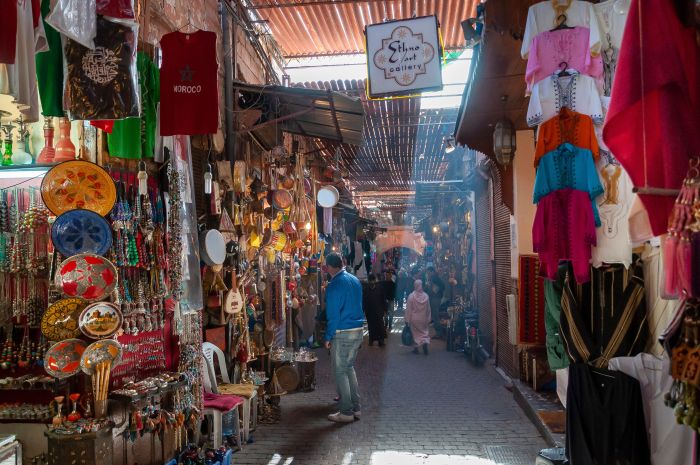
The souks are organised by trade, not by map — which is why the medina is hard to read alone.
Half-Day · 4 hours · Vehicle
Modern Marrakech: Majorelle, Gueliz & the Gardens
The counterweight to the medina, and the right choice for the hottest hours. The Majorelle Garden with its cobalt villa, restored by Yves Saint Laurent, plus the YSL Museum and Berber Museum on the same site. Then the Menara gardens with their Atlas backdrop, or the Almohad-era Agdal, and a walk through Gueliz, the French-era new town. Majorelle runs on timed entry and sells out — book ahead.
Full Day · 8 hours · Walking + Vehicle
Full-Day Marrakech City Tour
Medina in the morning while the alleys are cool, lunch on a rooftop, gardens and Gueliz by vehicle in the afternoon, back to Jemaa el-Fna at sunset when the square turns over into food stalls, storytellers and Gnaoua musicians. Long, but the only format that shows you both Marrakechs.
Half-day or full day? One day in the city — take the full day. Three days — split the city into two half-days and give the third to a day trip. In July and August four hours is as much as the heat sensibly allows, so the half-day is the honest choice.
Day Trips from Marrakech
Half-Day · 5 hours · Vehicle
Agafay Desert: Sunset, Camp & Dinner
Forty minutes out, a rolling stone desert with the High Atlas behind it — spectacular at sunset. A typical afternoon combines a camel ride or quad circuit, a viewpoint over the Lalla Takerkoust reservoir, and dinner at a desert camp.
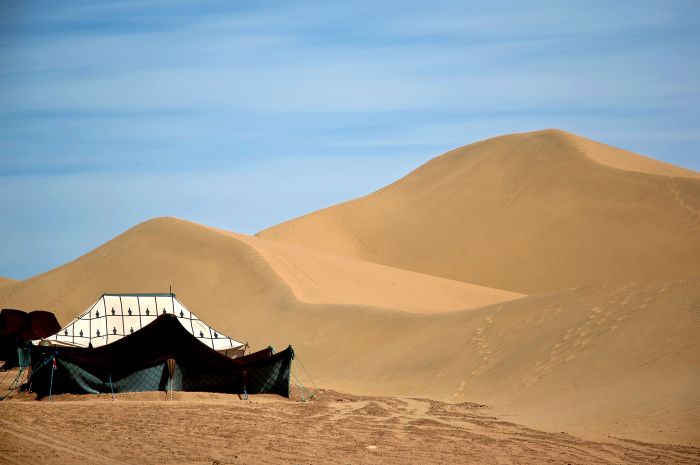
The Agafay — stone desert forty minutes from the city. Beautiful, and not sand.
Full Day · 8–9 hours · Vehicle · Nature guide
Atlas Mountains: Ourika Valley or Imlil
Two versions of the same escape from the heat. Ourika is the easy one — an hour south, river terraces with tables in the water, an Amazigh house visit and the Setti Fatma waterfalls for those who want the scramble. Imlil, at 1,740 m below Jebel Toubkal, is the walking one: walnut terraces, mule tracks and stone villages. Spring is best, when the valleys are in blossom. Both need a nature-category guide.
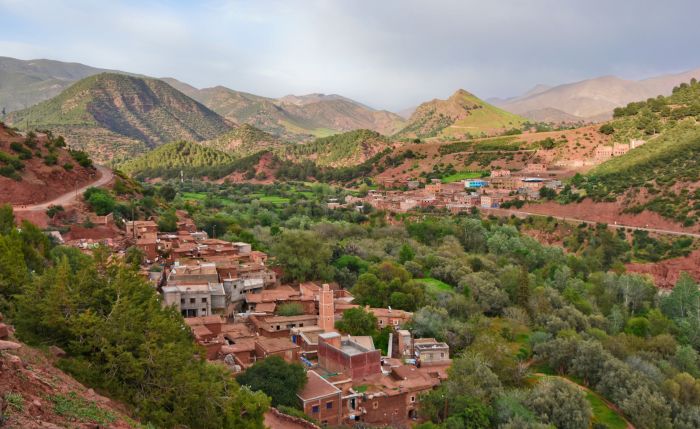
The High Atlas above Imlil — ninety minutes from the medina, and a different guiding category.
Full Day · 10 hours · Vehicle
Ouzoud Waterfalls
Two and a half hours north-east for Morocco’s highest waterfall — a 100-metre drop in tiers, with olive terraces above and rainbows in the spray most mornings. The walk down and back is a solid hour of steps each way, and Barbary macaques live along the path — do not feed them. Strongest flow March to June.
Full Day · 11 hours · Vehicle
Essaouira on the Atlantic
Three hours west and around fifteen degrees cooler — which is why this is the most popular summer day trip. A walled eighteenth-century port with ramparts over the ocean, a working blue-and-white fishing harbour, a relaxed medina, and the best thuya woodwork in Morocco. The drive passes argan groves and the goats in the trees, which are worth a stop and worth knowing are semi-staged. Bring a layer — the wind is constant even in August.
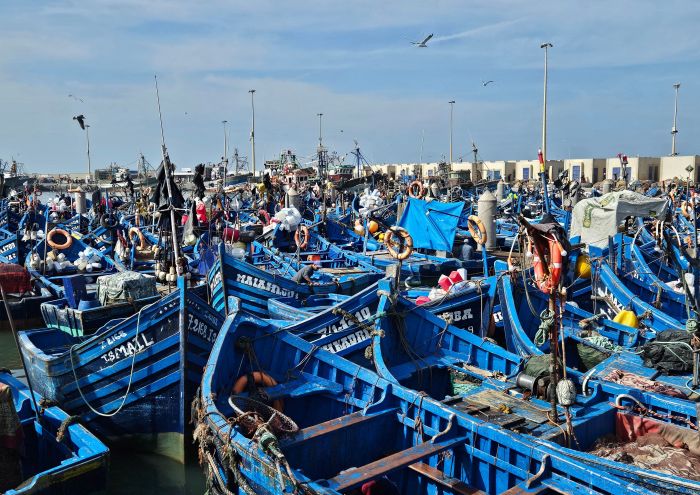
Essaouira — three hours west and around fifteen degrees cooler, which is the whole point in July.
Full Day · 12 hours · Vehicle
Aït Benhaddou & Ouarzazate
The long one, and the most rewarding drive in Morocco. The road climbs the Tizi n’Tichka pass at 2,260 m, then drops into the pre-Sahara. Aït Benhaddou is a UNESCO-listed earthen kasbah village stacked against a hillside, familiar from a long list of films; the climb to the granary takes twenty minutes. Add Ouarzazate‘s Taourirt Kasbah and film studios. Worth it — but not on your first day, and not with small children.
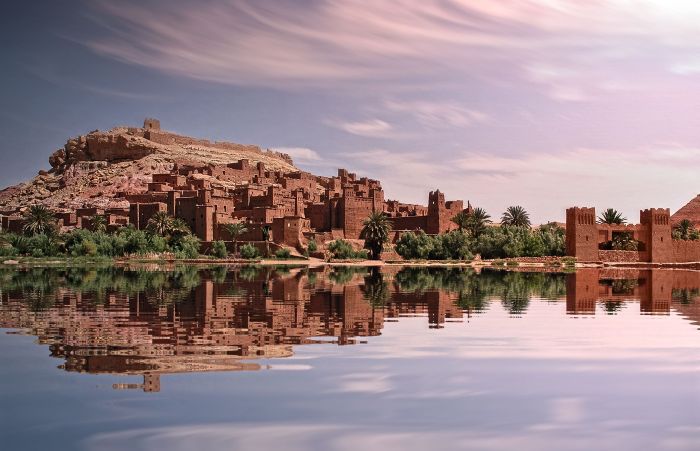
Aït Benhaddou — UNESCO-listed, on the far side of a 2,260-metre pass.
Is the Agafay the Sahara? No — Here Are the Real Distances
The most commonly blurred claim in this market, stated plainly.
The Agafay is not the Sahara. It is a rocky, rolling stone desert about forty minutes from the city — beautiful, especially at sunset — but it has no dunes.
Zagora is the nearest real Saharan edge, roughly seven hours’ drive each way, normally a two-day trip with a night in a camp. The dunes there are modest.
Merzouga and the great dunes of Erg Chebbi — the Sahara people picture — are nine to ten hours away. Three days and two nights is the minimum that makes sense, and it is genuinely worth it.
One evening available: take the Agafay and enjoy it for what it is. Three days available: go to Merzouga. Nothing in between is a good use of your time.
How Much Do Private Tours in Marrakech Cost?
Fees are per group, not per person, for 1–6 travellers, with a licensed guide and — where the route needs one — a private vehicle and driver. Medina routes need no vehicle.
| Private tour | Duration | Fee (per group) |
|---|---|---|
| Medina city tour: palaces, tombs & souks | 4 hours | MAD 400 – 700 |
| Food tour: Jemaa el-Fna after dark | 3 hours | MAD 450 – 800 |
| Modern Marrakech: Majorelle, Gueliz & gardens | 4 hours | MAD 700 – 1,100 |
| Full-day Marrakech city tour | 8 hours | MAD 1,000 – 1,700 |
| Agafay desert sunset & dinner | 5 hours | MAD 1,200 – 2,000 |
| Ourika Valley & Atlas foothills | 8 hours | MAD 1,400 – 2,200 |
| Imlil & the High Atlas villages | 9 hours | MAD 1,600 – 2,400 |
| Ouzoud waterfalls | 10 hours | MAD 1,800 – 2,600 |
| Essaouira on the Atlantic | 11 hours | MAD 1,900 – 2,800 |
| Aït Benhaddou & Ouarzazate | 12 hours | MAD 2,200 – 3,200 |
Guide only, no vehicle: roughly MAD 150–250 per hour, MAD 400–700 a half-day, MAD 700–1,200 a full day, per group. Guiding in a language other than English or French adds 15–30%.
Not included: monument tickets — Bahia around MAD 100, the Saadian Tombs and El Badi around MAD 70 each, Ben Youssef MAD 50–70, with Majorelle and the YSL Museum ticketed separately and costing more — plus meals and gratuities. Marrakech monument prices have risen most years; treat these as a guide, not a quote.
Best Time to Visit: Heat, High Season and the Coast
Marrakech sits at 460 m on a plain below the Atlas, far from the sea, so the day–night swing is large and summer is severe. The sea column is Essaouira, three hours west — the only swimmable water in day-trip range, kept cool year-round by the Canary Current.
High season is March–May and September–November; the best guides commit weeks ahead in both. June–August reaches the mid-thirties and the medina holds the heat — an 08:00 start, covered souks and shaded gardens midday, Essaouira or the Atlas for outdoor days. Ramadan shifts the rhythm rather than closing the city: quiet days, restaurants shut until sunset, extraordinary evenings. Tell your guide and the day gets rebuilt around iftar.
Camels, Quads and the Mountains: What Is Actually Safe?
Camel rides in the Palmeraie and Agafay are short, slow and led on foot by a handler. The awkward moments are mounting and dismounting, because a camel rises back legs first and pitches you forward then sharply back — hold the saddle handle, lean back as it stands and forward as it kneels. Not advisable in pregnancy or with back problems; children normally ride with an adult. Welfare varies: a well-run operation keeps animals in shade with water and works them in rotation. Wash your hands afterwards.
Quad bikes are generally well run — check that helmets are provided, that the operator insures passengers, and that age and licence rules are applied rather than waved through. Not after dark.
Calèches are a regulated trade with official stands and posted tariffs. Use those, look at the horse’s condition before getting in, and avoid midday in summer.
Mountains. Day walks around Imlil and Ourika are straightforward with proper shoes. Above roughly 3,000 m altitude sickness becomes real, and from November to April the Toubkal summit is a winter mountaineering objective needing crampons, an ice axe and a winter-competent guide. A nature-category guide is legally required on the Imlil–Toubkal trail in any season.
What to Know Before Your Tour
Mosques. With very few exceptions, mosques in Morocco are closed to non-Muslims, including the Koutoubia — admired from outside. The great exception is the Hassan II Mosque in Casablanca. In Marrakech the madrasas, palaces and tombs are the equivalent experience, and they are open.
Money. The dirham is a closed currency — you generally cannot buy it before arriving, and should spend or convert it before leaving. Souks, taxis and hammams are cash only; use bank ATMs, not kiosks on the square.
Getting around. Riads inside the walls cannot be reached by car, so your guide meets you at the nearest gate.
Languages. French is near-universal among licensed guides and usually costs no more than English; Spanish, Italian, German, Dutch, Russian and Japanese come in smaller numbers. The card lists the languages a guide is authorised to work in.
Dress, photos, tipping. Shoulders and knees covered is the comfortable default. Ask before photographing people. Tipping is customary rather than obligatory: MAD 100–150 per group for a half-day, MAD 150–300 for a full day, plus something for a driver.
Frequently Asked Questions
How much does a private tour guide in Marrakech cost?
Licensed guides typically charge MAD 150–250 per hour, around MAD 400–700 for a half-day and MAD 700–1,200 for a full day, per group rather than per person. With a vehicle and driver, a day trip beyond the city runs roughly MAD 1,400–3,200 by distance. Tickets, meals and tips are separate; a language other than English or French adds 15–30%.
How do I check that my Marrakech guide is really licensed?
Ask to see the professional card: photograph, guide number, category and authorised languages. Morocco publishes no open public search tool for individual guides, so this in-person check is the practical route — along with confirming the category matches your plan. Any professional will show it without hesitation.
Can my Marrakech city guide take me into the Atlas Mountains?
Not legally, unless they also hold the second category. Moroccan law separates a guide des villes et circuits touristiques from a guide des espaces naturels, and mountains, valleys and national parks fall to the latter, trained through institutions such as the CFAMM at Tabant. A day combining the medina with Imlil or Ourika needs a nature-category guide or a handover between two professionals — normal practice, and a better sign than a guide who claims to cover everything.
Do I need a guide to climb Mount Toubkal?
Yes. Since December 2018 a certified guide has been mandatory on the trail from Imlil to the summit, with police checkpoints outside Aremd, at Sidi Chamharouch and at the Toubkal refuges where credentials are checked and unaccompanied trekkers turned back. Larger groups must take a second guide. From November to April the summit is a winter mountaineering objective requiring crampons, an ice axe and a winter-competent guide.
What are faux guides, and how do I avoid them?
Unofficial guides open with an unsolicited claim — your route is closed, the tanneries are only open today — and end at a shop that pays them commission. It is a business model rather than a danger. Decline clearly and keep walking, never accept unsolicited directions, and if you have a licensed guide, say so. That is the most effective deterrent available.
Is the Agafay the Sahara?
No. The Agafay is a rocky stone desert forty minutes from Marrakech — beautiful at sunset, but it has no dunes. Zagora, the nearest real Saharan edge, is about seven hours each way and normally a two-day trip; the great dunes of Erg Chebbi at Merzouga are nine to ten hours away and need three days. Anyone selling the Agafay as a Sahara experience is describing something else.
Is camel riding safe?
Rides in the Palmeraie and Agafay are short, slow and handler-led. The awkward moments are mounting and dismounting, since a camel rises back legs first and pitches you forward then back — hold the handle, lean back as it stands and forward as it kneels. Not advisable in pregnancy or with back problems. Choose a camp that keeps its animals in shade with water.
Can I go inside the Koutoubia Mosque?
No. With very few exceptions, working mosques in Morocco are closed to non-Muslims, and the Koutoubia is admired from outside and from its gardens. The exception is the Hassan II Mosque in Casablanca, which runs guided visits for all faiths. In Marrakech the Ben Youssef Madrasa, the Saadian Tombs, Bahia and El Badi are open — and that is where the finest craftsmanship actually is.
When is the best time to visit Marrakech?
March to May and September to November are the comfortable, busy windows, with April and October the strongest single months. June to August reaches the mid-thirties by mid-afternoon — tours run, but with early starts, shaded gardens and a day at Essaouira or in the Atlas, and prices are the lowest of the year. December to February is mild by day, cold at night, and gives the best Atlas snow views.
Ready to Explore Marrakech?
Browse the guide profiles above, check availability, and start a direct conversation — no agency fees, no middlemen.
Request a Free Quote
Share your tour details using the form below and receive a personalized quote from our Marrakech guides.
Image note: photographs on this page show the locations described and are not images of specific tours or of the guides listed above. Where a photograph is not available, an illustration is used and labelled.
Note: OfficialGuides is a marketplace that connects travellers with licensed tour guides; it is not a travel agency and does not sell or promote tours. Prices and seasonal information shown are indicative, not offers, and should be confirmed before booking. Read the disclaimer and privacy policy