Last Updated on 09/09/2026
What each ticket actually buys you, the two queues nobody separates, the entrance printed on your ticket, and the Sundays this autumn when the nearest metro station is shut.
Planning an Eiffel Tower visit? The tower runs entirely on timed entry, and almost every problem visitors have here comes from one of three things: buying the wrong level, arriving at the wrong pillar, or assuming a ticket removes a queue that it doesn’t. None of the three costs money to avoid — they cost five minutes of reading before you leave your hotel.
On this page: the two queues, and what a timed ticket really skips, which entrance is yours, summit or 2nd floor, lift or stairs, opening hours and weather closures, how to get there — and the Sunday metro closures, the tower for free, visiting with a licensed guide, and ticket prices.
OfficialGuides is a directory of independent licensed tour guides. We are not the Eiffel Tower ticket office — that is toureiffel.paris, operated by SETE. The two ticket links on this page go to an authorised resale platform and are affiliate links; the price you pay is not affected.
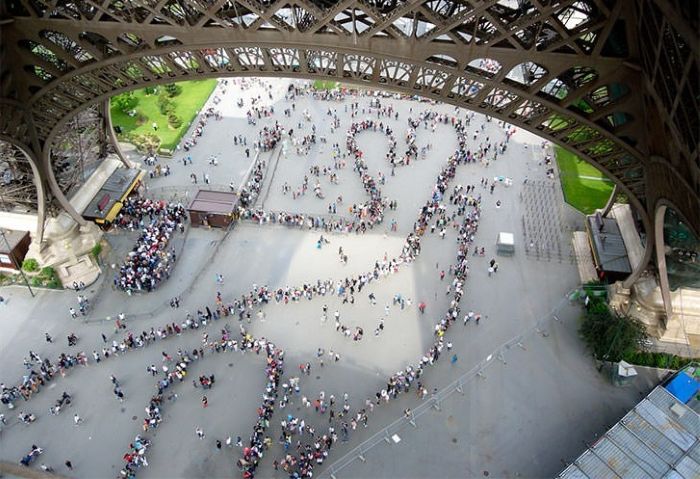 The on-site ticket office queue at the foot of the tower. In high season it regularly runs well over an hour — and it is only one of the two lines you will meet.
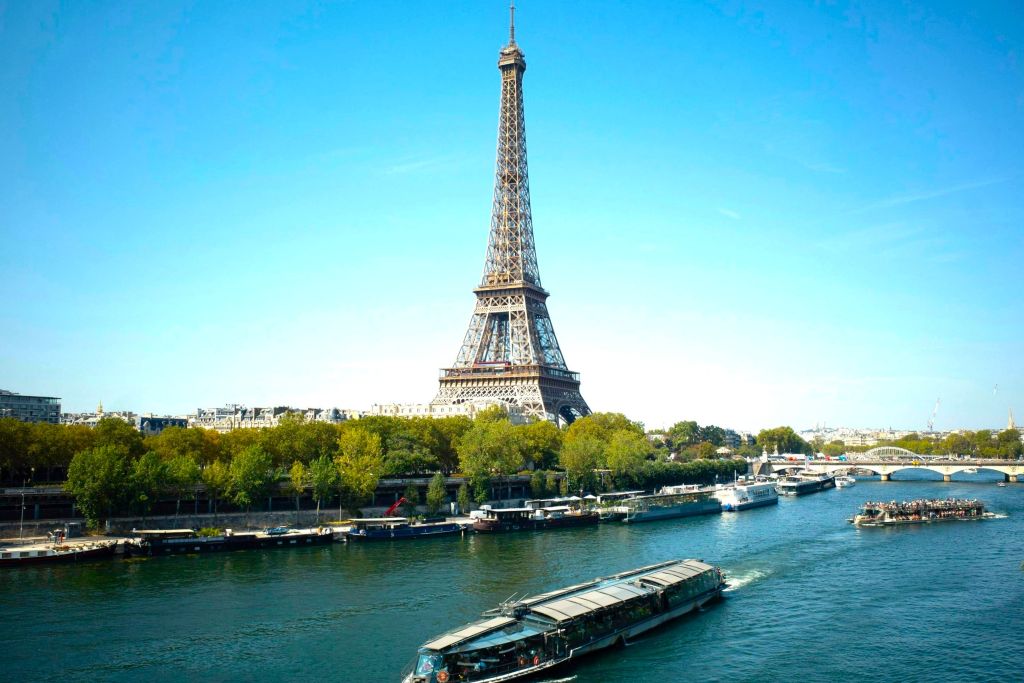
The Eiffel Tower — la tour Eiffel — is a 324-metre iron lattice tower on the Champ-de-Mars, on the Left Bank. Gustave Eiffel built it for the 1889 Exposition Universelle as a temporary structure, and it survived largely because it turned out to be useful as a radio mast. It now takes more than six million visitors a year, which makes it the most-visited paid monument in the world.
There are really only two decisions to make: how high you go — the 2nd floor at 115 m or the summit at 276 m — and how you get up, by lift or on foot. Price, queue and time all follow from those two.
The two queues — and what a timed ticket actually skips
This is the single most misunderstood thing about visiting the tower, and it is why people who paid extra still end up standing in a line.
There are two separate queues at the base:
1. The ticket office queue. This is the long one in the photographs, and it exists only for people buying on the day at the box office. Any ticket bought in advance — official or resale, cheap or expensive — skips it completely. You do not need a premium product to avoid this queue. You need to have bought anything beforehand.
2. The security queue. Every visitor without exception passes through a bag check and metal detector inside the fenced perimeter, airport style. No ticket skips this one. Budget 10 to 20 minutes for it in season, and travel light — large bags and suitcases are refused outright, and there is no left-luggage facility at the tower.
So when a listing says “skip the line”, what it means in practice is queue number one, which your €23.50 official ticket already skips. What a more expensive product genuinely buys is one of three things: a host who takes you through the process, a guaranteed slot on a date the official site has sold out, or a package with something else attached — a cruise, a meal, a guide. Those can be worth paying for. Faster entry, on its own, is not what you are buying.
Which entrance is yours
The tower has four pillars — North, South, East and West — and your ticket assigns you to a specific entrance. Lift tickets normally go through the east side, stair tickets through the south, and the perimeter is fenced, so you cannot simply cut across underneath. Walking the wrong way around the base takes ten to fifteen minutes and eats straight into your time slot.
Read the entrance on your ticket before you set off, and aim to be there about 15 minutes before your window opens. The official access map names Entrance 1, Allée des Refuzniks, on the Bir-Hakeim side, which is the one most metro arrivals reach first — but confirm against your own booking rather than assuming.
Your window has a tolerance of roughly 30 minutes in practice, but staff apply it at their discretion on busy days. Arriving an hour early does not help; you will be turned away and told to come back.
Summit or 2nd floor?
The summit at 276 m is a different experience, not just a higher one: a genuine 360° panorama, Gustave Eiffel’s reconstructed office with its wax figures of Eiffel, his daughter Claire and Thomas Edison, the beacon that sweeps across Paris at night, and a small champagne bar. It is also the level that sells out first and the one that closes in high wind.
The 2nd floor at 115 m is the practical choice, and a surprising number of repeat visitors prefer it. You are close enough to read the city — to pick out the Invalides dome, the Arc de Triomphe, the Seine bends, Montmartre on its hill — where from the summit Paris flattens into a grey-beige map. It is cheaper, less crowded, and the right call with tired legs or small children.
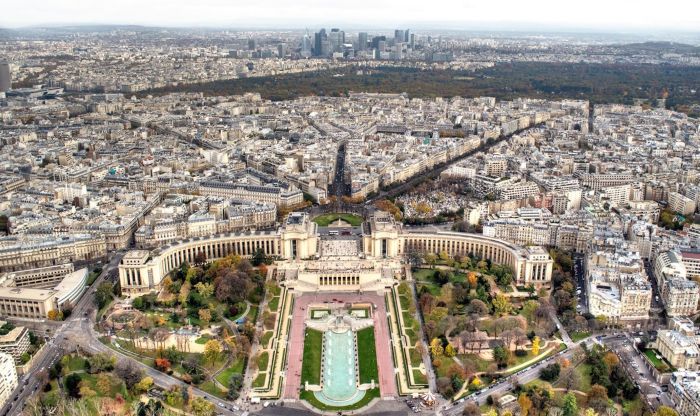 From the summit at 276 metres the panorama is complete — but the city reads as a map. Many visitors find the 115 m platform more legible.
Lift or stairs
The stairs to the 2nd floor are 674 steps up the open ironwork, and at €14.80 the cheapest way into the monument. It is also the only way to see the structure itself properly — the rivets, the curve of the arches, the way the whole thing is a piece of engineering rather than a viewing platform. Most reasonably fit adults manage it in 30 to 45 minutes with stops.
Two caveats. Stair access closes earlier than the lifts, often in the early evening out of season, and it can shut in bad weather. And there is no longer any ticket that lets you climb all the way to the top: the stairs end at the 2nd floor, and the summit is by lift only. The €28.00 combo — stairs up, then the summit lift from the 2nd floor — is the cheapest route to 276 m.
The lift is the all-weather option and the only one for prams and reduced-mobility visitors. Lifts run from the ground to the 2nd floor, where you change cars for the dedicated summit lift.
🛗 Summit by lift
Ground → 2nd floor → change to the summit lift. The classic route to 276 m, easiest on the knees. Sells out first, closes first in wind.
🛗 2nd floor by lift
Straight to the 115 m platform. The best balance of price, view and queue, and the usual family choice.
🪜 Stairs + lift to summit
674 steps to the 2nd floor, then the summit lift. Saves €8.70 against the full lift ticket and gets you close to the ironwork.
🪜 Stairs to 2nd floor
The cheapest ticket in the building. A real climb, and the best view of the structure itself. Check that stair access is open for your slot.
Opening hours and weather closures
The tower opens every day of the year, with no regular closure day. Hours are seasonal:
- Mid-June to early September: roughly 09:00 to 00:45, with the last summit ascent around 23:00.
- Rest of the year: roughly 09:30 to 23:00 by lift, last entry around 22:30. Stairs close considerably earlier, often around 18:00–18:30.
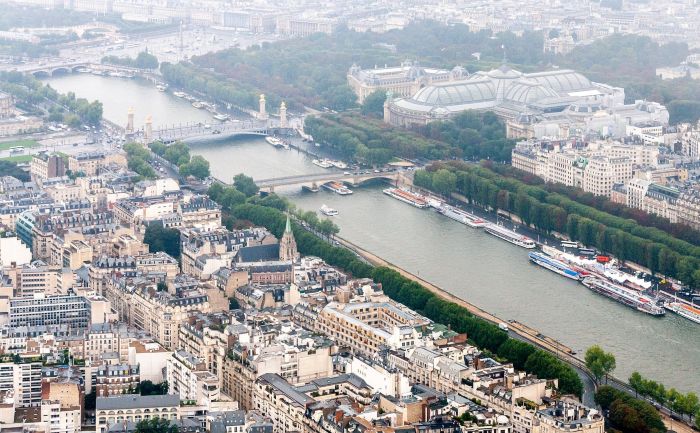 The 2nd floor at 115 metres — close enough to identify the monuments below, which is why many visitors rate the view here above the summit.
The part worth planning around is the summit. It is an exposed platform on a metal tower and it closes at short notice in strong wind, storms and occasionally in freezing conditions — the tower itself sways a little in high wind by design, and the operator stops summit lifts long before that becomes a safety question. It also closes for scheduled lift maintenance, usually in the quiet weeks of January and February. Summit tickets are not refunded when this happens mid-visit; you are simply held at the 2nd floor.
Two practical consequences. If the summit is the reason for your trip, check the live status on the official site or the Eiffel Tower app on the day, and if you have flexibility, book it early in your stay so a wind-blown day is not your only attempt. And never book a summit slot for the evening you fly out.
How to get to the Eiffel Tower
The official address is 5 Avenue Anatole France, 75007 Paris, on the Champ-de-Mars. Public transport is the sensible option; the streets around the tower are congested and parking is scarce.
- 🚇 Metro line 6 to Bir-Hakeim — the closest station, under ten minutes on foot to Entrance 1. The elevated approach along line 6 is also one of the best free views in Paris.
- 🚇 Metro line 9 to Trocadéro — about fifteen minutes’ walk, on the other side of the river. Worth the detour: this is where the postcard view is, and you approach the tower head-on down the Palais de Chaillot steps.
- 🚇 Metro line 8 to École Militaire — fifteen minutes, approaching up the length of the Champ-de-Mars lawn.
- 🚆 RER C to Champ de Mars–Tour Eiffel — a short walk from the southern pillars.
- 🚌 Buses 42, 69, 82 and 87 stop within a few minutes of the base.
⚠️ Sunday metro closures, September to November 2026
This is worth checking before you plan a Sunday visit. Because of modernisation works, metro line 6 is suspended between Charles de Gaulle–Étoile and La Motte-Picquet–Grenelle on seven Sundays this autumn, which closes Bir-Hakeim, the station closest to the tower. The dates are 6 and 20 September, 4, 11 and 18 October, and 8 and 22 November 2026. A replacement bus runs along the closed section and bus 73 is reinforced.
If your visit falls on one of those Sundays, do not plan around Bir-Hakeim. Use Trocadéro (line 9), which is a nicer arrival anyway, École Militaire (line 8), or RER C. Add fifteen minutes to whatever your map application tells you, and remember that your timed slot will not wait for a transport problem.
The tower without a ticket
A ticket buys you the view from the tower. It is worth saying plainly that the view of the tower — the one on everyone’s photographs — is free, and that many visitors get more out of it.
- ✨ The sparkle. After dark the tower’s 20,000 bulbs flash for five minutes at the top of every hour, until 23:00 (later in midsummer). It is free from anywhere with a sightline, and it is the single most reliable good moment of a Paris evening.
- 📸 Trocadéro. The Palais de Chaillot terrace is the classic frontal view. Crowded and heavily worked by hawkers, but the composition is unbeatable — go early morning for it to yourself.
- 🌿 Champ-de-Mars. The lawn behind the tower, where Parisians actually sit. Best in the hour before sunset.
- 🌉 Pont de Bir-Hakeim. The two-level bridge with the metro running above — the diagonal view along the river that photographers use, and quieter than Trocadéro.
- 🏛️ Rue de l’Université, no. 29. The tower framed at the end of a narrow Haussmannian street, five minutes from the base. A local trick rather than a landmark.
If you are travelling on a budget with a family, a €14.80 stair ticket for one adult plus an evening on the Champ-de-Mars for everyone is a defensible plan. Nobody is obliged to spend €150 to enjoy this monument.
Eating at the tower
There are three options inside, and they are genuinely different things. Madame Brasserie on the 1st floor is a sit-down restaurant with lift access included in the booking, so the visit becomes lunch or dinner rather than a queue — and because the table comes with its own lift access, the ticket queue stops being your problem. Le Jules Verne on the 2nd floor is the Michelin-starred one, booked weeks ahead, priced accordingly. And there are ordinary buffets and bars on the 1st and 2nd floors and a champagne bar at the summit for people who just want a sandwich or a drink with the view.
Restaurant tables are booked directly through the restaurants’ own sites, not through ticket platforms, and a restaurant booking is not a ticket to the upper levels — it gets you to its own floor.
Visiting with an English-speaking licensed guide
The tower does not need much interpretation to enjoy, but a guide changes what you do with the rest of the day: the Champ-de-Mars, the 1889 Exposition ground, the Trocadéro, the Seine and the 7th arrondissement around them make a coherent half-day walk that most visitors reduce to one photograph.
A private licensed guide in Paris usually costs around €80–100 per hour for the whole group, not per person, with monument tickets paid separately. OfficialGuides connects you directly with independent licensed guides — no agency in between and no commission on the guide’s fee.
PRIVATE TOUR GUIDE REQUEST
Share your dates, group size, preferred language and a mobile number with country code. Available guides reply with their own availability and price.
Eiffel Tower ticket prices
These are the official rates set by SETE, the operator, and they apply both online and at the box office. Booking on the official site costs the same as queuing for it — there is no online surcharge, which is why the official site should always be your first stop.
| Official ticket (adult 25+) | Price |
|---|---|
| Stairs to the 2nd floor 674 steps. The cheapest way into the monument. | €14.80 |
| 2nd floor by lift The most popular ticket, and the one that stays available longest. | €23.50 |
| Stairs to 2nd floor + lift to summit The cheapest route to 276 m. | €28.00 |
| Summit by lift The full ascent, all by lift. Sells out first. | €36.70 |
Young people aged 12–24 pay roughly half the adult rate and children 4–11 roughly a quarter, across the range €3.80–€18.40. Under-4s go free but still need a zero-euro ticket, because lift capacity is counted by head. Visitors with a disability and one companion qualify for reduced entry — bring proof. Figures are the current published rates; confirm the exact amount at checkout.
When the official site is sold out
Official lift tickets are released about 60 days ahead and stair tickets about 40 days ahead, and summit slots around sunset go first. If your dates come back empty, resale platforms hold separate allocations, usually bundled with a host who meets you and takes you through entry. You pay more than the official fee for that service, not for faster access.
| Option | From |
|---|---|
| Official website, timed ticket Always the cheapest option when your dates are available. Start here. | €14.80 Official site → |
| Hosted 2nd-floor entry (resale) A host meets you, handles entry and takes you up to 115 m. Useful when official dates are gone. | €39 Check availability → |
| Summit access by lift (resale) Reserved entry through to 276 m on dates the official site has sold out. | €99 |
Resale prices move with date and demand and are shown live at checkout. No ticket at any price skips the security screening.
Which ticket fits your trip
First visit, whole evening free → Summit by lift, booked as far ahead as possible, ideally not at sunset.
Family with children → 2nd floor by lift, mid-morning.
Fit, curious about the structure → Stairs to the 2nd floor, then decide on the summit lift there.
Tight budget → Stairs at €14.80, or the sparkle from the Champ-de-Mars for nothing.
Official site sold out for your dates → A hosted resale slot, understanding what you are paying for.
Sunday in September, October or November → Check the line 6 closure dates first.
Practical tips
- 🎒 Travel light. Suitcases and large bags are refused and there is no storage on site.
- 📱 Keep the ticket on your phone. It is a timed QR code, scanned at more than one checkpoint.
- 🪪 Bring ID for reduced rates. Youth, under-26 EU and disability rates are all checked at the barrier.
- 🚫 You cannot upgrade inside. A 2nd-floor ticket stays a 2nd-floor ticket; choose the summit at purchase if there is any doubt.
- 🧥 Dress for the top. The summit is open-air and consistently colder and windier than the ground, even in July.
- 🕒 Allow two to three hours for the visit itself — longer if you want to eat or stay for the sparkle.
Building the rest of the day
The tower is a half-day at most, and it sits awkwardly far from the Right Bank museums. If you are planning a full Paris itinerary, the Louvre runs on the same timed-entry logic and is worth its own separate morning rather than being squeezed in after the tower — our Louvre ticket prices and access guide covers the 2026 two-tier pricing and which entrance to use.
Frequently asked questions
How much are Eiffel Tower tickets?
Official adult rates run from €14.80 for the stairs to the 2nd floor, through €23.50 for the 2nd floor by lift and €28.00 for stairs plus the summit lift, up to €36.70 for the summit entirely by lift. Young people aged 12–24 pay about half and children 4–11 about a quarter; under-4s are free but still need a zero-euro ticket.
What does a skip-the-line Eiffel Tower ticket actually skip?
The ticket office queue — which any advance ticket skips, including the cheapest official one. It does not skip the security screening, which every visitor passes through regardless of what they paid. A more expensive resale ticket buys a host, a guaranteed slot on a sold-out date, or an added extra such as a cruise or a meal, not faster entry.
Can I climb the stairs all the way to the top?
No. The public staircase ends at the 2nd floor after 674 steps, and the summit is reachable only by lift. The €28.00 combo ticket — stairs up, summit lift from the 2nd floor — is the cheapest way to reach 276 metres.
Is the summit worth the extra money?
For a first visit, usually yes, for the 360° panorama, Gustave Eiffel’s restored office and the champagne bar. But it is also the level that closes in high wind and sells out first, and plenty of repeat visitors prefer the 2nd floor, where you are close enough to identify the monuments below.
How far ahead should I book?
Official lift tickets are released around 60 days ahead and stair tickets around 40 days ahead. From April to October, book as soon as your dates open, especially for the summit and for anything near sunset. Out of season, one to two weeks is usually enough, though weekends and holidays still fill quickly.
Which metro station is closest to the Eiffel Tower?
Bir-Hakeim on line 6, under ten minutes’ walk. Trocadéro on line 9 is about fifteen minutes and gives the best approach for photographs; École Militaire on line 8 is a similar distance across the Champ-de-Mars; RER C stops at Champ de Mars–Tour Eiffel.
Is the metro to the Eiffel Tower affected by works in autumn 2026?
Yes, on Sundays. Line 6 is suspended between Charles de Gaulle–Étoile and La Motte-Picquet–Grenelle on 6 and 20 September, 4, 11 and 18 October, and 8 and 22 November 2026, which closes Bir-Hakeim station. A replacement bus runs along the closed section. On those dates use Trocadéro on line 9, École Militaire on line 8, or RER C.
What happens if the summit closes because of the weather?
The summit closes at short notice in strong wind or storms and for scheduled lift maintenance, usually in January and February. Visitors are held at the 2nd floor and summit tickets are not generally refunded once the visit has begun. Check the live status on the official site or app on the day, and book the summit early in your stay rather than on your last evening.
What are the Eiffel Tower’s opening hours?
It opens every day of the year. From mid-June to early September it runs roughly 09:00 to 00:45 with the last summit ascent around 23:00; the rest of the year roughly 09:30 to 23:00 by lift, with last entry around 22:30. Stair access closes considerably earlier, often around 18:00 to 18:30 out of season.
Can I see the Eiffel Tower for free?
Yes. The illuminations sparkle for five minutes at the top of every hour after dark, free to watch from anywhere with a sightline — Trocadéro for the frontal view, the Champ-de-Mars lawn, or the Pont de Bir-Hakeim for the diagonal view along the river. Only going up the tower costs money.
How long should I allow for the visit?
Two to three hours covers security, the lifts, time on each level and photographs. Add an hour for a meal, and more if you plan to stay for the hourly sparkle after dark.
Booking your visit
Start at the official Eiffel Tower ticket office — the same price online as at the window, and always the cheapest option when your dates are open. If they are sold out, resale platforms hold separate allocations.
This page is also available in: العربية · 简体中文 · Čeština · Nederlands · Français · Deutsch · Ελληνικα · Magyar · Italiano · 日本語 · 한국어 · polski · Português · Română · Русский · Español · Svenska · Türkçe