Last Updated on 30/08/2026
Licensed English Speaking Guides and Private Tours in Siem Reap
How to see Angkor with a government-licensed Cambodian guide — what the licence means, what local guides, tuk-tuks and cars really cost, which private tour circuit to choose, and how to enter Cambodia with an e-visa or visa on arrival.
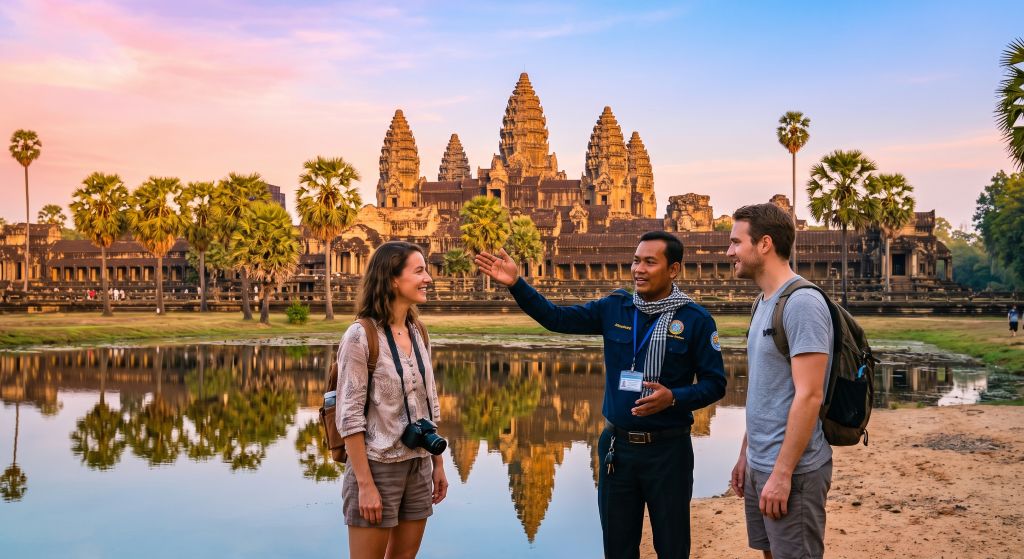
Siem Reap exists for one reason: the Angkor Archaeological Park, 401 square kilometres of forest holding Angkor Wat, the face-towers of the Bayon, the tree-strangled galleries of Ta Prohm and some ninety other temples raised between the ninth and thirteenth centuries. Most visitors see it from the back of a tuk-tuk, and a tuk-tuk driver — however friendly — is not a guide and by law cannot act as one. Cambodia reserves temple guiding for licensed Cambodian guides trained and badged by the Ministry of Tourism, and the difference between reading the bas-reliefs with one of them and walking past them alone is the difference between understanding the Khmer Empire and photographing it. On this page you can contact licensed private tour guides in Siem Reap directly, compare Angkor Wat sunrise tours and temple tours and day trips to Beng Mealea, Koh Ker and the Tonlé Sap, check guide, tuk-tuk and car prices, and sort out your Cambodian visa before you fly.
OfficialGuides.com is a directory of independent, licensed guides, not a tour company. In Siem Reap the temple circuit is full of intermediaries — hotel desks, tuk-tuk stands, booking apps — each taking a margin between you and the person who will actually walk you through Angkor. Here the Ministry-licensed guide writes their own profile, quotes their own price and answers your message in the chat themselves. The platform’s fee is a fixed, visible fifteen percent; nothing is added on top.
Licensed English Speaking Tour Guides in Siem Reap 👇
Ratha C.
Check each profile for the private tours offered, languages spoken and licence number. Many work as guide and driver in one, with hotel pickup included. You can send a message or voice note directly through the chat button on each profile.
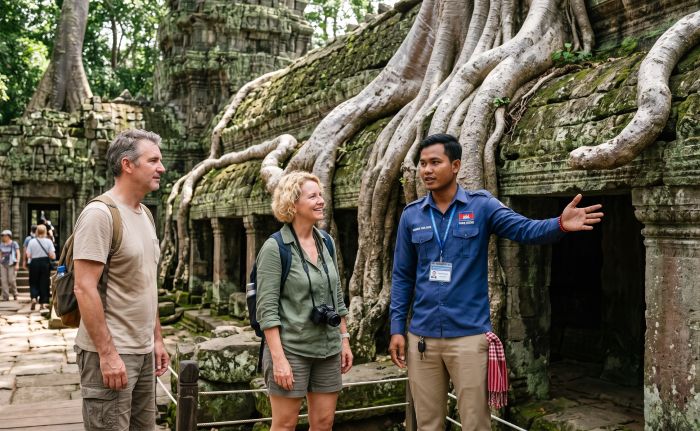
A licensed guide with two visitors at Ta Prohm, where silk-cotton and strangler fig roots have been left in place since the French cleared the site (AI generated)
Why Hire a Licensed Guide at Angkor?
Because the temples do not explain themselves, and a professional guide is the only label they have. Angkor Wat carries almost two kilometres of bas-relief — the Churning of the Sea of Milk, the armies of Suryavarman II, the thirty-two hells — and there is not a single label on any of it. The Bayon’s two hundred faces, the Terrace of the Leper King, why Ta Prohm was left to the jungle while Angkor Wat was restored: all of it is legible only if someone tells you what you are looking at. A good guide turns a hot morning of sandstone into a coherent story about a civilisation that fed a million people from an engineered landscape of reservoirs and canals.
The second reason is logistics. The park is large, the upper level of Angkor Wat has a strict dress code and closes on Buddhist holy days, and the crowd at any site swings between empty and overrun by the hour. Guides here know how to run the circuit against the flow of the big buses and when to abandon Phnom Bakheng for a quieter sunset. That knowledge is not in any app.
The third reason most visitors discover only on arrival: a tuk-tuk driver is transport, not interpretation. They wait at the car park while you walk in alone. A certified local guide alongside the driver — or a guide and driver in one, running the day as a private guided tour — is what changes the visit.
Are Tour Guides in Cambodia Licensed?
Yes, and the rule has legal force. Cambodia’s Law on Tourism makes guiding a licensed profession — an official guide, in the strict sense of the word: a tour guide must be a Cambodian national, complete the Ministry of Tourism’s training and examination, and carry a Ministry-issued licence and identification card while working. Guides are licensed either nationally or for a specific region, and Siem Reap — because of Angkor — has the largest and most tightly regulated guide corps in the country. Working guides in the park wear the standard uniform and a visible badge that identifies them as authorized guides, and the Ministry has repeatedly reminded them that fines, suspension or loss of the licence follow any breach of the professional code.
Two consequences matter for visitors. First, foreign nationals cannot legally guide at Angkor: a tour leader from abroad may accompany a group, but interpretation inside the park is reserved for a licensed Cambodian guide. Second, foreign-language guiding is a separate qualification — an English-, French-, Japanese- or Chinese-speaking guide has been examined in that language, which is why guides in the rarer languages cost more and book out first.
Every certified guide listed on this page shows their licence number on their profile. You may also simply ask to see the card on the day — it is a routine request and no professional will hesitate.
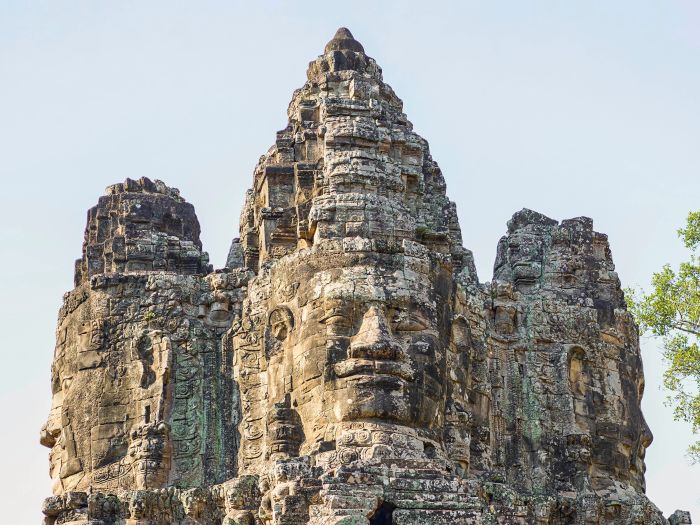
The face-towers of the Bayon at the centre of Angkor Thom, built under Jayavarman VII at the end of the twelfth century
How Much Does a Private Tour Guide at Angkor Wat Cost?
The Angkor Wat tour guide price is simpler than most visitors expect: a licensed local guide in Siem Reap speaking English typically charges US$35 to US$50 for a full day in the main Angkor park, quoted per group rather than per person. Transport is priced separately — a tuk-tuk or a car with driver — and the temple pass is on top of both. Cambodia uses the US dollar for almost all tourist transactions, so the figures below are exactly what you will be quoted; small change comes back in riel.
| Guide service | Typical range (per group) |
| Half day, 4 hours — Angkor Wat or Angkor Thom only | $25 – $35 |
| Full day, 8 hours — Small or Grand Circuit | $35 – $50 |
| Sunrise start, 4:30 am pick-up, full day | $45 – $60 |
| Long day to outlying temples (Beng Mealea, Koh Ker, Kulen) | $50 – $70 |
| Guide in French, Japanese, Chinese, Korean, German or Spanish — full day | $45 – $70 |
Add transport: a tuk-tuk for the main park runs about $20–$30 a day, an air-conditioned car with driver $40–$60, and a car for the long run to Beng Mealea and Koh Ker $90–$120. Many guides quote one all-in figure with the vehicle, which is simpler and usually no dearer. The Angkor Pass is a fixed government price — $37 for one day, $62 for three, $72 for seven — and is never included in a guide’s fee. Rates peak from November to February and drop in the green season.
These are indicative market ranges drawn from what independent professional guides in Siem Reap publish; each guide sets their own price and will confirm it in the chat before you commit.
Which Languages Do Siem Reap Guides Speak?
English is the working language of the park and the easiest to book; French follows, a legacy of the colonial school and of France’s long role in Angkor conservation. Chinese, Japanese and Korean guides serve the largest Asian markets; Spanish, German, Italian and Russian guides exist in smaller numbers, and Thai and Vietnamese speakers cover the neighbouring countries. Each language is a separately examined qualification, so a guide advertising three languages has passed three tests.
For any language other than English, contact the guide early — a fortnight ahead in high season for French, longer for Spanish, German or Italian, where the pool is small. The languages on each profile are what a guide is certified to work in, not what they can manage over lunch.
What Private Tours Can You Book in Siem Reap?
A private tour in Siem Reap is built around the temple circuits — a one-day Angkor Wat sunrise tour, a two-day temple tour with the Grand Circuit, or a three-day programme reaching the outlying sites. Every guide on this page will tailor one to your pace and interests; the four types below cover most requests.
Small Circuit & Sunrise
The classic first-day temple tour: Angkor Wat at dawn from the western reflecting pool, then Angkor Thom’s south gate, the Bayon, the Terrace of the Elephants and Ta Prohm. About 17 kilometres, and everything a first-time visitor came for.
Grand Circuit & Banteay Srei
Preah Khan, Neak Pean’s island shrine, Ta Som, East Mebon and Pre Rup for sunset, plus the pink sandstone carvings of Banteay Srei forty minutes north. Quieter, more varied, and the better second day.
Tonlé Sap & Floating Villages
The stilt village of Kompong Phluk or the floating village of Kompong Khleang by boat, the flooded forest in the wet season, and a lake that swells to five times its size each year. Best combined with a temple morning.
Food, Markets & Recent History
Psar Leu market before breakfast, a Khmer cooking morning, the Angkor National Museum, the War Museum and the landmine centres — the Siem Reap that exists beyond the park, and the part most tours skip.
Sample Private Itineraries
Angkor Wat Sunrise Tour and the Small Circuit
Hotel pickup before five to reach the Angkor Wat moat as the sky lightens, then inside the temple before the buses arrive: the third-level Bakan, the bas-relief galleries, the Churning of the Sea of Milk. Breakfast nearby, then Angkor Thom through the south gate, the Bayon, the Baphuon terrace and the Terrace of the Elephants. Afternoon at Ta Prohm once the midday heat and crowds have eased, finishing at Banteay Kdei and the Srah Srang reservoir. Back in town by mid-afternoon.
Banteay Srei and the Grand Circuit
North first, to Banteay Srei, the tenth-century “citadel of women” whose deep, pink-sandstone carving is the finest in Angkor and is best seen in morning light. Back via the Landmine Museum if you want it, then the outer ring: Preah Khan, the water shrine of Neak Pean, Ta Som and East Mebon. End on the upper terrace of Pre Rup for sunset over the rice fields.
Beng Mealea and Koh Ker
Two hours north-east to Koh Ker, briefly the tenth-century capital, with its seven-tier pyramid of Prasat Thom rising out of the forest and a scatter of sanctuaries almost nobody visits. Lunch in a village, then Beng Mealea, an Angkor Wat–sized temple left unrestored under the trees — wooden walkways, collapsed galleries and roots everywhere. A separate ticket is needed for Koh Ker; Beng Mealea is covered by the Angkor Pass.
Tonlé Sap and Kompong Phluk
Drive south through rice country to the lake, then by boat into Kompong Phluk, a village on ten-metre stilts that stands high and dry in April and sits at water level in October. A small paddle-boat through the flooded forest, the open lake beyond, and a sunset return if you start after lunch. Boat tickets are charged per person and are not included in the guide’s fee.
Private tour prices in Siem Reap
Guides here usually quote one price per group for a full-day tour, bundling their fee with vehicle, driver and fuel. The ranges below cover that combined figure for one to three travellers; temple passes, boat tickets and meals are extra.
| Private tour, guide + transport | Typical range (per group) |
| Small Circuit full day, guide + tuk-tuk | $60 – $80 |
| Sunrise + Small Circuit, guide + car | $80 – $110 |
| Grand Circuit + Banteay Srei, guide + car | $100 – $130 |
| Tonlé Sap floating village half day, guide + car | $70 – $110 |
| Beng Mealea + Koh Ker long day, guide + car | $150 – $200 |
| Phnom Kulen waterfall + Kbal Spean, guide + car | $120 – $160 |
For four to six people add roughly $20–$40 for a minivan; a two-day or three-day tour booked with one guide is normally discounted against the single-day rate. Koh Ker ($15) and Phnom Kulen ($20) carry their own tickets outside the Angkor Pass.
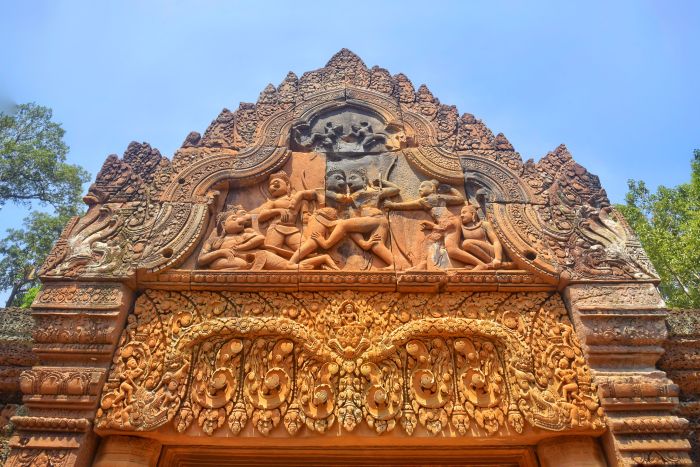
Banteay Srei, whose tenth-century carving is the reason most guides insist on the Grand Circuit day
Day Trips from Siem Reap
All of these run as private day tours with a local guide and car — most guides will build a custom tour combining two of them; none is worth attempting by tuk-tuk.
Beng Mealea and Koh Ker (long day): the most rewarding excursion for anyone with a third day — two hours out on good road, easily combined by car.
Phnom Kulen (full day): the sacred mountain where the Khmer Empire was proclaimed: the reclining Buddha, the riverbed carvings of the thousand lingas and the waterfall where Cambodian families picnic. Kbal Spean’s carved river can be added with an hour’s forest walk.
Tonlé Sap lake (half day): Kompong Phluk, Kompong Khleang or the Prek Toal bird sanctuary in the dry season. Your guide will steer you away from the heavily commercialised Chong Khneas.
Roluos Group (half day): Bakong, Preah Ko and Lolei, the ninth-century beginnings of Angkor, fifteen kilometres east and almost empty — an easy first afternoon after a morning flight.
Battambang (long day or overnight): two and a half hours by road for the bamboo train, colonial streets and the bat cave at Phnom Sampeau.
Tuk-Tuk, Car or Driver-Guide?
For the main park in the cool season a tuk-tuk is the right choice: open to the air, slow enough to see the forest, and cheap. From March to May, when it reaches forty degrees by late morning, an air-conditioned car is not a luxury, and for anything beyond Banteay Srei it is the only sensible option. Most guides arrange either and will say honestly which the day needs.
Some local guides hold both a licence and a vehicle and quote as a guide and driver in one — for couples and small families often the best value: one person, one price, one conversation. Ask whether the guide drives themselves or works with a regular driver; both are normal, and the answer affects the quote.
Best Time to Visit Siem Reap
November to February is the dry, cooler season and the peak: clear skies, mornings around twenty degrees, and the biggest crowds and highest prices of the year. Book guides in the rarer languages well ahead. March to May is the hot season; the light is flat and the heat by noon is punishing, but Kompong Phluk stands dramatically on its stilts and the park empties after lunch.
June to October is the green season. Rain usually comes as an afternoon storm rather than an all-day soak, the moats and reservoirs fill, the Tonlé Sap is at its most spectacular, and the temples are quieter than at any other time. September and early October are the wettest months. Around the spring and autumn equinoxes the sun rises directly over the central tower of Angkor Wat, and guides book out for those mornings a long way in advance.
Water Festival in November and Khmer New Year in mid-April bring large domestic crowds into the park; if either falls in your dates, plan the temple days around them.
Do You Need a Visa for Cambodia?
Most visitors do, and it is easy. Citizens of the ASEAN countries enter visa-free for short stays, and a temporary pilot scheme has extended visa-free entry to Chinese, Hong Kong and Macao passport holders for part of the year. Everyone else — including travellers from Europe, North America, Australia and the Gulf — needs a tourist visa, available two ways: an e-visa applied for online at the government portal evisa.gov.kh, currently US$30 with about three working days’ processing, or a visa on arrival at Siem Reap–Angkor International Airport for the same US$30, paid in clean US dollar notes with a passport photo. Both give thirty days and can be extended once.
Separately from the visa, Cambodia now requires every arriving passenger to complete the free digital e-Arrival Card in the seven days before travel; it replaced the paper arrival, health and customs forms and is checked at the airport.
One warning that applies specifically to Siem Reap: the traditional overland route from Bangkok through the Poipet border has been closed or heavily restricted for long periods since the Cambodia–Thailand border dispute began. Do not plan a land crossing from Thailand without checking its current status; flying is the reliable option.
Getting to Siem Reap and Around
Flights arrive at Siem Reap–Angkor International Airport, about forty kilometres east of town and roughly an hour by road; your guide can meet you there. Direct flights connect Siem Reap with Bangkok, Singapore, Kuala Lumpur, Ho Chi Minh City, Hanoi and several Chinese cities; Phnom Penh is five to six hours by road.
Inside the park, distances are too long to walk — Angkor Wat is six kilometres from town and the Grand Circuit runs twenty-six — and the pass is scanned at every temple, so keep it to hand. Siem Reap itself is safe, including at night around Pub Street and the Old Market; petty theft from tuk-tuks and monkeys at the temples are the two real risks. Cash is king: US dollars for anything over a dollar, riel for change, cards at hotels, the ticket office and better restaurants but rarely elsewhere.
How Booking a Guide Works Here
Open a profile, press the chat button and write to the guide with your dates, group size and what you want to see. The guide replies personally with a tailor-made tour plan and a price; adjust either as you like. When you are happy, the guide sends a booking proposal through the chat and you confirm it. You pay the guide directly on the day in US dollars, unless the guide has chosen to ask for a deposit under their own cancellation terms. OfficialGuides charges the guide a fifteen percent platform fee on confirmed bookings and charges you nothing.
Frequently Asked Questions
Are tour guides in Siem Reap licensed?
Yes. Under Cambodia’s Law on Tourism, guiding is a licensed profession restricted to Cambodian nationals who have completed the Ministry of Tourism’s training and examination. Guides at Angkor carry a Ministry licence and ID card, wear a uniform and badge, and are examined separately for each foreign language they work in. Foreigners may not guide inside the park.
How much does a private tour guide at Angkor Wat cost?
A licensed English-speaking guide charges about US$35–$50 for a full day in the main park and $25–$35 for a half day, per group. Transport is extra — roughly $20–$30 for a tuk-tuk or $40–$60 for a car with driver — as is the Angkor Pass. A typical all-in private day with guide and car is $80–$130 for up to three people.
How much is the Angkor Pass and where do I buy it?
US$37 for one day, $62 for three days and $72 for seven days, fixed by Angkor Enterprise. Multi-day passes do not need to be used on consecutive days and carry your photo, so they cannot be shared. Buy online from the official Angkor Enterprise site, at the ticket office on the road to the park, or let your guide collect it the afternoon before. Children under twelve enter free with a passport.
Do I need a visa to visit Siem Reap?
Unless you hold an ASEAN passport, yes. Apply for a US$30 tourist e-visa at evisa.gov.kh a week or more before you fly, or get a visa on arrival for the same fee at Siem Reap–Angkor airport with a passport photo and US dollars in cash. Everyone must also complete the free e-Arrival Card online within seven days of travel.
Is one day enough for Angkor?
A one-day guided tour covers the Small Circuit — Angkor Wat, the Bayon and Ta Prohm — at a steady pace and is what most day-trippers do. Two days is much better, adding the Grand Circuit and Banteay Srei, and the three-day pass costs only $25 more than the one-day. If you want Beng Mealea, Koh Ker or the Tonlé Sap, plan three or four days in Siem Reap.
Can a tuk-tuk driver act as my guide?
No. Tuk-tuk drivers provide transport and wait outside each temple; guiding inside the park is legally reserved for licensed Cambodian guides. Many drivers are knowledgeable and friendly, but if you want the bas-reliefs, the history and the route planning explained, you need a certified local guide with the driver, or a guide who arranges the vehicle as part of the day.
What is the best time of year to visit Siem Reap?
November to February for dry, cooler weather and clear skies, at the cost of the largest crowds and highest prices. June to October, the green season, brings afternoon showers but full moats, a spectacular Tonlé Sap and far fewer visitors. March to May is very hot; start early and use a car.
Can I still travel overland from Bangkok to Siem Reap?
Not reliably. The Poipet–Aranyaprathet crossing that the Bangkok–Siem Reap bus and train route depends on has been closed or restricted for long stretches because of the Cambodia–Thailand border dispute. Check the crossing’s current status before planning a land journey; the direct flight from Bangkok takes about an hour and is the safe choice.
What should I wear to the temples?
Shoulders and knees covered — a rule enforced at the upper level of Angkor Wat, where you will be turned away otherwise, and applied at other temples too. Light, loose fabrics, a hat, closed shoes with grip for the steep stairways, and a scarf that can cover shoulders in a hurry. The Bakan of Angkor Wat is closed to children under twelve.
Are private Angkor tours suitable for families with children?
Yes, with a professional guide who plans for them. Ta Prohm’s roots, the elephant reliefs and the monkeys along the road hold children’s attention; the bas-relief galleries do not. A guide will shorten the walking, time the day around the midday heat and add the Tonlé Sap boat or the Kulen waterfall, which children generally prefer to a fourth temple. Say the ages when you first message.
Ready to Explore Angkor with a Licensed Guide?
Browse the local guide profiles above, check availability for your sunrise tour or multi-day temple tour, and start a direct conversation — no agency fees, no middleman.
Request a Free Quote
Share your travel details using the form below and receive a personalized quote from our English speaking guides in Siem Reap.
Note: OfficialGuides is a marketplace that connects travelers with licensed tour guides; it is not a travel agency and does not sell or promote tours. Prices shown are indicative market ranges and are set independently by each guide. Read the disclaimer and privacy policy
This page is also available in: Deutsch