Last Updated on 30/08/2026
Official English Speaking Guides and Private Tours in Agra
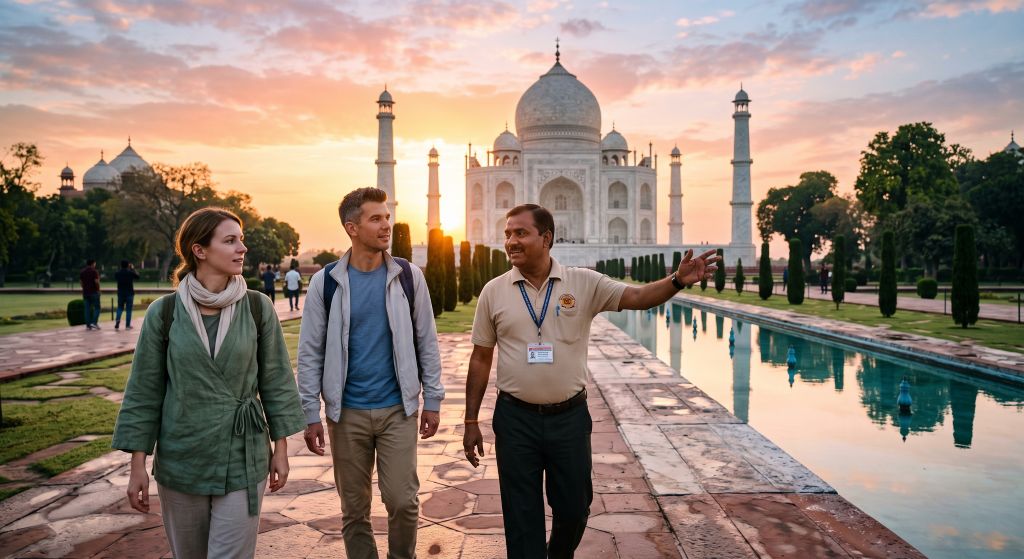
How to see the Taj Mahal with a government-approved Indian guide — what the official / licenc means and why it matters at the gate, what guides, cars and monument tickets really cost, whether to come from Delhi for the day or stay, and how to get your Indian e-visa.
Agra is the only city on earth with three UNESCO World Heritage sites inside forty kilometres — the Taj Mahal, Agra Fort and the abandoned Mughal capital of Fatehpur Sikri — and most of the people who visit see all of them through a car window in a single twelve-hour day trip from Delhi. That is a pity, because the Taj at dawn, the fort where Shah Jahan was imprisoned within sight of his wife’s tomb, and the empty courtyards of Sikri each reward hours a rushed day cannot give them. The other thing every visitor learns at the East Gate is that the men offering a “free guide” or an “official guide” are neither: guiding inside an Archaeological Survey of India monument is reserved for official, government-approved guides carrying a Ministry of Tourism identity card. On this page you can contact licensed private tour guides in Agra directly, compare Taj Mahal sunrise tours and full-day Agra tours, plan day trips to Fatehpur Sikri, Mathura and Bharatpur, check guide, car and ticket prices, and sort out your Indian e-visa before you fly.
OfficialGuides.com is a directory of independent, licensed guides, not a tour company — and in Agra that matters more than almost anywhere. The city’s tourism runs on commission: the driver who steers you to a marble workshop, the hotel desk that adds its cut to a guide’s fee, the “guide” at the gate who cannot legally enter the marble platform with you. Here the government-approved guide writes their own profile, shows their own licence number, quotes their own price and answers your message in the chat personally.
Licensed English Speaking Tour Guides in Agra 👇

Shafiq A.
Check each profile for the private tours offered, languages spoken and licence number. Most guides will meet you at your hotel, at Agra Cantt railway station or at the Taj gate, and many arrange a car with driver for the day. You can send a message or voice note directly through the chat button on each profile.
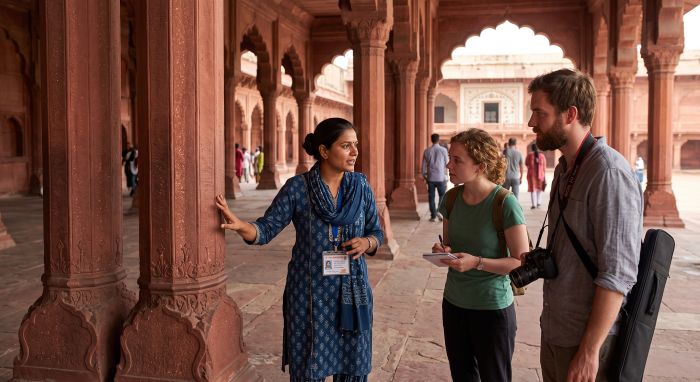
A government-approved, official guide with two visitors in the Diwan-i-Am of Agra Fort, where Shah Jahan received petitioners before his son confined him to the palace above (AI generated)
Why Hire a Licensed Guide in Agra?
Because the Taj Mahal is the most photographed building in the world and one of the least understood. Almost nobody who walks through the Great Gate knows that the four minarets lean outward by design so an earthquake would throw them away from the dome, that the calligraphy on the arches grows larger as it rises so it reads evenly from the ground, or that the Taj appearing to shrink as you approach is a deliberate trick of the gate’s proportions. There is no signage inside that explains any of it. A professional guide turns forty minutes of queueing and selfies into the story of Shah Jahan, Mumtaz Mahal and the empire that could afford twenty-two years of marble.
The second reason is the gate itself: a three-hour limit inside, a strict list of what may not be brought in, separate queues for foreigners and Indians, and a supplement counter for the mausoleum most visitors discover only when they reach it. A guide who works the East Gate every morning has you on the platform while the day-trip buses are still finding the ticket window.
The third reason you feel on the pavement outside: Agra’s touts are persistent, inventive and sometimes wearing something that looks like a badge. An official guide at your side ends that conversation before it starts, and keeps the day clear of the marble-inlay “cooperative” where a driver’s commission is built into every price.
Are Tour Guides in Agra Licensed?
Yes, and inside the monuments the rule has legal force. Under the Ancient Monuments and Archaeological Sites and Remains Rules, showing a visitor round a protected monument requires authorisation from the Archaeological Survey of India or the Ministry of Tourism. The Ministry issues that authorisation through its Regional Level Tourist Guide licence — a graduate-entry scheme with an entrance examination, a training course and a Ministry identity card — and, more recently, through the Incredible India Tourist Guide certification that sits alongside it. Uttar Pradesh Tourism licenses a second tier of state-level guides for Agra, whose cards carry a UPT number. In every case the guide is an Indian citizen who has passed an examination on the monuments they work in.
Three things follow. First, the “tourist facilitators” created under the newer certification are explicitly not permitted to guide inside ASI monuments — only the full guide category can, so the distinction is worth asking about. Second, foreign-language guiding is a separate “linguistic” qualification, examined language by language, which makes a French- or Japanese-speaking guide scarcer and dearer than an English-speaking one. Third, the men at the gates offering free or cheap guiding hold none of these cards and cannot enter the marble platform with you — they are the reason there is a tourist police post at the entrance.
Every guide listed on this page shows their licence number on their profile; the Ministry cards carry a photograph and, for the newer ones, a scannable code. Ask to see the card on the day — it is a normal request and no professional will mind.
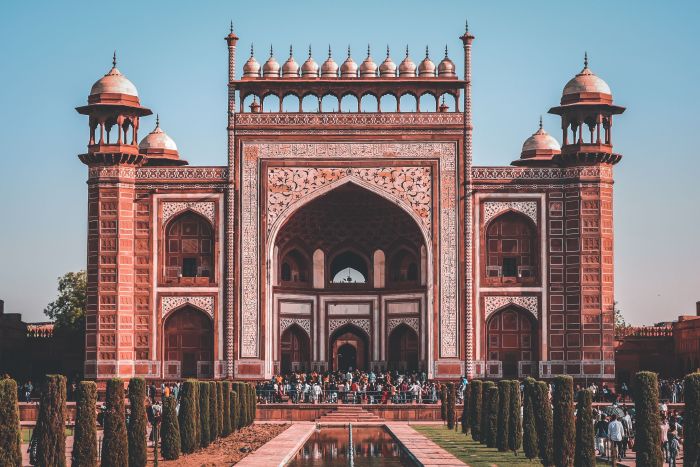
The Buland Darwaza at Fatehpur Sikri, the fifty-four-metre victory gate Akbar raised over his short-lived capital forty kilometres west of Agra
How Much Does a Private Tour Guide in Agra Cost?
The Agra tour guide price is set per group, not per person, and is lower than most visitors expect: a licensed English-speaking guide charges about ₹1,500 to ₹2,500 for the Taj Mahal alone and ₹3,000 to ₹5,000 for a full day covering the Taj, Agra Fort and the Baby Taj. At roughly eighty-five rupees to the dollar that is $18–$30 for the Taj and $35–$60 for the day, for up to five or six people. Transport and tickets are separate and are usually the larger part of the bill.
| Guide service | Typical range (per group) |
| Taj Mahal only, 2–3 hours (sunrise or daytime) | ₹1,500 – ₹2,500 |
| Taj Mahal + Agra Fort, half day, 4–5 hours | ₹2,000 – ₹3,500 |
| Full day in Agra — Taj, Fort, Baby Taj, Mehtab Bagh, 8 hours | ₹3,000 – ₹5,000 |
| Full day including Fatehpur Sikri, 9–10 hours | ₹4,000 – ₹6,000 |
| Guide in French, Spanish, German, Italian, Japanese or Chinese — full day | ₹4,500 – ₹7,000 |
Add a car with driver — ₹2,500 to ₹4,000 for a day inside Agra in an air-conditioned sedan, ₹6,000 to ₹9,000 for a same-day return from Delhi — and the monument tickets, which are fixed by the ASI and never included in a guide’s fee: ₹1,300 for a foreigner’s Taj Mahal ticket plus ₹200 for the mausoleum chamber, about ₹650 for Agra Fort, ₹610 for Fatehpur Sikri, and ₹300 or so each for the Baby Taj and Mehtab Bagh. Indian passport holders pay a fraction of these figures. The ₹500 Agra Development Authority levy inside the Taj ticket covers the other monuments on the same day, so keep the stub. Many guides quote one all-in figure with car and driver, which is simpler and usually no dearer.
These are indicative market ranges drawn from what independent professional guides in Agra publish and from the rates the local guide associations circulate; each guide sets their own price and confirms it in the chat before you commit.
Which Languages Do Agra Guides Speak?
English and Hindi are universal, and English-speaking guides are plentiful — Agra has one of the largest licensed guide corps in India. French comes next, then Spanish, German, Italian and Japanese, each a separate “linguistic” licence with its own examination; Chinese, Korean and Russian speakers exist in small numbers. A guide advertising four languages has passed four tests, and the foreign-language guides book out first in winter.
For a language other than English, contact the guide at least two weeks ahead between October and March, longer around Christmas and New Year. The languages on each profile are the ones a guide is certified to work in.
What Private Tours Can You Book in Agra?
A private tour in Agra is built around the Taj Mahal and how much time you can give the city — a sunrise-and-fort half day off the morning train, a full day with the Baby Taj and Mehtab Bagh for those staying the night, a two-day programme adding Fatehpur Sikri, or a same-day Taj Mahal tour from Delhi for those who cannot stay at all. Every guide on this page will tailor one to your pace, with hotel pickup included; the four types below cover most requests.
Taj Mahal Sunrise & Agra Fort
The classic half day: through the East Gate as it opens, the Taj in the pink light before the crowds, then the fort’s palaces and the view of the tomb from the Musamman Burj. Done by eleven, and the shape of most day trips.
Full-Day Mughal Agra
Taj, fort, then the Baby Taj — the tomb of Itimad-ud-Daulah, whose pietra dura inlay came first — and Akbar’s tomb at Sikandra, ending at Mehtab Bagh across the river for the Taj at sunset. The day Agra deserves.
Agra & Fatehpur Sikri
A long day or a second one: the Taj and fort in the morning, then forty kilometres west to Akbar’s abandoned capital, the Buland Darwaza and the tomb of Salim Chishti, where the emperor prayed for a son. Empty, red and astonishing.
Same-Day Taj Mahal from Delhi
By the Gatimaan Express or by car on the Yamuna Expressway, a guide waiting at Agra Cantt, the Taj and fort, lunch, and back in Delhi by evening. Not the best way to see Agra, but a very good way if it is the only way.
Sample Private Itineraries
Taj Mahal at Sunrise and Agra Fort
Hotel pickup in the dark and a short drive to the East Gate for opening, half an hour before sunrise. Through the Great Gate for the first view, then the guide walks you round the reflecting pool to the platform, into the mausoleum chamber and along the river terrace while the light changes. Breakfast back at the hotel, then Agra Fort: the Diwan-i-Am, the Jahangiri Mahal, the Khas Mahal and the Musamman Burj, where Shah Jahan spent his last years looking across the bend of the Yamuna at the Taj. Finished by late morning; the afternoon is yours or your train’s.
Mughal Agra with Sunset at Mehtab Bagh
Sunrise at the Taj Mahal and the fort as above, then a long lunch through the heat of the day. Mid-afternoon to the tomb of Itimad-ud-Daulah, the “Baby Taj”, where the marble-inlay technique was perfected twenty years before the Taj; then across the river to Mehtab Bagh, the Moonlight Garden, for the Taj Mahal reflected in the Yamuna at sunset. On request the guide adds Akbar’s tomb at Sikandra on the way.
Agra and Fatehpur Sikri
Taj Mahal and Agra Fort in the morning, then the road west to Fatehpur Sikri, the capital Akbar built in the late sixteenth century and abandoned within fifteen years. The Buland Darwaza, the marble tomb of Salim Chishti in the great mosque courtyard, the Panch Mahal and the debating hall where Akbar argued with Jesuits and Jains. Back to Agra by late afternoon — or on to Bharatpur and Jaipur if you are crossing to Rajasthan.
Taj Mahal Day Trip from Delhi by Car
Pickup from a Delhi hotel at six, the Yamuna Expressway to Agra in three and a half hours, and a licensed Agra guide waiting to take you into the Taj Mahal before the midday heat. Lunch, Agra Fort, an optional stop at Mehtab Bagh, and back in Delhi by nine. The price covers the Delhi car and the Agra guide; those coming by the Gatimaan Express book the guide and a local car for about half that.
Private tour prices in Agra
Guides here usually quote one price per group that bundles their fee with the car, driver and fuel, since almost every Agra tour needs a vehicle. The ranges below cover that combined figure for one to three travellers; monument tickets, meals and train fares are extra.
| Private tour, guide + car with driver | Typical range (per group) |
| Taj Mahal sunrise + Agra Fort, half day | ₹4,000 – ₹6,000 |
| Full day Mughal Agra with Mehtab Bagh sunset | ₹5,500 – ₹8,000 |
| Sunset half day — Baby Taj + Mehtab Bagh | ₹3,500 – ₹5,500 |
| Agra + Fatehpur Sikri, long day | ₹7,000 – ₹10,000 |
| Same-day Taj Mahal tour from Delhi by car | ₹10,000 – ₹15,000 |
| Same-day from Delhi by Gatimaan Express, guide + Agra car (train extra) | ₹5,500 – ₹8,000 |
For four to six people add roughly ₹1,500–₹3,000 for an Innova or a small van; a two-day Agra programme with one guide is normally discounted against two single days. In dollars, a full private day with guide and car runs about $65–$95, and the same-day trip from Delhi $120–$175, for the whole group.
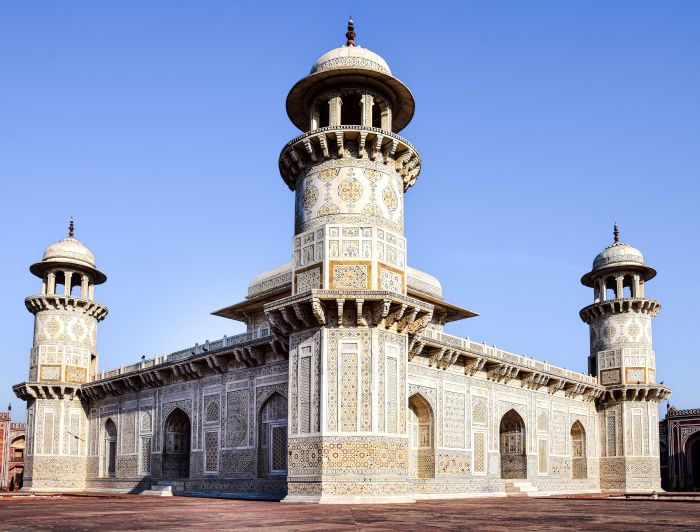
The tomb of Itimad-ud-Daulah, where the pietra dura inlay later used at the Taj Mahal was first perfected a generation earlier
Day Trips from Agra
All of these run as private day tours with a local guide and car; most guides will build a custom tour combining one with a morning at the Taj.
Fatehpur Sikri (half day, 40 km): the essential second site — Akbar’s abandoned capital, its mosque and the Buland Darwaza — and the best reason to spend a second night in Agra.
Mathura and Vrindavan (full day, 60 km): the birthplace of Krishna and the town of five thousand temples, at its most extraordinary at evening aarti on the Yamuna and during Holi, when the whole region turns to colour.
Bharatpur, Keoladeo National Park (full day, 55 km): a former duck-shooting marsh turned World Heritage bird sanctuary, best from November to February by cycle-rickshaw with a naturalist. Easily combined with Fatehpur Sikri on the road to Jaipur.
Gwalior (long day, 120 km): a hill fort, the Scindia palaces and the Jai Vilas museum, an hour and a half by train and almost untouched by foreign visitors.
Delhi and Jaipur: Agra is the middle point of the Golden Triangle, four hours from either; guides here regularly hand over to colleagues in both cities for a continuous private circuit.
Car and Driver, or Guide and Driver?
Agra’s monuments are too far apart to walk between, so almost every private tour uses a car with driver, booked through the guide or your hotel. In India the two roles are legally separate: a driver holds a commercial permit, a guide holds the Ministry card, and a driver may not guide inside a monument, however good his English. What you want is a guide who works with a regular, trusted driver — the pair run the day, and the guide keeps the route free of “just five minutes” at a marble showroom.
A few guides in Agra own a car and drive it themselves, quoting as a guide and driver in one; for a couple or a family of four this is often the simplest and best-value arrangement. Ask on the profile which model the guide works with and whether the car is included in the quote.
Best Time to Visit Agra
October to March is the season: dry, with daytime temperatures in the twenties and the clearest light on the marble. It is also the busiest; around Christmas and New Year the Taj can pass fifty thousand visitors in a day. December and January bring a catch: winter fog on the Yamuna often hides the Taj until nine or ten, so a sunrise booking then is a gamble your guide will warn you about — the fort first, the Taj at midday, is the better plan.
April to June is brutally hot, forty-five degrees by afternoon; the monuments empty out and a sunrise start followed by a long siesta is the only sensible plan. July to September is the monsoon: humid, green, with the Yamuna full behind the Taj and prices at their lowest. The Taj is closed every Friday all year, and opens for night viewing on the five nights around each full moon, with tickets bought a day ahead from the ASI office.
Do You Need a Visa for India?
Almost certainly yes, and for most nationalities it is an online e-visa. Citizens of some 170 countries — all of Europe, the United States, Canada, Australia, the Gulf states and most of Asia — apply at the government portal indianvisaonline.gov.in and receive an Electronic Travel Authorisation by email; the visa itself is stamped on arrival. The 30-day e-Tourist Visa costs US$25 (reduced to US$10 for arrivals between April and June) and allows two entries; the one-year multiple-entry version costs US$40 and the five-year US$80, with higher reciprocal rates for a few nationalities. Apply at least four working days before you fly and only through the official portal — the lookalike sites charge several times the fee for the same form.
Your passport needs six months’ validity and two blank pages, and since this year every foreign visitor must also complete the free digital e-Arrival Card online in the seventy-two hours before landing; it replaces the paper disembarkation form. Nationals of Nepal and Bhutan enter without a visa, and holders of an OCI card need none.
Getting to Agra and Around
Nearly everyone arrives via Delhi, 230 kilometres north. The Gatimaan Express and the Vande Bharat cover Hazrat Nizamuddin to Agra Cantt in about an hour and forty minutes — book a fortnight ahead in season; by road the Yamuna Expressway takes three and a half to four hours. Agra’s own airport has few flights; from Jaipur it is four hours by road or three by train, which makes Agra the natural middle night of the Golden Triangle.
Combustion vehicles stop half a kilometre short of the Taj: your car drops you at the Shilpgram or West Gate car park and an electric shuttle, free with the foreigner ticket, takes you to the gate. Wear slip-off shoes and carry only a small bag, water, phone and camera. Agra is a safe city for visitors; the risks are commercial rather than criminal, and a licensed guide removes most of them. Cash is useful at the smaller sites; the Taj sells foreigner tickets online at a discount and checks them against your passport.
How Booking a Guide Works Here
Open a profile, press the chat button and write to the guide with your dates, group size, where you are arriving from and what you want to see. The guide replies personally with a tailor-made tour plan and a price, including or excluding a car; adjust either as you like. When you are happy, the guide sends a booking proposal through the chat and you confirm it. You pay the guide directly on the day in rupees, unless the guide has chosen to ask for a deposit under their own cancellation terms. OfficialGuides charges the guide a fifteen percent platform fee on confirmed bookings and charges you nothing.
Frequently Asked Questions
Are tour guides at the Taj Mahal licensed?
Yes. Guiding inside an Archaeological Survey of India monument requires a licence — the Ministry of Tourism’s Regional Level Tourist Guide card or the newer Incredible India Tourist Guide certification, plus a state-level tier issued by Uttar Pradesh Tourism. Licensed guides carry a photo identity card and are examined per foreign language. The “free guides” at the gates are unlicensed touts.
How much does a private tour guide cost in Agra?
A licensed English-speaking guide charges about ₹1,500–₹2,500 for the Taj Mahal alone and ₹3,000–₹5,000 for a full day in Agra, per group of up to five or six. A car with driver adds ₹2,500–₹4,000 for the day, and the Taj ticket is ₹1,300 plus ₹200 for the mausoleum. A typical all-in private day with guide and car is ₹5,500–₹8,000, roughly $65–$95, before tickets.
How much is the Taj Mahal ticket for foreigners?
₹1,300 for the main ticket plus ₹200 for the mausoleum chamber, so ₹1,500 for the full visit — about $18. Indian citizens pay far less and SAARC nationals a middle rate. The foreigner ticket includes shoe covers, a bottle of water and the electric shuttle from the car park; buy it online for a small discount, carry your passport, and note the three-hour limit inside.
Do I need a visa to visit Agra?
Yes, unless you are from Nepal or Bhutan or hold an OCI card. Most nationalities get an e-Tourist Visa online at indianvisaonline.gov.in: US$25 for 30 days, US$40 for a year, US$80 for five years, applied for at least four days before travel. You must also fill in the free e-Arrival Card online within three days of landing.
Is a day trip from Delhi to the Taj Mahal worth it?
Yes, if it is your only option — but a night in Agra is far better. The same-day trip means three and a half hours each way by car, or an hour and forty minutes by the Gatimaan Express, and the Taj in flat late-morning light. A night in Agra puts you at the gate for sunrise and adds Mehtab Bagh and Fatehpur Sikri for little more.
Is the Taj Mahal closed on Fridays?
Yes — every Friday, all year, for prayers at the mosque inside the complex. Agra Fort, the Baby Taj and Fatehpur Sikri stay open, so plan the Taj for another day. Night viewing runs on the five nights around each full moon, except Fridays and Ramadan, with limited tickets sold a day ahead.
Can my driver act as my guide at the Taj?
No. Drivers hold a transport permit, not a guide licence, and may not guide inside ASI monuments; they wait at the car park. A licensed guide with the driver, or a guide who drives, is the arrangement that works — and it keeps the day free of commission stops.
What is the best time of year to visit Agra?
October to March, for dry weather and clear light, with the caution that December and January mornings can be fogbound until mid-morning. April to June is extremely hot; July to September is the monsoon and the cheapest, greenest and quietest time.
What can I not take into the Taj Mahal?
Food, tobacco, tripods, drones, large bags, books other than a guidebook, and anything electronic beyond a phone and camera. Security is airport-style and lockers are available. Wear slip-off shoes — shoe covers are compulsory on the marble — and dress modestly; there is no formal code, but covered shoulders and knees avoid attention.
Are private Agra tours suitable for families with children?
Yes, with a guide who plans around the heat and the queues. Children under fifteen enter the Taj free, and a guide will shorten the fort, add the lawns at Mehtab Bagh and time the day so the walking happens before ten. Mention the ages when you first message.
Ready to See the Taj Mahal with a Licensed Guide?
Browse the local guide profiles above, check availability for your sunrise tour or day trip from Delhi, and start a direct conversation — no agency fees, no commission stops, no touts.
Request a Free Quote
Share your travel details using the form below and receive a personalized quote from our English speaking guides in Agra.
Note: OfficialGuides is a marketplace that connects travelers with licensed tour guides; it is not a travel agency and does not sell or promote tours. Prices shown are indicative market ranges and are set independently by each guide. Read the disclaimer and privacy policy
This page is also available in: Français