Last Updated on 29/08/2026
Licensed English Speaking Guides and Private Tours in Luoyang
How to see the Longmen Grottoes and China’s oldest capital with a licensed local guide — what the Chinese guide licence means, what it costs, and how to get there visa-free.
Luoyang was the capital of thirteen dynasties, and for much of the first millennium the largest city in the world. Today it is one of the few places where you can stand almost alone in front of a UNESCO World Heritage Site: the Longmen Grottoes, more than 100,000 Buddhist carvings cut into the cliffs above the Yi River. Nearby are the White Horse Temple, the first Buddhist temple founded in China, and the reconstructed palaces of Sui and Tang Luoyang. Fewer than one in a thousand visitors here comes from abroad, so a licensed English speaking guide changes the day more than it would in Beijing or Shanghai. Browse the guide profiles below to arrange a private tour or a day trip to the Shaolin Temple, and check whether your passport qualifies for visa-free entry.
OfficialGuides.com lists guides, not packages. Every profile here belongs to a working professional who sets their own rates and answers your message personally — which matters in China, where most inbound travel still runs through agencies that quote a bundled price and only tell you the guide’s name the night before. Read the profile, ask what you want to ask, agree the day directly. No commission is added and no itinerary is imposed on you.
Licensed English Speaking Tour Guides in Luoyang 👇
Linjie Z.
Check each profile for offered tours, languages and specializations. You can send a message or voice note directly through the chat button on each profile.
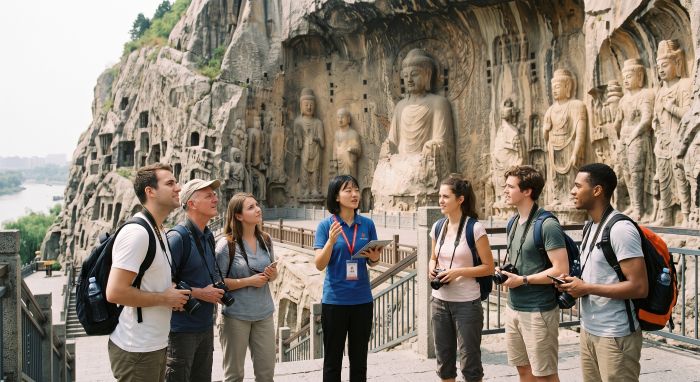
A private guide with a small group below the Vairocana Buddha at Longmen (AI generated)
Why Hire a Private Guide in Luoyang?
Because the interpretation gap here is unusually wide. Luoyang recorded about 158 million domestic visits in 2025 against roughly 194,000 inbound visits — barely one in a thousand. The city is built almost entirely for Chinese visitors, and that shapes everything: signage, audio guides, ticket apps, restaurant menus.
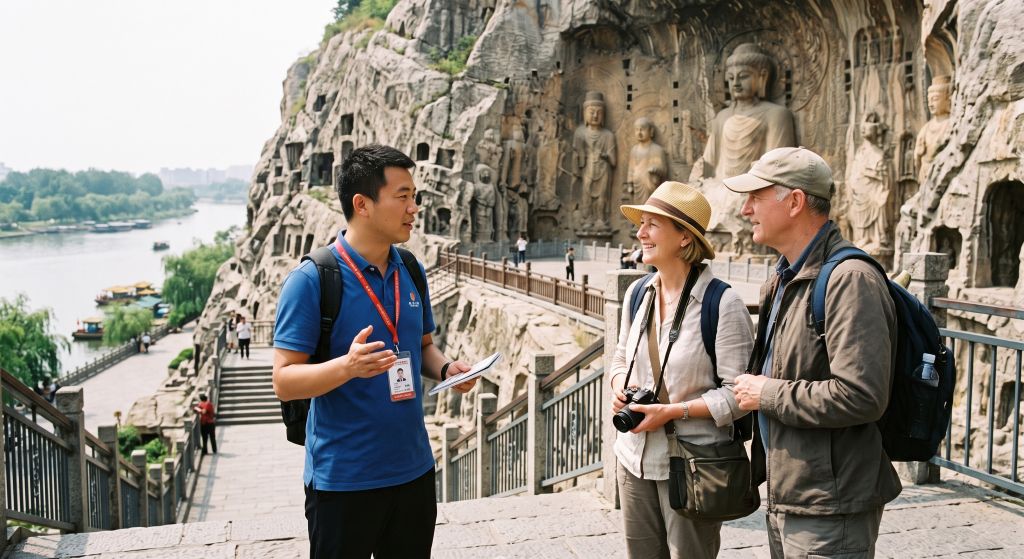
At Longmen this matters more than it sounds. The site runs a kilometre along both banks of the river, and without someone to tell you which niches are Northern Wei and which are Tang, why the Fengxian Temple Vairocana is said to carry Empress Wu Zetian’s features, or where the missing heads went and when, you are looking at a very long wall of damaged stone. The same is true at the White Horse Temple, where the interesting part is not the buildings but the story of two monks arriving from India in 68 AD.
A guide also solves the mechanics. Ticketing runs through Chinese apps, most restaurants have no English menu, and while Longmen now accepts passports for online booking and foreign bank cards at the gate, that is the exception rather than the rule across the city.
Are Tour Guides in China Licensed?
Yes, and unlike Britain the rule has legal force. Under China’s Tourism Law and the Regulations on the Administration of Tour Guides, guiding is a licensed profession: a guide must pass a national examination, hold a tour guide card (导游证), and be registered with a travel agency or an approved guide service company. The card is renewed on a cycle and carries the guide’s photo, registration number and working languages. Guiding without one is not permitted.
There is a nuance worth understanding, because it explains how independent guides work here. A licensed guide may operate freelance rather than being tied to a single employer, but the reception paperwork for a tour is still issued through a registered agency. So an independent guide in Luoyang is genuinely independent in who they work with and what they charge, while the trip itself remains inside the legal framework. This is not a loophole; it is the normal arrangement.
Grades matter too. Chinese guides hold junior, intermediate, senior or special grades, and foreign-language guides sit a separate language qualification. Ask which grade and which language your guide is certified in — it is a routine question and any professional will answer it in one line.
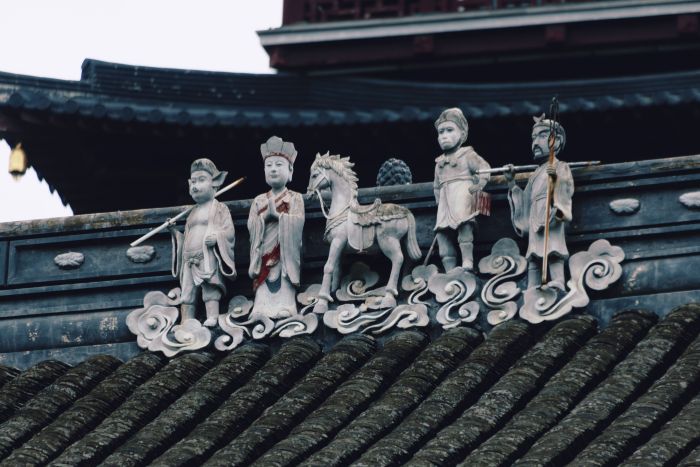
The White Horse Temple, founded in 68 AD and the oldest Buddhist temple in China
What Private Tours Can You Book in Luoyang?
Longmen Grottoes
Half a day along both banks of the Yi River: the Fengxian Temple colossi, the Binyang caves, Wanfo Cave with its fifteen thousand miniature Buddhas, and Xiangshan Temple opposite. Night visits run in the warmer months and are the quietest way to see it.
Buddhist & Imperial Heritage
The White Horse Temple, Guanlin where Guan Yu’s head is buried, and the Luoyang Museum — free to enter and the best single hour for understanding what you are about to see everywhere else.
Sui–Tang City & Night Luoyang
The reconstructed Mingtang and Tiantang halls, the Dingding Gate site, and Luoyi Ancient City after dark, where thousands of visitors walk the lanes in rented Tang-dynasty hanfu. Odd, theatrical and genuinely the liveliest thing in the city.
Peonies, Tombs & Food
Wangcheng Park and the National Peony Garden in April; the Museum of Ancient Tombs, an underground gallery of relocated burial chambers that most visitors never hear about; and the Water Banquet, Luoyang’s twenty-four-course soup dinner.
Sample Private Itineraries
Luoyang Classic
Morning at the Longmen Grottoes, starting on the West Hill before the tour groups arrive and crossing to the East Hill for the view back across the river. Lunch in the old town. Afternoon at the White Horse Temple, then the Luoyang Museum to place the day in order. Finish at Luoyi Ancient City as the lanterns come on.
Shaolin Temple & Songshan
An hour and a half east to the Shaolin Temple on Mount Song, the birthplace of Chan Buddhism and of Chinese martial arts: the temple complex, the Pagoda Forest with its 240 stone tombs, and a kung fu demonstration by the school’s students. Back to Luoyang by evening, or onward to Zhengzhou for the train.
Day Trips from Luoyang
Shaolin Temple and Mount Song (full day): the single most popular excursion, about 90 minutes by road. Comfortably combined with Longmen only if you start early and accept a long day.
Xi’an (full day, by high-speed train): ninety minutes each way, which makes the Terracotta Army a realistic day trip. Most travellers do it the other way round and add Luoyang to a Xi’an trip — either works.
Zhengzhou and the Henan Museum (half day): forty minutes by train. The provincial museum holds the finds that give Luoyang’s sites their context.
Laojun Mountain (long day): Daoist temples on a granite ridge in the south of the province, reached by cable car and spectacular in autumn. Popular with Chinese visitors, almost unknown abroad.
Xiaolangdi Dam on the Yellow River (half day): best in late June, when the sediment-flushing release turns the river into a wall of ochre water.

The Pagoda Forest at the Shaolin Temple, about ninety minutes from Luoyang
Do You Need a Visa to Visit Luoyang?
Probably not, and this is the single biggest change for anyone who last considered China before the pandemic. As of 2026, ordinary passport holders from around fifty countries — most of Europe including the UK, plus Japan, South Korea, Australia, New Zealand, Canada, Brazil, Argentina, Chile and others — can enter mainland China visa-free for up to 30 days for tourism, with nothing but a passport and a return or onward ticket.
If your nationality is not on that list, the separate 240-hour visa-free transit policy allows a ten-day stay when you are travelling on to a third country or region — Hong Kong, Macau and Taiwan all count. Henan is one of the covered provinces and Zhengzhou airport is an approved port of entry, an hour from Luoyang by high-speed train. This is the route most American visitors use.
Two practical warnings. The transit policy requires a genuine onward ticket to a third country, booked before you arrive; returning to where you came from does not qualify. And the visa-free lists have been extended and amended repeatedly since 2023, so confirm your exact nationality against the current official notice before booking flights rather than trusting a travel article.
Once you are in, set up Alipay or WeChat Pay with your foreign card before you land. Cash is accepted but awkward, and almost everything else in Luoyang runs through a QR code.
When to Visit Luoyang
April is peony season and the reason Luoyang is famous inside China. The Peony Festival fills the city for most of the month and the flowers are genuinely worth seeing, but so is the crowd: expect to book a guide and a hotel six to eight weeks ahead and to pay considerably more.
May, September and October are the sweet spot — warm, dry, and without the April crush. Summer is hot and humid, with heavy rain possible in July and August; the Longmen night visits are a good way to work around it. Winter is cold and grey but the grottoes are all but empty, which some travellers prefer.
Avoid the first week of October and the Chinese New Year period entirely unless you have no choice. These are national holidays and every major site in China is at capacity.
How Much Does a Private Guide in Luoyang Cost?
Guide fees in China are quoted per group, per day rather than per person, and Luoyang is significantly cheaper than Beijing or Shanghai. The ranges below reflect what independent English-speaking guides charge; other languages are scarcer and cost more.
| Format | Typical range (per group) |
| Half day, 3–4 hours (guide only) | ¥400 – ¥700 |
| Full day, 7–8 hours (guide only) | ¥700 – ¥1,200 |
| Full day with car and driver | ¥1,400 – ¥2,200 |
| Shaolin Temple day trip with vehicle | ¥1,800 – ¥2,600 |
Rates rise during the April Peony Festival and the October national holiday, sometimes sharply. Entrance tickets are separate: Longmen is the expensive one at roughly ¥100 per adult, the White Horse Temple and Guanlin are modest, and the Luoyang Museum is free. Ask your guide to confirm both the fee and who is buying the tickets before you agree anything — Chinese sites increasingly require advance booking with passport details, and a guide can do this for you.
What Is Included
Included: the guide’s time and interpretation, planning the route around your interests, help with advance ticket bookings that need a passport number, and the ordinary translation work of a day out — ordering food, asking directions, negotiating a taxi.
Not included: entrance tickets for you and normally for the guide, transport unless a vehicle is quoted, and meals. Tipping is not customary in China and is not expected, though it is accepted; a good review is worth more.
Getting to Luoyang and Around
Luoyang sits on the main east–west high-speed line. Xi’an is ninety minutes away, Zhengzhou forty, Beijing about four hours, Shanghai around five and a half. Trains arrive at Luoyang Longmen station, north of the grottoes and connected to the city by metro. Book through the official 12306 system or an international platform with your passport; you collect or scan at the gate.
Luoyang has a small metro network and plentiful taxis, and the ride-hailing apps work well if you have Alipay set up. Getting between Longmen, the White Horse Temple and the old town by public transport is possible but slow — this is where a guide with a car earns their fee.
The city is safe, including at night, to a degree most first-time visitors find surprising. The practical difficulties are linguistic and digital, not physical.
Frequently Asked Questions
Are tour guides in Luoyang licensed?
Yes. Guiding is a regulated profession in China: a guide must pass a national examination, hold a tour guide card issued under the Regulations on the Administration of Tour Guides, and be registered with a travel agency or an approved guide service company. The card shows the guide’s photo, registration number and certified working languages, and foreign-language guiding requires a separate language qualification. You can ask to see it.
How much does a private guide in Luoyang cost?
Typically ¥400–¥700 for a half day and ¥700–¥1,200 for a full day with an English-speaking guide, quoted per group rather than per person. Adding a car and driver brings a full day to roughly ¥1,400–¥2,200, and a Shaolin Temple day trip with vehicle to ¥1,800–¥2,600. Entrance tickets and meals are separate, and rates rise during the April Peony Festival and the October holiday.
Do I need a visa to visit Luoyang?
Most likely not. Around fifty nationalities — including most of Europe, the UK, Japan, South Korea, Australia, New Zealand, Canada and several South American countries — can enter mainland China visa-free for up to 30 days as tourists. Everyone else, including US citizens, can use the 240-hour visa-free transit policy for a ten-day stay when travelling onward to a third country or region; Henan is a covered province and Zhengzhou is an approved port. Check the current official list before booking, as it has changed repeatedly.
Is one day enough for Luoyang?
One full day covers Longmen, the White Horse Temple and the museum at a brisk pace. Two days is much better: Longmen deserves a slow morning, and the second day frees you for the Sui–Tang sites, the Museum of Ancient Tombs and the old town at night. If you also want the Shaolin Temple, plan three.
When is the Luoyang Peony Festival, and is it worth it?
It runs through most of April, and it is the busiest month of the Luoyang year by a wide margin — the 2026 edition drew over 18 million visits. The peonies are spectacular and the city is at its most festive, but hotel prices climb and the major sites are crowded. If flowers are the point of your trip, come; if they are not, late March, May, September or October will give you a much better experience of everything else.
How do I get from Xi’an or Zhengzhou to Luoyang?
By high-speed train, which is the easy part of travelling in China. Xi’an to Luoyang Longmen takes about ninety minutes and Zhengzhou about forty, with frequent departures. Book with your passport through the official 12306 platform or an international booking site, and allow time at the station for the passport lane. Many visitors treat Luoyang as a day trip from Xi’an, though it rewards an overnight stay.
Can I pay with a foreign credit card in Luoyang?
Sometimes, but do not rely on it. The Longmen Grottoes now accept foreign bank cards and allow online booking with a passport, which is ahead of most of the city. Elsewhere, daily life runs on Alipay and WeChat Pay QR codes. Both apps now let you link an international card — set this up before you travel, because doing it on arrival without a Chinese phone number is harder. Carry some cash as a fallback.
Is English widely spoken in Luoyang?
Not widely. Luoyang receives roughly 194,000 international visits a year against about 158 million domestic ones, so the city is built for Chinese travellers: signage, menus, ticket apps and audio guides are overwhelmingly in Chinese. Staff at the major sites and international hotels will manage, but ordinary restaurants and taxis will not. This is the strongest practical argument for hiring a guide here rather than in Beijing or Shanghai.
Are private tours suitable for families with children?
Yes, and Luoyang works better for children than its reputation suggests. The grottoes involve a lot of steps, so a guide who knows the flatter route along the river matters; the kung fu demonstration at Shaolin holds most children’s attention completely; and renting hanfu at Luoyi Ancient City is enjoyed by more visiting families than would admit it. Tell your guide the ages when you first make contact.
Can my guide also take me to the Shaolin Temple?
Yes. It is in the same province, about ninety minutes by road, and a Luoyang guide with a vehicle can run it as a full-day trip. Confirm whether the quote includes the temple entrance, the shuttle inside the scenic area and the kung fu performance, since these are ticketed separately and are a common source of confusion.
Ready to Explore Luoyang with a Licensed Guide?
Browse the guide profiles above, check availability, and start a direct conversation — no agency fees, no middleman.
Request a Free Quote
Share your travel details using the form below and receive a personalized quote from our English speaking guides in Luoyang.
Note: OfficialGuides is a marketplace that connects travelers with licensed tour guides; it is not a travel agency and does not sell or promote tours. Prices shown are indicative market ranges and are set independently by each guide. Read the disclaimer and privacy policy
This page is also available in: 简体中文