Last Updated on 14/10/2026
Licensed Tour Guides and Private Tours in Marseille, from the Cruise Port to Provence
City walks, shore excursions and day trips to Cassis, Aix-en-Provence, Arles and Avignon, priced per group
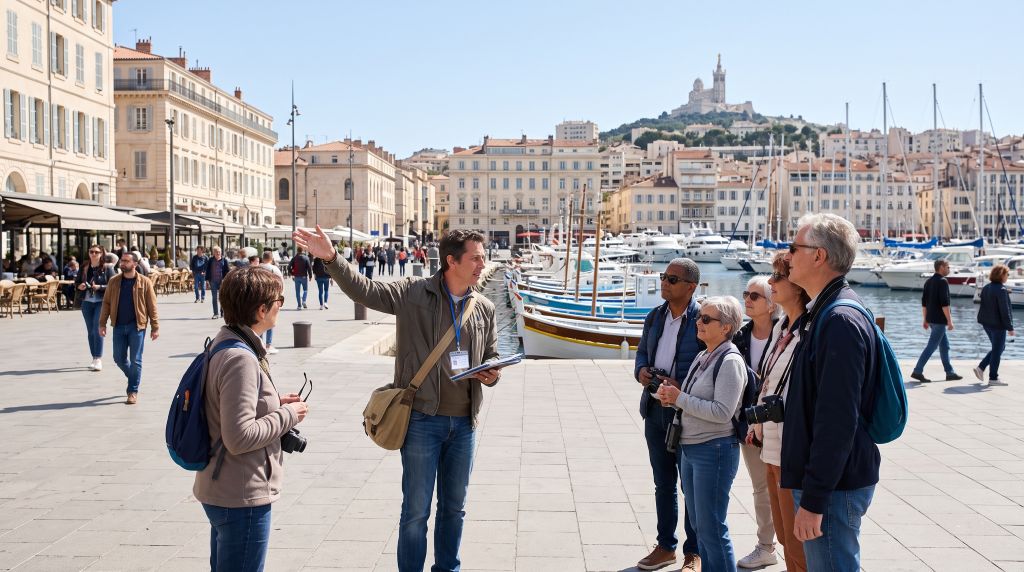
Marseille has been a port for about 2,600 years, and many visitors still arrive by sea. An independent licensed tour guide can meet you in the Vieux-Port or, on request, at the cruise terminal, then build the day around what you have time for: Le Panier and the Vieille Charité, the climb to Notre-Dame de la Garde, a boat to the Château d’If, or a full day out to Cassis, Aix-en-Provence, Arles or Avignon. Guide fees are set per group, not per person, and are listed in the price table; the sample programmes show what fits into a half day, a ship’s call or a full day.
Licensed tour guides in Marseille
In France, guided commentary inside a museum labelled “musée de France” or a monument historique open to the public is reserved for holders of the carte professionnelle de guide-conférencier. The rule sits in the Code du tourisme, article L221-1 and following, and the obligation falls on whoever organises or sells the visit. In practice, a guide without this licence card can lead you through the streets of Le Panier but cannot give the commentary inside the Vieille Charité or the Château d’If.
English-language listings for Marseille mix licensed guides, driver-guides and local hosts offering to “explore the city with a local”. Some state the licence and say they may guide inside heritage monuments; others do not mention it. That can be fine for a panoramic drive, but if your list includes the Château d’If, the Abbaye Saint-Victor crypts or a museum in Aix or Arles, ask to see the licence card before you book.
OfficialGuides lists independent guides who hold the carte professionnelle de guide-conférencier issued under the French Code du tourisme. You write directly to the guide who will run your day, agree the programme, meeting time and pick-up point with them, and pay them for the guiding.

Malvina B.
Each guide sets their own programme and languages. Message the guide directly to check a date, a cruise call or a day trip.
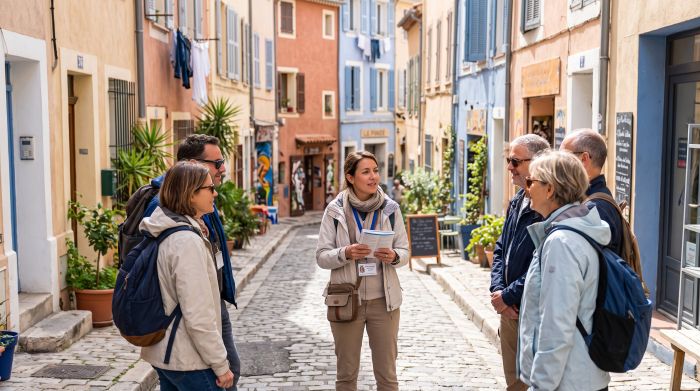
A licensed guide in the lanes of Le Panier (ai illustrated)
Private tours in Marseille
Marseille is spread around a working harbour, so a private tour usually combines walking with a bus, a boat or a short drive. The four formats below cover most requests.
Walking tours of the old city
Vieux-Port, Le Panier, the Vieille Charité and the harbour forts in three to four hours on foot.
Shore excursions
A guide who meets you at the cruise terminal on request and plans the day around your all-aboard time.
Day trips in Provence
Cassis and the Calanques, Aix-en-Provence, Arles and Les Baux, Avignon and the Luberon villages.
Boats and islands
The Château d’If and the Frioul islands from the Vieux-Port, or the Calanques by boat from Cassis.
Vieux-Port, Le Panier and the Vieille Charité
The Greek city of Massalia was founded around 600 BC by settlers from Phocaea, today Foça on the Aegean coast of Turkey, on the hill now covered by Le Panier. That makes Marseille the oldest city in France, and the walk starts where it began: the Vieux-Port, then up the stairs into Le Panier’s lanes.
The centre of the quarter is the Vieille Charité, a poorhouse designed by Pierre Puget, who was born in the neighbourhood and worked as architect to the king. The first stone was laid in 1671 and the complex was finished in 1749; the chapel in the middle of the courtyard has an oval dome. Today it holds museums and research institutes. The walk comes back down past Fort Saint-Jean, where the footbridge to the MuCEM starts; the museum’s outdoor terraces and gardens are free to walk through.
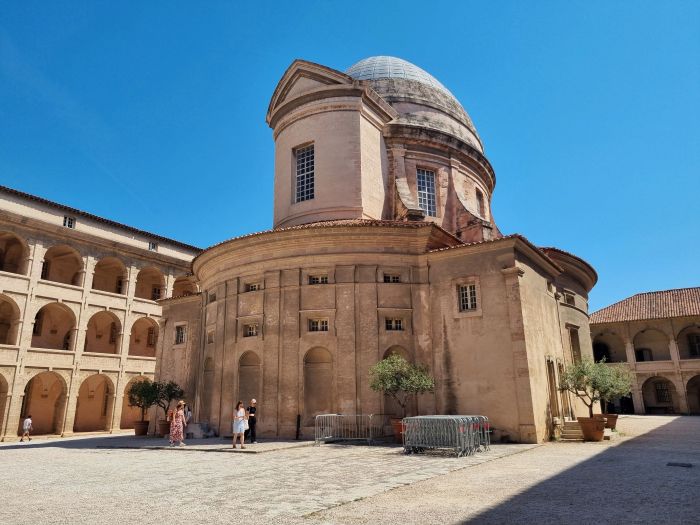
The Vieille Charité courtyard, designed by Pierre Puget
Notre-Dame de la Garde and the Abbaye Saint-Victor
The south side of the harbour holds two of the city’s religious landmarks. The Abbaye Saint-Victor goes back to the 5th century and was fortified in the 14th; its crypts sit in a Greek quarry and a Hellenistic burial ground and hold early Christian sarcophagi. The basilica is free and the crypts take a 2 € donation. On 2 February, for Candlemas, a procession walks from the Vieux-Port up rue Sainte to the abbey, and the archbishop then blesses the boat-shaped navette biscuits at the Four des Navettes.
From there, bus 60 climbs to Notre-Dame de la Garde, on a limestone outcrop 161 m above the sea. The belfry is 41 m high and carries a gilded statue of the Virgin and Child over 9 m tall, known locally as la Bonne Mère. Entry is free, the site is open every day, and most of it is accessible to wheelchair users.
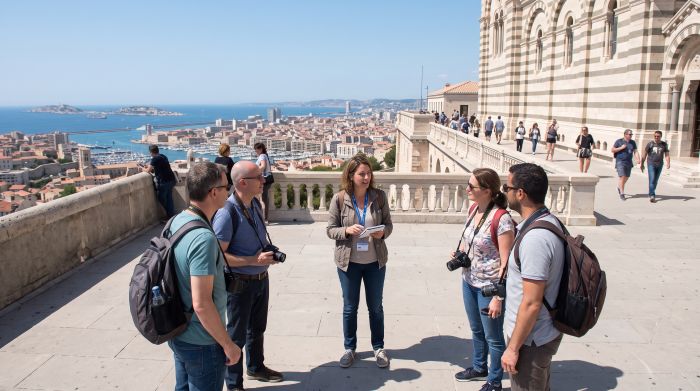
The terrace of Notre-Dame de la Garde, 161 m above the harbour (ai illustrated)
Château d’If and the Frioul islands
The Château d’If was built for François I between 1524 and 1531 on an island of about 3 hectares, and from the 17th century it served as a state prison. Alexandre Dumas locked Edmond Dantès up here in The Count of Monte Cristo, and the visit plays on both histories. Boats leave from the quai de la Fraternité in the Vieux-Port and take about 20 minutes; some continue to Ratonneau and Pomègues in the Frioul archipelago.
Entry to the fortress is 7 €, and the boat ticket is bought separately. From October to March the site closes at 17:00 and on Mondays. On days of strong mistral there are no crossings at all, so this is the programme to keep flexible.
Cruise day: Marseille and Aix-en-Provence
Larger ships berth at the Marseille Provence Cruise Terminal, on the Môle Léon Gourret, about 7–8 km north of the Vieux-Port. On days with a ship in port, a free shuttle runs from the terminal to the Place de la Joliette, from where the Vieux-Port is roughly 15 minutes on foot. Your guide can meet you at the terminal if you ask for it when you book.
A six-hour call is enough for the old city and one town inland: the Vieux-Port and Le Panier in the morning, then Aix-en-Provence for the Cours Mirabeau and the old town. Transport is not included in the guide’s fee; it is arranged with the guide in advance. Allow a margin before all-aboard time; no guide can promise how long traffic will take.
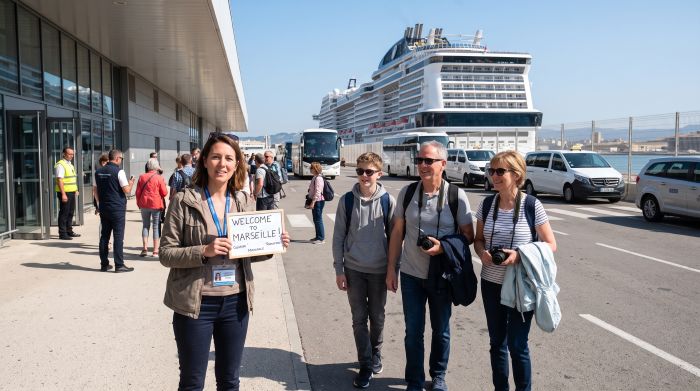
Meeting cruise passengers at the terminal (ai illustrated)
Day trips from Marseille
All four trips below stay within the Bouches-du-Rhône and the Vaucluse. Aix on its own takes four hours; combined with a Marseille city tour it becomes a five- to six-hour day.
Aix-en-Provence and Cézanne’s studio
The walk follows the Cours Mirabeau into the old town, then heads up the Lauves hill to the Atelier des Lauves, the studio where Paul Cézanne worked until his death in 1906. It is at 13 avenue Paul Cézanne, served by buses 5 and 12 (stop “Atelier Cézanne”). Booking is compulsory, on cezanne-en-provence.com or at the desk if places remain; tickets cost 9.50 to 15 € depending on the visit format. Holders of the guide-conférencier licence card enter free, so your guide’s ticket is not added to your costs.
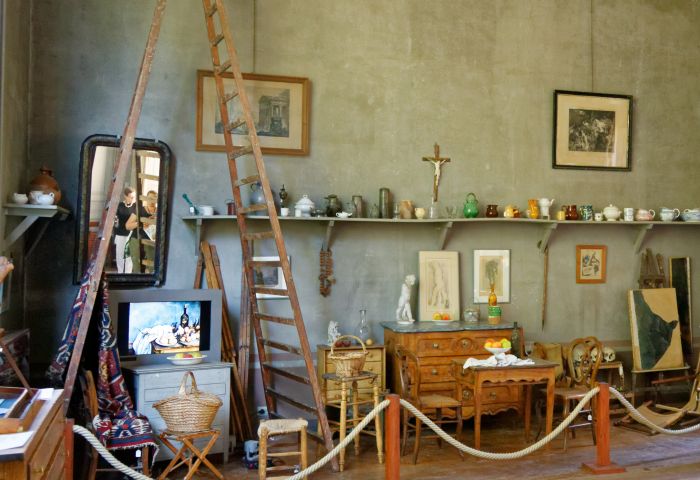
The Atelier des Lauves on the Lauves hill
Cassis and the Calanques
The Calanques are limestone inlets inside a national park that covers land, sea and the edge of the city. Sugiton, Morgiou and Sormiou are on the Marseille side; Port-Miou, Port-Pin and En-Vau are reached from Cassis. Boats leave the port of Cassis all year: three calanques in 45 minutes to an hour for 16 to 19 € depending on the operator, or five, eight and nine calanques for 25, 29 and 33 € (1 h 20, 1 h 50 and 2 h 20). Tickets are sold at the port on the day.
The rest of the day is the harbour village itself and, for those who walk, the path to Port-Miou. Access rules for walkers change in summer; see the season section below.
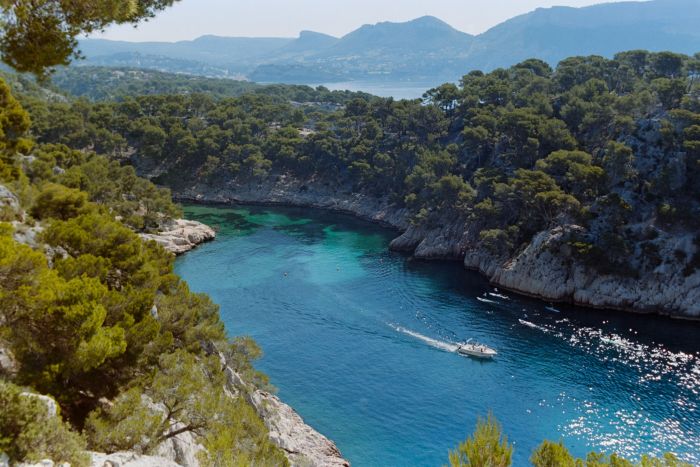
A calanque seen from the boat out of Cassis
Arles and Les Baux-de-Provence
Arles has been on the UNESCO list since 1981 as the “Roman and Romanesque Monuments of Arles”. The amphitheatre dates from the end of the 1st century, and the cathedral of Saint-Trophime and its cloister were built between the 12th and 14th centuries. The Pass Avantage covers the six UNESCO monuments and four museums and stays valid for six months.
The afternoon moves 15 km north-east to Les Baux-de-Provence, where the Carrières des Lumières project art onto the walls of a former quarry, 800 m from the château; tickets run from 13 to 16.50 €.
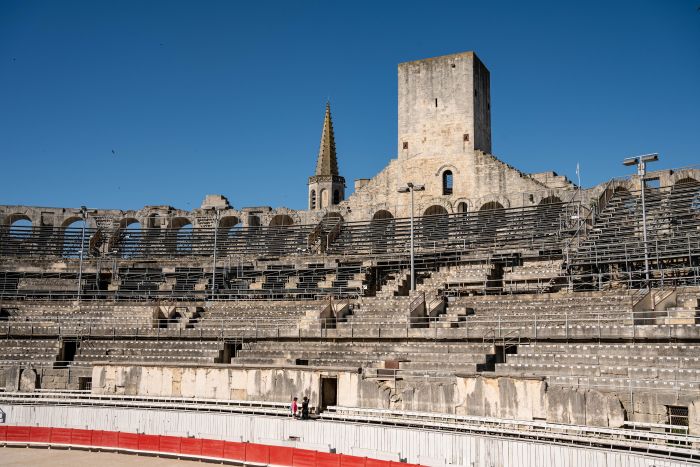
The Roman amphitheatre of Arles
Avignon and the Luberon villages
Avignon’s UNESCO site groups the Palais des Papes, the cathedral of Notre-Dame des Doms, the Rocher des Doms and the Pont Saint-Bénezet, the bridge of the children’s song, begun in the 12th century. The palace was the seat of the papacy in the 14th century. A combined palace and bridge ticket costs 17 €; the bridge alone is 5 €. Count about an hour and a half for the palace and 40 minutes for the bridge.
The afternoon goes east into the Luberon: Gordes on its hilltop, then Roussillon, 48 km from Avignon, where the Sentier des Ocres trail runs through the old ochre quarries in 35 minutes or an hour and a half, depending on the loop.
Guide prices in Marseille
A licensed guide in Marseille costs 60–80 € per hour, 240–280 € for a half day and 380–480 € for a full day, per group. A six-hour cruise day, for example Marseille plus Aix-en-Provence, costs 340–440 €. None of these prices include a vehicle, entrance tickets or boat fares.
| Service | Price per group (EUR) |
| Hourly rate | 60–80 € |
| Half day (city tour, Château d’If, Aix-en-Provence) | 240–280 € |
| Cruise day, 6 hours (e.g. Marseille + Aix-en-Provence) | 340–440 € |
| Full day (Cassis, Arles and Les Baux, Avignon and Luberon) | 380–480 € |
| Vehicle, tickets, boats | not included |
Entrance fees you will pay on the day, per person:
| Site | Adult ticket |
| Notre-Dame de la Garde | free |
| Abbaye Saint-Victor (basilica / crypts) | free / 2 € donation |
| MuCEM outdoor terraces and gardens | free |
| Château d’If (boat extra) | 7 € |
| Cassis boat, 3 calanques | 16–19 € |
| Atelier des Lauves, Aix-en-Provence | 9.50–15 € |
| Carrières des Lumières, Les Baux | 13–16.50 € |
| Palais des Papes + Pont d’Avignon | 17 € |
Getting around: port, airport, trains
The guide’s fee covers guiding only; transport is agreed separately. In the city, the old quarters are walkable, bus 60 runs from the MuCEM, the Quai du Port, the Quai des Belges and the Cours Jean Ballard up to Notre-Dame de la Garde, and the Petit Train’s route 1 makes the same climb from the Vieux-Port.
From Marseille Provence Airport, the L091 shuttle bus reaches Saint-Charles station in about 25 minutes. There is no direct link between the airport and the cruise terminal. TGV trains from Paris Gare de Lyon reach Saint-Charles in about three hours to three hours twenty. Regular buses link Marseille and Aix-en-Provence in about 40 minutes; for Les Baux and the Luberon villages, plan a car with a driver booked in advance.
If you are also visiting the capital, our Paris private tours and day trips page works the same way.
Driver, guide or both
When you search for shore excursions from Marseille in English, many of the private listings are priced around a vehicle. Some of them sell a “transport only” option at the same page as the guided version: a car meets you at the ship, with no guide and no tickets. If what you want is commentary at Notre-Dame de la Garde or inside the Château d’If, check which of the two you are paying for.
Guiding and driving passengers are separate qualifications in France. Some guide-conférenciers hold both; others work alongside a driver or with public transport. Since the fees on this page exclude transport, ask your guide how the day will be moved before you agree the programme, and whether a driver’s fee is added.
English-speaking guides and other languages
This page is written for English-speaking travellers. Each guide’s listing above shows the languages that guide works in, so check for English-speaking guides there before you write, and mention any second language your group needs in your first message.
Seasons, opening hours and the mistral
From 1 June to 30 September, access to the Calanques massif depends on daily fire risk. A map for the next day is published every evening at 18:00; on red days the walking trails are closed. In high summer the Sugiton cove needs a free online booking, and the roads to Sormiou, Morgiou and Callelongue are closed to private cars for the season, so these coves are reached on foot or by boat.
Notre-Dame de la Garde closes at 18:15 from October to March and at 19:15 from April to September. The Château d’If closes on Mondays and at 17:00 in the winter months. The mistral is the main variable all year: when it blows, the boats to the islands stop. Cosquer Méditerranée, the replica of the painted cave found underwater at Cap Morgiou, uses timed tickets at weekends and in summer; visitors ride through in six-person modules for about 35 minutes.
Private boat and car days
For a more private day, two things change the experience more than anything else. The first is a car with a driver for the whole day, which turns Arles and Les Baux or Avignon and the Luberon into a single loop without timetables. The second is a private boat: Le Canaille, a hybrid boat based in Cassis, offers private hire for up to half a day along the Calanques, alongside its scheduled 45-minute to 1 h 50 trips. Both are booked and paid separately from the guide’s fee; your guide can plan the day around them.
Visas and entry to France
Entry conditions depend on your nationality and the length of your stay. Check them on the official France-Visas website, france-visas.gouv.fr, before you travel; cruise passengers should also confirm the requirements with their cruise line.
Frequently asked questions
How much does a private tour guide in Marseille cost?
A licensed guide costs 60–80 € per hour, 240–280 € for a half day and 380–480 € for a full day, for the whole group. A six-hour cruise day is 340–440 €. Vehicles, boats and entrance tickets are extra.
Can a guide meet us at the Marseille cruise terminal?
Yes, on request. Ask for a terminal pick-up when you agree the programme. Otherwise the free port shuttle takes you to the Place de la Joliette, about 15 minutes’ walk from the Vieux-Port.
Is a shore excursion long enough for Marseille and Aix-en-Provence?
Six hours is enough for the old city and the centre of Aix. Aix alone takes about four hours; with a Marseille city tour it becomes five to six. Keep a margin before all-aboard time.
Can we visit the Calanques in summer?
By boat from Cassis, yes, throughout the year. On foot, access between June and September depends on the fire-risk map published at 18:00 for the next day, and Sugiton needs a free booking in high season.
Why does it matter that the guide is licensed?
Only holders of the carte professionnelle de guide-conférencier may give commentary inside French museums and public historic monuments. A licensed guide can therefore take you inside the Château d’If or the Vieille Charité, not only past them.
Is the Château d’If open every day?
Not in winter, and not in a strong mistral. From October to March it closes on Mondays and at 17:00, and boats do not sail when the mistral blows.
Plan your day in Marseille
Write to a licensed guide with your dates, ship times or day-trip ideas, and agree the programme directly.
Send a request
Prices and opening hours are indicative and can change; please confirm them with your guide and the sites before travelling. See our terms of service and privacy policy.
This page is also available in: Français · Deutsch · Italiano