Last Updated on 29/05/2026 by OfficialGuides Editorial Team
The standard Passport ticket with timed entry — which covers the Palace, the Estate of Trianon and the Gardens — costs €25 in low season and €35 in high season for non-EU visitors. EEA residents pay €22 / €32 (a €3 discount applied at the gate with ID, from 14 January 2026). A Palace-only or Trianon-only ticket costs €15 (€12 for EEA). Under-18s and EU residents aged 18–25 enter free, but still need a reserved time slot. The Palace is open 9am–6:30pm and closed every Monday, plus 1 January, 1 May and 25 December. Booking online is the single best thing you can do — peak summer tickets regularly sell out 2–3 weeks ahead. Since the palace is far from central Paris, a guided tour with transport from Paris is the least stressful option. You can also reserve a guided tour in various languages, or a skip-the-line entry ticket, in a couple of minutes.
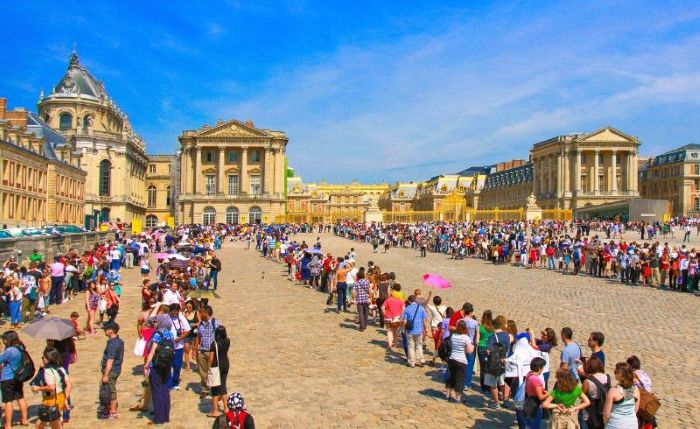
The on-site ticket line at Versailles regularly runs 60–90 minutes in peak season. A pre-booked timed ticket lets you walk straight to the priority entrance.
That queue is exactly what an online ticket lets you skip. Below are the most popular Versailles tickets and tours available right now — skip-the-line entry, guided tours in several languages and combined day trips from Paris — all with live prices and instant confirmation.
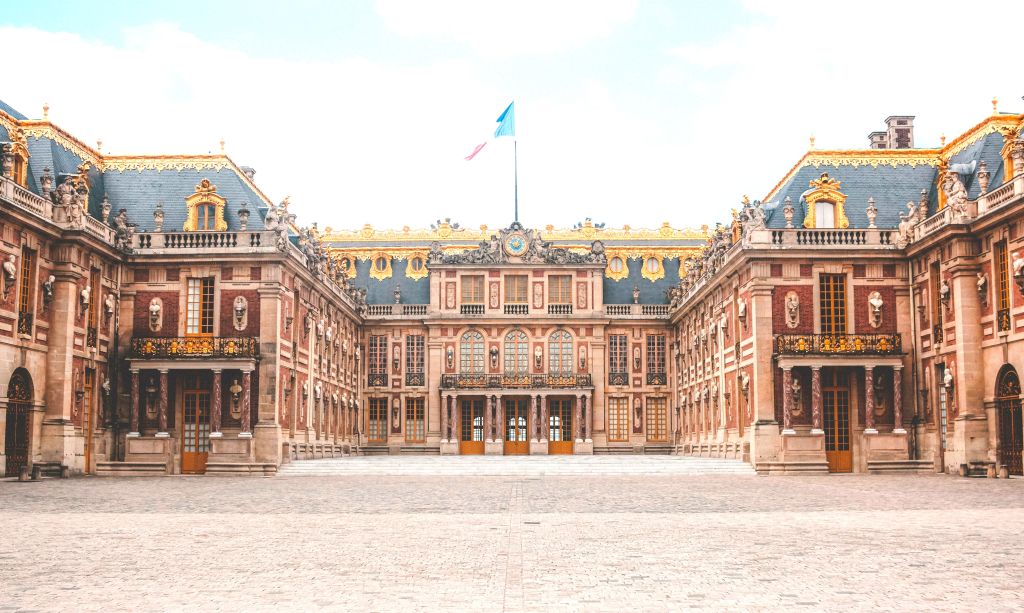
The Palace of Versailles is the most visited monument in France after the Eiffel Tower, and the most ambitious day trip you can take from Paris. Around eight million visitors pass through its gates every year — and many of them lose the first ninety minutes of their day in a security queue they did not need to join. With a pre-booked Passport ticket, the right entry gate and a clear plan for the gardens, the same estate becomes one of the most rewarding visits in Europe.
This page explains everything you need to decide before you book: which ticket is right for you, the new 2026 prices that started on 14 January 2026, how the timed-entry system works, opening and closed days, the simplest way to get there from central Paris on the RER C, what to see inside the palace and across the wider estate, the best time of day to arrive, and the practical mistakes to avoid. There is also a short history section and a long FAQ at the end.
Versailles ticket options — what each one covers
Versailles sells three main ticket products, and the differences between them are not always clear. Here is what each one includes in 2026.
Passport ticket (with timed entry)
The best-value option for most first-time visitors. Covers the Palace (with a 30-minute timed slot), the Estate of Trianon, Marie Antoinette’s estate, the Gardens, and the Musical Fountains and Musical Gardens shows on event days.
Palace-only ticket
Cheaper, but limited: gets you into the main palace (Hall of Mirrors, State Apartments, Royal Chapel, Gallery of Great Battles). Does not include the Estate of Trianon. Suitable only if you have less than half a day.
Estate of Trianon ticket
Grand Trianon, Petit Trianon and Marie Antoinette’s Hamlet — but not the main palace. A good option for return visitors who have already seen the Hall of Mirrors and want a quieter day.
Guided tour ticket
A 90-minute tour led by an official Palace guide takes you into the King’s Private Apartments, the Royal Opera or other rooms closed to independent visitors. Includes the full Passport. Slots are limited and sell out early.
2026 Versailles ticket prices
Prices changed on 14 January 2026, with a new EEA discount system replacing the old single rate. The table below shows the official rates from the Château de Versailles. Resellers like Tiqets and GetYourGuide sell the same Passport ticket with a small service fee, and often have inventory when the official site is sold out.
| Ticket type | Non-EU adult | EEA resident (with ID) | Under-18 / EU 18–25 |
|---|---|---|---|
| Passport (low season, Nov–Mar) | €25 | €22 | Free (timed slot required) |
| Passport (high season, Apr–Oct, fountain days) | €35 | €32 | Free (timed slot required) |
| Palace-only ticket | €15 | €12 | Free (timed slot required) |
| Estate of Trianon (Grand + Petit Trianon) | €15 | €12 | Free (no timed slot) |
| Late-entry Passport (from 3pm / 4pm) | €18–€25 | €15–€22 | Free |
| High-season Gardens supplement | €10 | €10 | €10 (under 6 free) |
Free admission applies to under-18s of any nationality and to EU/EEA residents aged 18–25 with valid ID, plus a few other categories (disability + companion, journalists, ICOM, French teachers). Anyone entitled to free entry still needs to book a timed Palace slot online — turning up without one is the most common mistake.
Opening hours and closed days
The Palace is open from 9:00 am to 6:30 pm, with last admission at 5:00 pm. The Estate of Trianon opens later, from 12:00 noon to 6:30 pm, with last admission at 5:30 pm. The Gardens are open daily from 7:00 am to 8:30 pm (April–October) or 8:00 am to 6:00 pm (November–March).
Closed days: the Palace and Estate of Trianon are closed every Monday, on 1 January, 1 May and 25 December. The Gardens stay open year-round except on those three holidays. Tuesday is the worst day to visit, because the Louvre is closed and many visitors move their Versailles day forward by 24 hours — Wednesday to Friday mornings are noticeably quieter.
How to get to Versailles from Paris
Versailles is about 22 kilometres south-west of central Paris. There are three reasonable ways to get there, but for most travellers one option is clearly the best.
1. RER C train (recommended)
Take the RER C to its terminus, Versailles Château Rive Gauche. The journey takes 35–45 minutes from central Paris and the station is a flat 10-minute walk from the palace gates — the shortest of all three local stations. Trains leave roughly every 15 minutes. A single Île-de-France ticket for Zone 4 costs around €4–€5 one way; round trip €7–€10. Standard Paris metro tickets (t+) do not work — buy a point-to-point Zone 4 ticket at the machines.
The most convenient RER C stations to board are Saint-Michel Notre-Dame, Musée d’Orsay, Invalides, Pont de l’Alma and Champ de Mars – Tour Eiffel. Make sure the destination sign on the platform reads “VICK” or “Versailles Château RG” — the RER C has several branches and only one of them goes to the palace.
2. Transilien Line L from Saint-Lazare
If you are staying in the 8th, 9th, 16th or 17th arrondissement, the Transilien Line L from Paris Saint-Lazare to Versailles Rive Droite is often faster than going down to RER C. It takes about 35 minutes, then a 15–20 minute walk to the palace.
3. Transilien Line N from Montparnasse
From Paris Montparnasse, Line N reaches Versailles Chantiers in about 15 minutes — the fastest train option, but the longest walk on arrival (around 18 minutes).
4. Organised day trips and private transfers
Full-day group tours from Paris generally include round-trip coach transfer, a guided tour of the State Apartments, and free time in the gardens. They cost €70–€120 per person and remove every logistical step. Private transfers from your hotel start around €80–€120 each way for up to four passengers — a good option for groups of three or more.
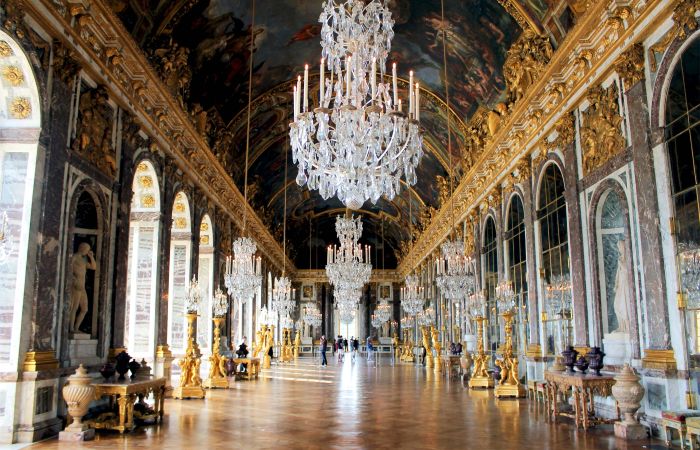
The Hall of Mirrors (Galerie des Glaces) — 73 metres long, 357 mirrors, 17 arched windows facing the gardens. It is busiest between 11am and 2pm; aim for the first hour after opening for clearer photos.
What to see inside the Palace
The signposted route through the main palace takes most visitors about 90 minutes to two hours, but you can spend half a day if you want to study the painted ceilings room by room.
The Royal Chapel is the first major space you enter — completed in 1710 and the setting for the marriage of the future Louis XVI and Marie Antoinette. The State Apartments (also called the King’s Grand Apartments) are a sequence of seven rooms each dedicated to a Roman god, decorated to impress visiting ambassadors. The Hall of Mirrors is the obvious centrepiece: 73 metres long, lined with 357 mirrors facing 17 arched windows, where the Treaty of Versailles was signed in 1919. The Queen’s Apartments, restored to their late-eighteenth-century appearance, include Marie Antoinette’s bedroom and the secret door she used to escape on the morning of 6 October 1789. The visit ends in the enormous Gallery of Great Battles, with thirty-three large paintings covering fifteen centuries of French military history.
The Gardens and the Estate of Trianon
The 800-hectare gardens, designed by André Le Nôtre in the 1660s, are arguably more impressive than the palace itself. Entry is free most of the year — the exceptions are the Musical Fountains Show and Musical Gardens days (Tuesdays, Saturdays and Sundays from April to October), when the music plays and the fountains run, and a €10 Gardens supplement applies. The Passport ticket already covers this on event days.
A 20-minute walk (or a few-euros shuttle train ride) from the back of the palace brings you to the Estate of Trianon — the most peaceful and least crowded part of the entire estate. The Grand Trianon is a pink-marble retreat Louis XIV built to escape the formality of the main court. The Petit Trianon became Marie Antoinette’s private domain in the 1770s, where she could live “simply” away from royal protocol. Just beyond it is the Queen’s Hamlet, a small mock village of thatched cottages, a working farm and a windmill — the closest thing eighteenth-century French royalty ever built to a leisure park.
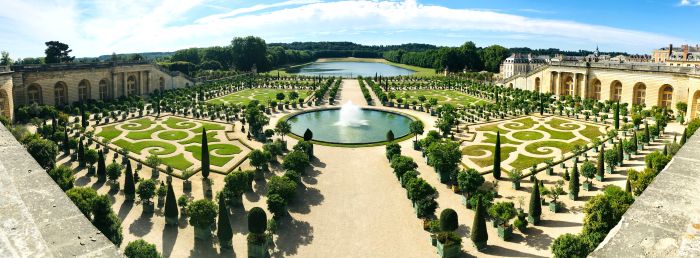
The 800-hectare gardens designed by André Le Nôtre are free to enter most of the year. On Musical Fountains and Musical Gardens days (April–October) a separate Gardens supplement applies.
Best time to visit Versailles
The single most useful piece of advice for Versailles: arrive before 9:30 am on a Wednesday, Thursday or Friday. Tuesday is the worst day (because of the Louvre-overflow effect), Saturday is the second-worst, and Sunday is unpredictable. The Hall of Mirrors is almost empty between 9:00 and 9:45 am, and starts to fill up by 10:30.
By season, April through October is the obvious choice if you want the gardens, fountains and Trianon at their best — but expect crowds and the high-season €35 Passport price. November through March brings shorter days, occasional cold rain and emptier rooms; prices drop to €25 and you can often book a same-week slot. The Gardens fountains are switched off in winter but the layout is still impressive, and the indoor light through the Hall of Mirrors windows is at its softest.
Practical tips before you go
Book the earliest available Palace time slot, even if it means starting your morning early. Crowds build by about 30% per hour after 10:00 am. Bring a printed ticket as a backup — mobile signal at the gates can be weak, and a screenshot of your QR code is enough if the live ticket does not load. Wear comfortable shoes: the marble floors are hard and you will easily walk 8–10 kilometres including the gardens.
Security is airport-level. Large bags (over 55 × 35 × 25 cm), suitcases, tripods, drones, selfie sticks and food are not allowed. There is a small free cloakroom for coats and small bags but no luggage storage. The Palace does not have a proper restaurant — the cafés inside are mediocre and expensive. Bring water (allowed) and either eat before you arrive or plan lunch in Versailles town along Rue de Satory after your visit. Photos are allowed without flash in all interior spaces; tripods and selfie sticks are not allowed.
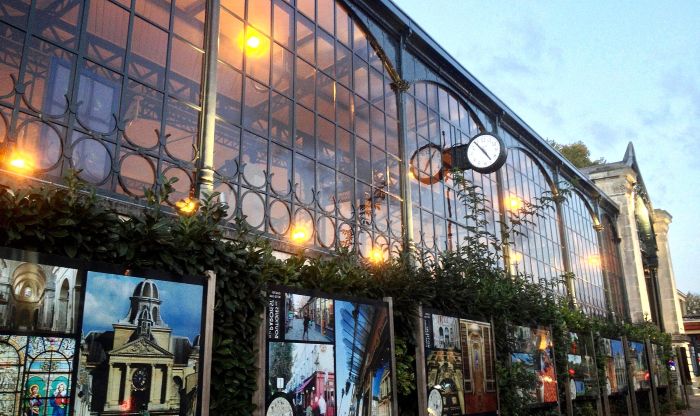
Versailles Château Rive Gauche is the closest station — a flat 10-minute walk to the palace gates. Buy a single Île-de-France ticket for Zone 4 (around €4–€5) before boarding the RER C.
A brief history of Versailles
Versailles started as Louis XIII’s hunting lodge in 1623 — a modest brick-and-stone retreat about a day’s ride from Paris. His son, Louis XIV, transformed it. From 1661 the Sun King used the resources of the entire kingdom to make Versailles the most magnificent court in Europe, and in 1682 he formally moved the seat of French government there from the Louvre. For just over a century, every important decision in France was made inside these walls.
That ended on 6 October 1789, when a Parisian crowd marched on Versailles, entered the Queen’s Apartments by force, and made Louis XVI and Marie Antoinette return to Paris. They never came back. The palace was stripped of its furniture during the French Revolution and was nearly demolished. Louis-Philippe saved it in the 1830s by turning it into a museum “to all the glories of France”, which is essentially what it remains today. UNESCO added Versailles to the World Heritage List in 1979.
Frequently asked questions
How long does it take to visit the Palace of Versailles?
Plan a minimum of 3–4 hours if you only visit the main palace. For the full Passport experience (Palace + Trianon + Gardens), allow a full day, 6–7 hours. Travel from central Paris adds another 90 minutes round-trip.
Is the Palace of Versailles worth visiting?
Yes, almost without exception. It is the most ambitious royal residence ever built in Europe, the original setting for the absolute monarchy and the birthplace of the modern French state. The only people who regret it are those who arrive without a booking on a Tuesday in July, spend two hours queueing, and never reach the Trianon.
Do I need to book Versailles tickets in advance?
Yes — even if you qualify for free entry. The Palace uses a strict timed-entry system and turning up without a slot is the most common reason visitors get turned away or pushed to a late-afternoon time. In peak summer the official site sells out 2–3 weeks ahead; resellers usually still have inventory.
What is the difference between the Passport ticket and the Palace ticket?
The Passport covers the entire estate (Palace, Trianon, Marie Antoinette’s estate, Gardens including the Musical Fountains supplement on event days). The Palace ticket only covers the main building. The Passport is €10 more and almost always the better choice.
Are the Versailles gardens free?
Yes, on most days. The Gardens are free to enter year-round except on Musical Fountains Show and Musical Gardens days (typically Tuesdays, Saturdays and Sundays from 1 April to 1 November), when a €10 Gardens supplement applies. The Passport ticket includes this automatically.
Are there discounts or free entry?
Yes. Under-18s of any nationality enter free. EU/EEA residents aged 18–25 enter free with valid ID. The Paris Museum Pass covers Palace entry (you still need to reserve a free timed slot online). EEA residents get a €3 discount on every paid ticket from 14 January 2026.
Can I bring a backpack or luggage?
Small backpacks and handbags are allowed. Bags larger than 55 × 35 × 25 cm and suitcases are not allowed and there is no luggage storage on site. If you are arriving from a train station with bags, leave them in a Paris locker (Gare du Nord, Gare de Lyon, etc.) before heading out.
Is photography allowed inside the Palace?
Yes, without flash, in all rooms. Tripods, selfie sticks, monopods and drones are not allowed. Video is permitted for personal use.
Is the Palace of Versailles wheelchair accessible?
Most of the main palace, including the State Apartments and the Hall of Mirrors, is accessible by elevator and adapted routes. Visitors with disabilities and one companion enter free with priority access at Gate H. The gardens have wide gravel paths, but parts of the Estate of Trianon have uneven ground.
What if my preferred date is sold out on the official site?
Check resellers like Tiqets, GetYourGuide or organised day-trip operators — they buy blocks of tickets ahead of release and often still have availability. A late-entry Passport (after 3pm winter / 4pm summer) is cheaper, easier to book and gives a 2–3 hour visit.
Ready to book your visit?
Compare timed-entry Passport tickets, guided tours and full-day trips from Paris — instant confirmation, mobile tickets, free cancellation on most options.
Check Versailles ticket availability on Tiqets →
Looking for a licensed private guide in Paris? View certified Paris guides