Last Updated on 20/11/2026
Private Tours in Madrid With a Licensed Guide: the Royal Palace, the Prado and Day Trips to Toledo and Segovia
This page explains how private walks, museum visits and day trips with a licensed guide work in Madrid, what guides typically charge and how Toledo and Segovia fit into a day.
Madrid holds a royal palace that is still used for state ceremonies, three major art museums within a short walk of each other, and the Plaza Mayor at the centre of the old Habsburg town. It is also the base for two of Spain’s oldest cities: Toledo is about 33 minutes away by train and Segovia about half an hour. A licensed guide who works in Madrid, Toledo and Segovia can take you through the Royal Palace and the Prado and plan the days beyond the city. Fees are set per group, not per person.
On this page: Guide licence · Private tours · Day trips · Prices · Tickets · FAQ
Lucía S.
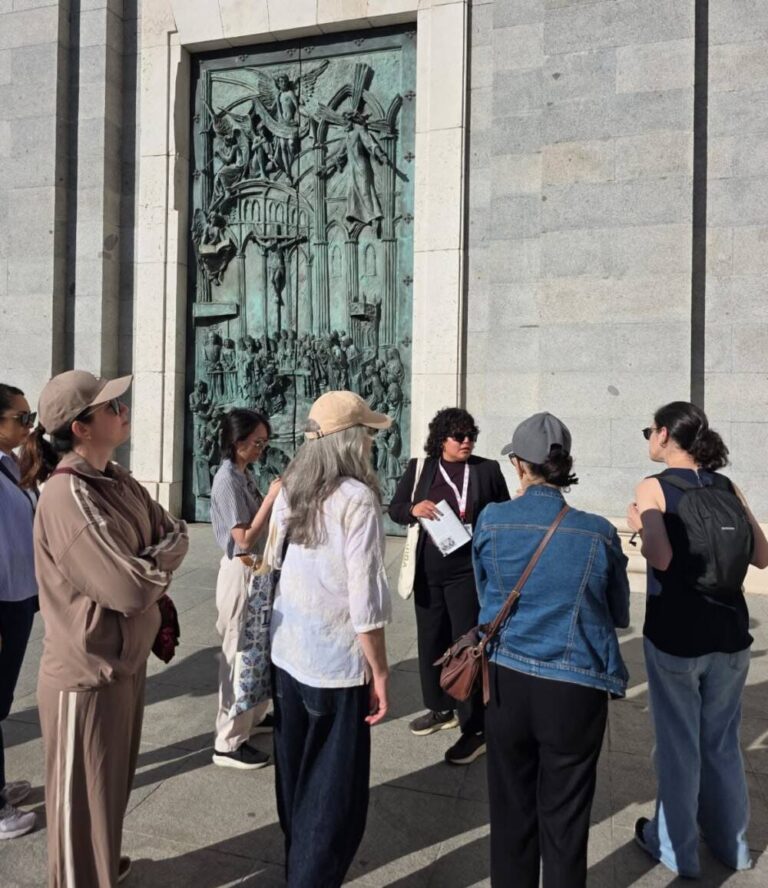
Guides listed on OfficialGuides for Madrid work independently. The guide on this page holds the regional licences for Madrid, Toledo and Segovia. You write to the guide directly, agree the route, the hours and the fee, and pay the guide; there is no booking engine or agency in between.
- Guiding fee: around €70–90 an hour (three hours minimum), €250–300 for a half day of four hours and €400–550 for a full day, per group.
- Licence: in Madrid the title of official tourist guide is optional; in Toledo and Segovia a regional licence is required.
- Day trips: Toledo, about 33 minutes by train from Atocha, and Segovia, about half an hour from Chamartín.
- Getting there: the Airport Express bus runs to the centre 24 hours a day for €5.
Licensed Guides in Madrid: How Guiding Works in Spain
In Spain, tourist guiding is regulated by each region, and the rules around Madrid differ from one region to the next. The Community of Madrid opened the profession under Law 8/2009, so a licence is not compulsory to guide in the city. Decree 18/2017 then created the title of Official Tourist Guide of the Community of Madrid, awarded after an exam on tourism, the region and foreign languages; more than 750 guides held it at the last count. For a traveller this means that anyone may offer a walk in Madrid, and the official title is the way to tell a qualified licensed guide from the rest.
The two day trips are different. Toledo is in Castilla-La Mancha, where Decree 7/2020 requires a regional licence obtained by exam; guides licensed by another Spanish region may also work there. Segovia is in Castilla y León, which regulates guiding under Decree 5/2016 and also keeps a qualifying exam. In Toledo, the local police have an agreement to help check guides’ identification in the old town. A guide who takes you from Madrid to Toledo or Segovia should therefore hold the licence for that region, as the guide on this page does.
Licence numbers you will see in Madrid listings
Licensed guides in Madrid often list several titles, and it helps to know what they refer to. Profiles quote a Madrid number, a Castilla-La Mancha number for Toledo, with a CLM prefix, or a Castilla y León licence for Segovia and Ávila. Many add a separate authorisation for the sites of Patrimonio Nacional, which runs the Royal Palace and El Escorial, and some mention a permit to guide inside Toledo Cathedral and its monuments. None of these is a warning sign; ask the guide which titles they hold for the places on your route.
Licensed, official, local or expert: what the listings say
English listings for Madrid most often describe the person as a “licensed guide”. Many write “official guide”, the literal translation of the Spanish guía oficial, and others write “local guide”, “expert guide” or “professional guide”. Only “licensed” and “official” point to a title; “local” says where someone lives and “expert” says what they know. A licensed tour guide will give the licence number without hesitation, so ask for it before you confirm.
 The Plaza Mayor, completed in 1619 by Juan Gómez de Mora
Private Tours and Guided Tours in Madrid
Central Madrid is walkable: the Royal Palace, the Plaza Mayor and the Prado are all within the old centre and the Paseo del Prado, so most private guided tours in the city are done on foot. Six kinds of private day work well with a licensed guide:
Royal Palace
The state rooms and Habsburg Madrid around the Plaza Mayor.
The Prado
Velázquez, Goya and El Greco in one morning.
Reina Sofía and Thyssen
Picasso’s Guernica and the Thyssen collection.
Retiro and Paseo del Prado
The Landscape of Light, Madrid’s World Heritage Site.
Toledo
The cathedral, El Greco and the old Jewish quarter.
Segovia
The Roman aqueduct, the cathedral and the Alcázar.
The Royal Palace and Habsburg Madrid: Plaza de Oriente and the Plaza Mayor
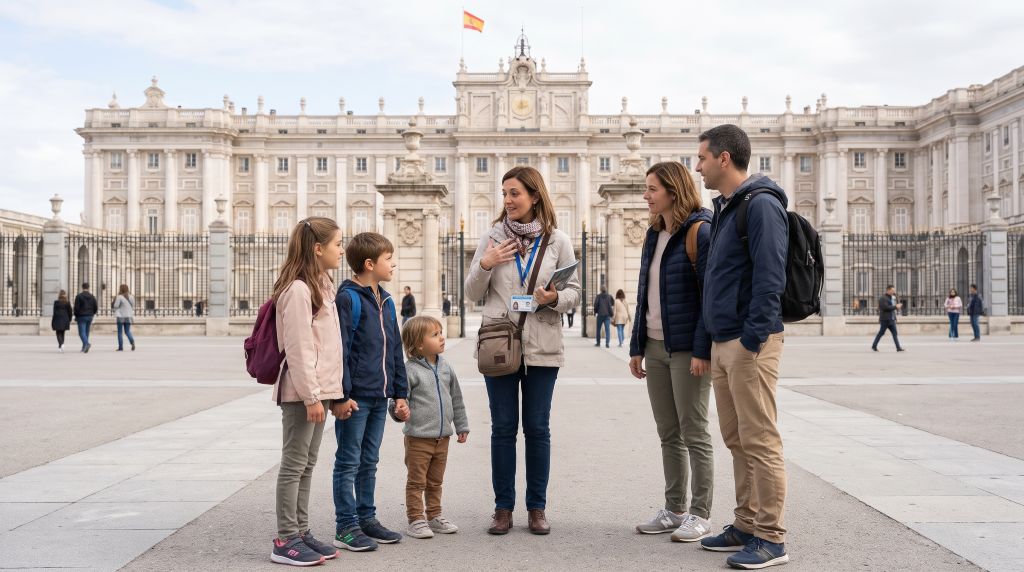
The morning starts at the Royal Palace, which is still used for state ceremonies; on those days it can close at short notice, and your guide checks the calendar before you meet. A self-guided round of the state rooms takes about 45 minutes, and with a licensed guide you see the same rooms with the history of the Spanish monarchy behind them. From the Plaza de Oriente and the Almudena Cathedral outside, the walk goes into the Madrid of the Habsburgs, the oldest part of the city. Its centre is the Plaza Mayor, begun in 1617 under Philip III and completed in 1619 by the architect Juan Gómez de Mora. The square burned three times, in 1631, 1670 and 1790, and was rebuilt each time; the Casa de la Panadería on its north side, with its painted facade, now houses the city’s tourist office, and the equestrian statue of Philip III stands in the middle.
The Prado and the Paseo del Prado: Velázquez, Goya and the Retiro
The Prado holds the largest collection of Spanish painting in the world, and a guided tour of its highlights is the best use of a first visit: Velázquez, Goya and El Greco, with Titian and Rubens. Your guide chooses the rooms in advance, so two to three hours inside are enough for the works most visitors come for. Afterwards you walk along the Paseo del Prado and into the Retiro. Together with the Jerónimos quarter, the boulevard and the park form the Landscape of Light, a UNESCO World Heritage Site and the first in the city of Madrid. The Retiro grew out of the gardens of the Buen Retiro palace, built for the court in 1640, and is now the green lung of the city.
 A private visit to the Prado with a licensed guide (ai illustrated)
Reina Sofía or Thyssen-Bornemisza: a Shorter Museum Visit
If you have only a few hours, book the guide by the hour for one museum. At the Reina Sofía, the visit is built around Picasso’s Guernica, painted in 1937, with Miró and Dalí in the surrounding rooms; photography of the Guernica is not allowed. The Thyssen-Bornemisza, opened in 1992 on the Paseo del Prado, covers European painting from the 13th century to the 20th, starting on the top floor and working down. Guides charge by the hour with a three-hour minimum, which also leaves time for a walk to the Retiro.
Madrid in One Day: the Royal Palace, the Plaza Mayor, the Prado and the Retiro
The full day joins the two half days: the Royal Palace and Habsburg Madrid in the morning, lunch near the Plaza Mayor or Puerta del Sol, then the Prado and a walk through the Retiro in the afternoon. It suits a first visit of one or two days. Book timed tickets for the palace and the Prado in advance; your guide can tell you which slots fit the route.
 The Retiro, part of Madrid’s Landscape of Light
Day Trips From Madrid to Toledo and Segovia With a Licensed Guide
Toledo lies about 70 km south of Madrid and Segovia about 90 km to the north-west. Both are reached by high-speed train in about half an hour, so a day trip can be done by rail, with the guide travelling with you or meeting you at the station, or by car with a driver.
Toledo: the Primate Cathedral, El Greco and the Jewish Quarter
Toledo stands on a rock in a bend of the river Tagus, and its old town has been a UNESCO World Heritage Site since 1986 for what Jews, Muslims and Christians left there. The day often begins at the Mirador del Valle, across the river, for the view of the whole city. Construction of the Primate Cathedral began in 1226 under Ferdinand III; inside, the sacristy holds El Greco’s Disrobing of Christ, and behind the high altar the Transparente, by Narciso Tomé, opens the vault to natural light. In the church of Santo Tomé, El Greco’s Burial of the Count of Orgaz, painted in 1586, still hangs in the chapel it was made for. In the old Jewish quarter you visit two former synagogues: Santa María la Blanca, turned into a church in 1411, and the Synagogue of El Tránsito, built in the 14th century by Samuel ha-Levi and now the Sephardic Museum, closed on Mondays. Depending on the time, your guide adds the small mosque of Cristo de la Luz, with its horseshoe arches, and the monastery of San Juan de los Reyes, built for the Catholic Monarchs.
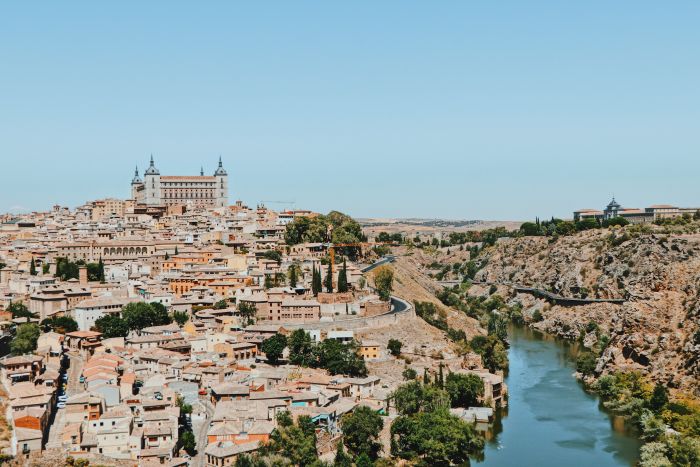 Toledo above the Tagus, about 33 minutes from Madrid by train
Segovia: the Roman Aqueduct, the Cathedral and the Alcázar
The old town of Segovia and its aqueduct have been a UNESCO World Heritage Site since 1985. The aqueduct, built by the Romans at the end of the 1st or the start of the 2nd century, crosses the Plaza del Azoguejo on 167 arches; at its highest point it stands 28.1 metres tall, and its granite blocks are held together without mortar. It carried water to the town until 1973. From the square you climb through the old town to the cathedral, begun in 1525 under Charles V by Juan Gil de Hontañón and known as the last Gothic cathedral built in Spain; it was consecrated in 1768. The walk ends at the western tip of the town at the Alcázar, the royal castle that took its present form under John II and Henry IV in the 15th century. It was rebuilt after a fire in 1862 and today also houses the museum of the Royal Artillery College. If you are fit, climb the 152 steps of the Tower of John II for the view over the town and the plain.
 The Roman aqueduct of Segovia, 28.1 metres at its highest point
Madrid Tour Guide Prices
Guiding fees in Madrid are typical figures, not set tariffs: each guide sets their own fee, and you agree the final price with the guide. Fees are per group, so a private walk costs the same for two people as for six.
| Service | Typical guiding fee (per group) |
| By the hour (minimum 3 hours)One museum, such as the Reina Sofía or the Thyssen | around €70–90 per hour |
| Half day (4 hours)Royal Palace and Habsburg Madrid, or the Prado and the Retiro | around €250–300 |
| Full dayMadrid in one day, or a day trip to Toledo or Segovia; train or vehicle extra | around €400–550 |
Not included: entry tickets, meals and, on day trips, train tickets or the car and driver. Ask the guide for a written breakdown before you confirm. For two or more days with the same guide, for example Madrid followed by Toledo and Segovia, ask for a quote for the whole programme.
Tickets for the Royal Palace, the Museums and the Day Trips
The Royal Palace costs €18 for a self-guided visit, €9 reduced, and official tickets are sold online by Patrimonio Nacional. From Monday to Thursday, in the last two hours before closing, entry is free for EU citizens and residents, with tickets sold only at the box office. The Prado costs €15 (€7.50 reduced) and is free for everyone in its last two opening hours: 18:00–20:00 from Monday to Saturday and 17:00–19:00 on Sundays and holidays. The Reina Sofía costs €12, is closed on Tuesdays and is free from 19:00 to 21:00 and on Sunday from 12:30 to 14:30. The Thyssen costs €14, with free entry to the permanent collection on Mondays from 12:00 to 16:00. In Toledo, the full cathedral ticket costs €12. In Segovia, the Alcázar costs €7 for the palace and museum, or €10 with the Tower of John II, chosen when you buy.
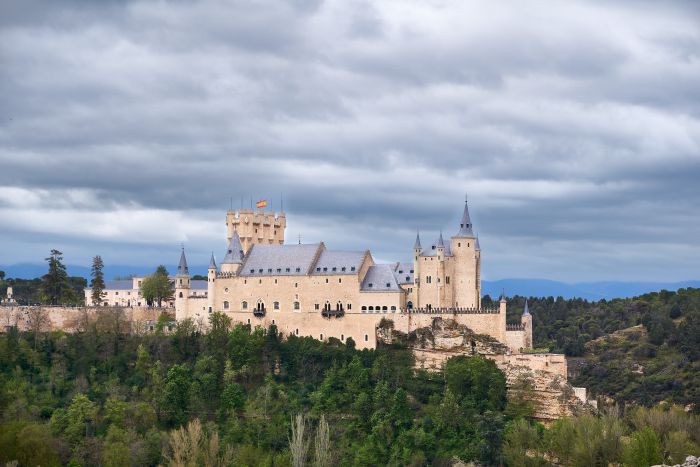 The Alcázar of Segovia, rebuilt after the fire of 1862
Guide, Driver or Train
For Toledo and Segovia, decide first whether you go by train or by car. The train is fast and cheap, and the guide can travel with you or meet you on arrival; a car with a driver saves the station transfer in Segovia and makes it easy to add a viewpoint. The fees in the table cover guiding only, so ask for the vehicle cost separately. Read the details of cheap coach trips sold online: some Toledo day trips from Madrid include only a one-hour guided walk and leave the rest of the day as free time.
Getting to Madrid and to Toledo and Segovia
From Madrid-Barajas airport, the yellow Airport Express bus (line 203) runs 24 hours a day to Cibeles and Atocha for a single fare of about €5. Metro line 8 serves all terminals and adds a €3 airport supplement to the fare, and the Cercanías C1 commuter train leaves from Terminal 4 only. Taxis charge a fixed €33 to anywhere inside the M-30 ring road. For Toledo, Avant trains leave from Madrid Atocha and take about 33 minutes, direct; seat reservations are compulsory. For Segovia, high-speed trains leave from Madrid Chamartín and reach Segovia Guiomar in about 25 to 35 minutes.
When to Plan Your Madrid Tour
Madrid has hot, dry summers and cool winters. In July the average daily high is about 33 °C, and highs stay above 30 °C from mid-June to early September; in January highs are around 10 °C and nights about 3 °C. October is the wettest month and July the driest. Spring and autumn suit long walks and the day trips best; in summer, plan the walking for the morning and spend the hot afternoon in a museum. The Prado closes on 1 January, 1 May and 25 December, and the Reina Sofía every Tuesday.
Premium Options
For families or small groups, ask your guide about a car with a driver for the whole day, or a programme of two to four days with the same licensed guide: Madrid on the first day, then Toledo and Segovia on separate days rather than together. Ask whether lunch in Toledo or Segovia can be planned into the day.
Guides in English and Other Languages
This page is for travellers looking for a guide in English. English-speaking guides are easy to find in Madrid, and many listings also offer French, Italian, German or Portuguese alongside Spanish. For less common languages, write to the guide three to four weeks ahead.
Visa for Spain
Spain is part of the Schengen area, and entry rules depend on your nationality. Check whether you need a visa, and how to apply, on the European Union’s official Travel Europe portal.
Frequently Asked Questions
How much does a private tour guide cost in Madrid?
A typical guiding fee is around €70–90 an hour, €250–300 for a half day and €400–550 for a full day, per group. Each guide sets their own fee; tickets, trains and vehicles are extra.
Do guides in Madrid need a licence?
No, guiding in the city of Madrid is open to anyone. The title of Official Tourist Guide of the Community of Madrid is awarded by exam; Toledo and Segovia require a regional licence.
Can I visit Toledo and Segovia in one day from Madrid?
It is possible by car, but each city deserves its own day. They lie on opposite sides of Madrid, so a combined day leaves only a few hours in each.
Is the train or a car better for a day trip to Toledo?
The train is quicker: about 33 minutes from Atocha. A car is easier for the Mirador del Valle viewpoint across the river, and for groups.
When is the Prado free?
In its last two opening hours: 18:00–20:00 from Monday to Saturday and 17:00–19:00 on Sundays. The free hours cover the permanent collection and draw long queues.
Is a guided tour of the Royal Palace worth it?
Yes, for most visitors: the self-guided route takes about 45 minutes. A guide places the rooms in the history of the Spanish monarchy.
Is a private tour of Madrid good for children?
Yes, the centre is compact and the Retiro is close to the museums. A guide can shorten museum time and add a break in the park.
Plan Your Days in Madrid, Toledo and Segovia
Write to a licensed guide in Madrid with your dates, group size and the places you have in mind, and agree the route in English before you arrive.
Questions Before You Book?
This page is also available in: Français · Português · Español