Last Updated on 20/11/2026
Private Tours in Bari With a Local Guide: Basilica di San Nicola, Bari Vecchia and Day Trips Across Puglia and Matera
This page explains how private walks and day trips with a local guide work in Bari, what guides typically charge and which towns of Puglia and Basilicata you can reach in a day.
Bari keeps the bones of Saint Nicholas, brought by its own sailors in 1087, in a Romanesque basilica at the edge of a walled old town where pasta is still made by hand in the lanes. It is also the natural base for Puglia: Alberobello, Matera, Polignano a Mare and Castel del Monte all lie within a day trip. A local guide who works across the region can walk you through Bari Vecchia in a morning and plan the days beyond it. Fees are set per group, not per person.
On this page: Guide licence · Private tours · Day trips · Prices · Tickets · FAQ
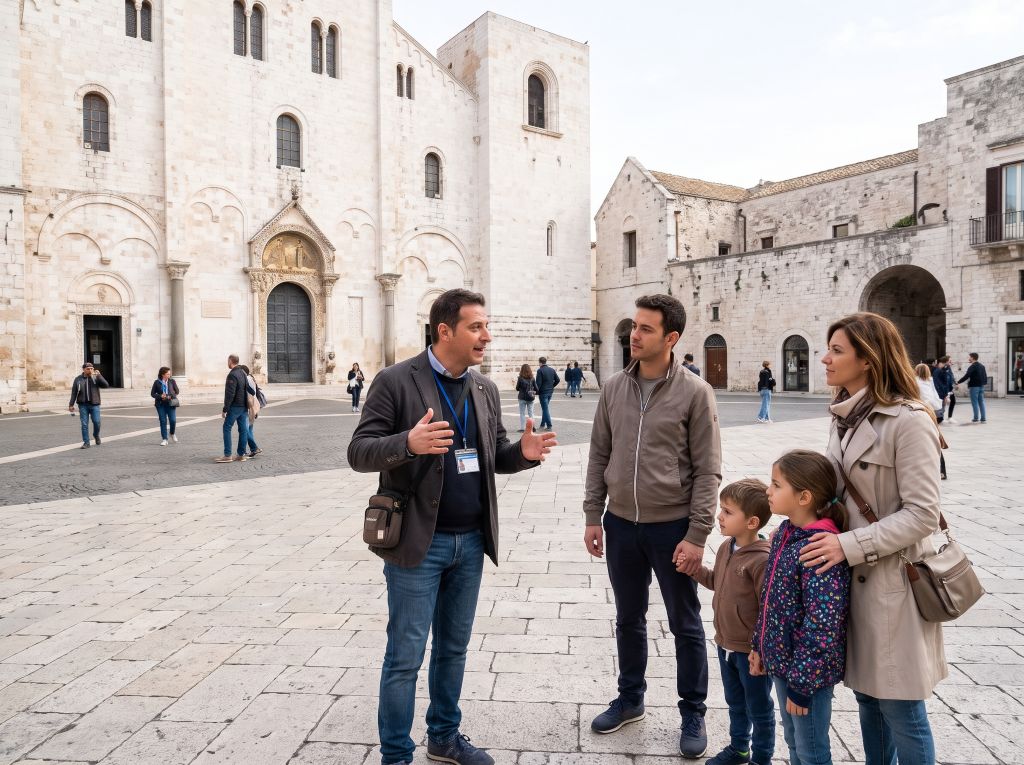
Yurii M.
Guides listed on OfficialGuides for Bari work independently and hold the Italian tourist guide licence. You write to the guide directly, agree the route, the hours and the fee, and pay the guide; there is no booking engine or agency in between.
- Guiding fee: around €350–400 for a half day and €400–450 for a full day, per group.
- Licence: Italian tourist guides are entered in a national register; many in Bari also quote a Puglia Region number.
- Day trips: Alberobello and the Valle d’Itria, Matera and Altamura, Castel del Monte and Trani, the coast to Ostuni, Lecce, Taranto and Grottaglie.
- Getting there: the airport train reaches Bari Centrale in about 20 minutes.
Licensed Local Guides in Bari: How Guiding Works in Italy
In Italy, tourist guiding is a regulated profession under Law No. 190/2023 and its implementing decree, Ministerial Decree No. 88. A guide qualifies through a national examination, or through recognition of a qualification obtained abroad, and is then entered in the national register of tourist guides (Elenco Nazionale delle Guide Turistiche) kept by the Ministry of Tourism. A guide on that register may work anywhere in Italy. Around Bari this matters more than in most cities: Matera, the day trip visitors ask for most, is not in Puglia but in the neighbouring region of Basilicata.
While working, the guide carries a personal identification badge with photo and registration number and shows it on request. You can also look up a name on the Ministry of Tourism’s national platform for tourist guides.
Puglia Region numbers in guide listings
Before the national register, licences were issued by the regions, and many guides in Bari still quote a Puglia Region licence number in their profiles. In Matera you will also see guides described as regionally qualified. Neither is a warning sign. What counts is that the guide shows the badge and gives you a number you can check.
Local, licensed or expert: what the listings say
Most English listings for Bari describe the person as a “local guide” or “local tour guide”. Fewer write “licensed guide”, and some write “expert guide” or “professional guide”. “Local” tells you where someone lives and works, not whether they hold the licence. A local tour guide who holds one will give the number without hesitation, so ask for it before you confirm. The same goes for driver-led day trips: a driver may know the region well, but only a licensed guide may lead the visit.
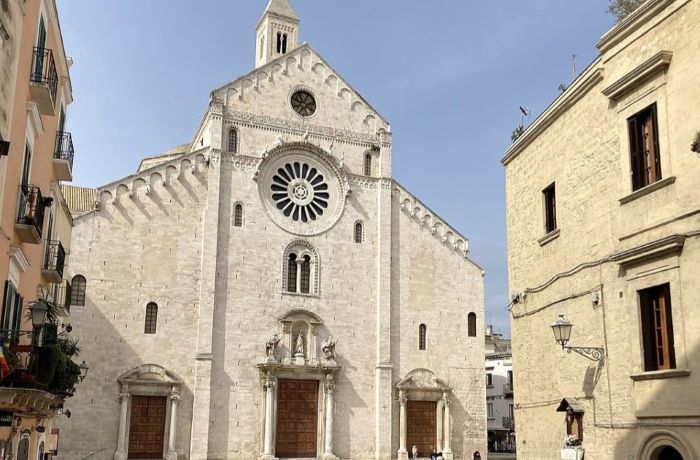 The Cathedral of San Sabino, built in the 12th and 13th centuries
Private Tours and Guided Tours in Bari
Bari Vecchia is compact and mostly pedestrian, so the city part of any private guided tour is on foot; for the rest of Puglia you need a car. Six kinds of private day work well with a local guide:
Bari Vecchia
San Nicola, the cathedral, the castle and the old squares.
Food and pasta
Orecchiette made by hand, focaccia and the fish market.
Trulli and Valle d’Itria
Alberobello and the white towns around it.
Matera and the Murgia
The Sassi cave districts and Altamura.
Castles of Frederick II
Castel del Monte, Trani and the Swabian castles.
Cruise days
Bari, or Bari with Alberobello, timed to the ship.
Bari Vecchia: Basilica di San Nicola, the Cathedral and the Swabian Castle
The walk starts at the Castello Normanno-Svevo. The Norman king Roger II built the first castle; it was destroyed in 1156, when King William I razed the city, and rebuilt in 1233 under Frederick II. Its rooms now hold a gallery of plaster casts of Puglia’s monuments. Across the road, in the lanes towards the cathedral, women sit at tables in front of their doors shaping orecchiette by hand, and your guide explains how this street work became one of the sights of the city. The Cathedral of San Sabino, built in the 12th and 13th centuries, stands over the remains of the Byzantine cathedral and a Roman street, which you can see in the excavated area below the church. The Diocesan Museum next door keeps the Exultet scrolls, illuminated parchments sung at Easter and made in Bari in the 11th century. The high point is the Basilica di San Nicola. It was begun in 1087 for the relics that 62 sailors from Bari had taken from Myra, today Demre in Turkey, and completed in 1197; Pope Urban II consecrated the crypt in 1089. The saint lies in the crypt, where an Orthodox chapel holds services in Greek, Russian and other languages for pilgrims from the Eastern churches. The walk ends in Piazza Mercantile, by the medieval Column of Justice, and on the seafront at Piazza del Ferrarese.
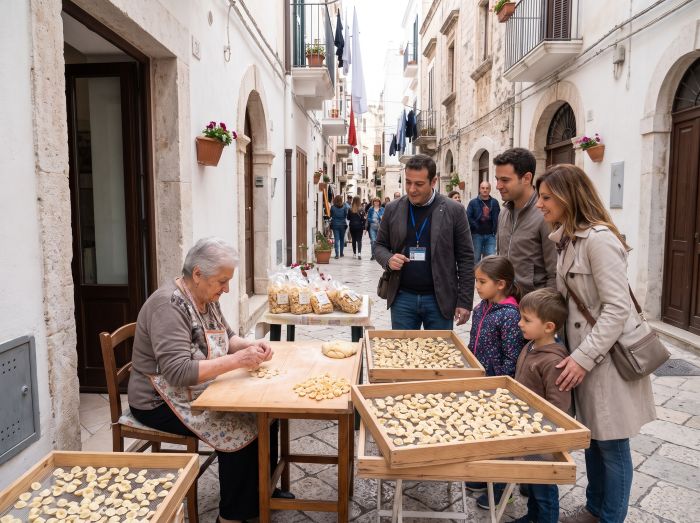 Orecchiette made by hand in the lanes of Bari Vecchia (ai illustrated)
Food walk: the same old town can be done as a tasting walk, with focaccia, fried panzerotti and street snacks, ending at the fish stalls on the old harbour. Cruise day: the cruise terminal is about 20 minutes on foot from the old town, so a half-day walk fits easily between arrival and all-aboard; a full day can add Alberobello or Polignano a Mare.
Day Trips From Bari With a Local Guide
Bari sits on the coast north of the area most visitors come for, with the Valle d’Itria, Matera and the Salento to the south and Frederick II’s castles to the west. The local guides who work from Bari cover all of it, and these are the days they run most often. All need a private car: the guide either drives or works with a driver.
Alberobello and the Valle d’Itria: Locorotondo, Martina Franca and Cisternino
Alberobello is about an hour from Bari by car. Its trulli, round stone houses with conical roofs built without mortar, have been a UNESCO World Heritage Site since 1996; the town has more than 1,500 of them. Rione Monti, with about 1,000 trulli, is the busy quarter of shops and the trullo-shaped church of Sant’Antonio; Aia Piccola, with about 400, is still mostly lived in and much quieter. Your guide takes you into the Trullo Sovrano, the only two-storey trullo in town, and explains the dry-stone technique and the symbols painted on the roofs. The afternoon goes to the white towns of the Valle d’Itria. Locorotondo is built in a circle on a hilltop, with whitewashed lanes and narrow houses with steep pitched roofs known as cummerse. Martina Franca has the most ornate Baroque and Rococo streets of the valley, the Basilica of San Martino and the Ducal Palace, and is the home of capocollo, a cured pork neck. Cisternino is known for its fornelli pronti: butcher’s shops where you choose the meat at the counter and it is grilled for you on the spot.
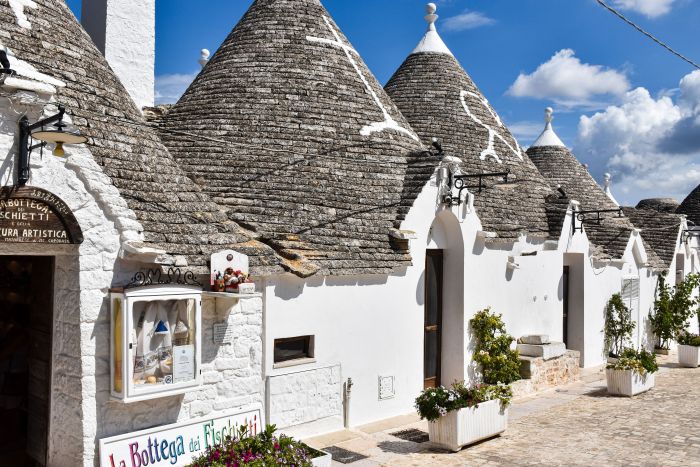 The trulli of Alberobello, about an hour from Bari
Matera and Altamura: the Sassi and the City of Bread
Matera lies about 56 km from Bari, across the regional border in Basilicata. Its two cave districts, Sasso Barisano and Sasso Caveoso, were inscribed by UNESCO in 1993, together with the rock churches of the Murgia. In the 1950s the Sassi were called “the shame of Italy” and their inhabitants were moved to new quarters; your guide tells that story as you walk down from the cathedral, built in 1270, into the lower lanes. Visits usually include a rock church such as Santa Maria de Idris or San Giovanni in Monterrone and a furnished cave house, the Casa Grotta. On the way back you stop in Altamura, whose cathedral was commissioned by Frederick II in 1232 and whose bread, Pane di Altamura, carries a protected designation of origin. In 1993 cavers found the almost complete skeleton of a Neanderthal man in the Lamalunga cave nearby, known as the Altamura Man; outside town, the Pulo is the largest karst sinkhole of the Alta Murgia.
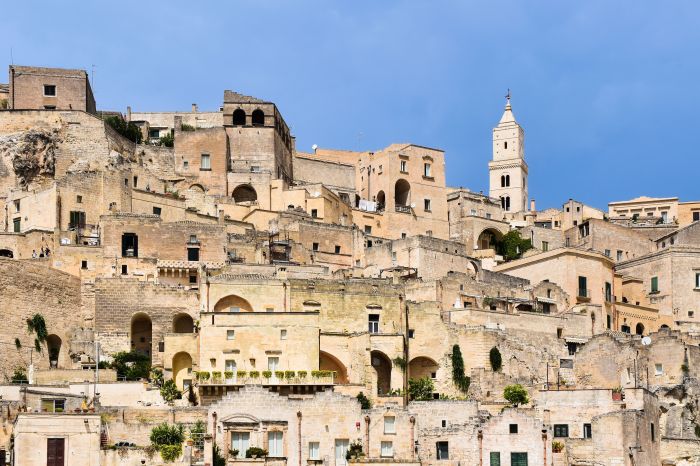 The Sassi of Matera, a UNESCO World Heritage Site since 1993
Castel del Monte and Trani: Frederick II and the Cathedral by the Sea
Castel del Monte stands alone on a hill of the western Murgia. Frederick II had it built in the 13th century on an octagonal plan, with eight octagonal towers around an octagonal courtyard, and it has been a UNESCO World Heritage Site since 1996. Its purpose has never been settled, and your guide sets out the theories behind its geometry. In the afternoon you drive down to Trani, where the Romanesque cathedral of Saint Nicholas the Pilgrim stands on the edge of the sea with a bell tower about 60 metres high. Behind it lies the medieval Jewish quarter: four synagogues once stood here, and two survive, the 13th-century Scolanova, again used as a synagogue, and Sant’Anna, which houses a Jewish museum. The Swabian castle of Trani stands on the waterfront.
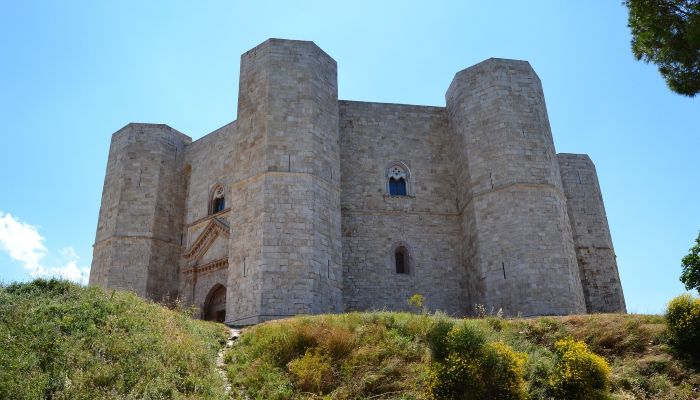 Castel del Monte, Frederick II’s octagonal castle
The Coast South of Bari: Polignano a Mare, Monopoli and Ostuni
Polignano a Mare is built on a limestone cliff above the Adriatic. Its best-known view is the cove of Lama Monachile, crossed by a bridge that stands on a Roman bridge of the Via Traiana, the old road from Rome to Brindisi. On the promenade stands the statue of Domenico Modugno, the singer of “Volare”, who was born here; in calm weather a boat takes you into the sea caves below the town. Monopoli, about 15 minutes further on, is a working fishing town with an old harbour, the 16th-century Castle of Charles V and the cathedral of the Madonna della Madia. The day ends in Ostuni, the White City, whose lime-washed houses climb a hill to the cathedral and the bishop’s palace at the top.
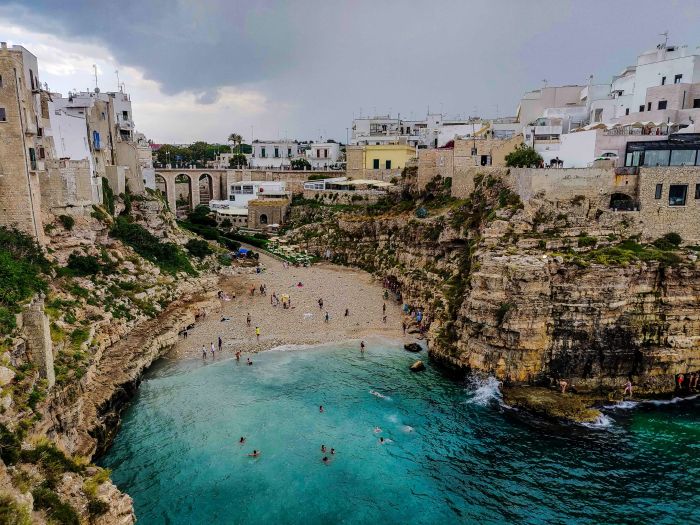 Lama Monachile, the cove of Polignano a Mare
Lecce: the Baroque Capital of the Salento
Lecce is about 140 km south of Bari; the fastest trains take around 1 hour 20 minutes, so the day can be done by rail with the guide meeting you there, or by car. The city is built of pietra leccese, a soft local limestone that can be carved in fine detail. The facade of the Basilica di Santa Croce took from 1549 to 1695 to complete and is the model of Lecce Baroque. In Piazza Sant’Oronzo, a Roman amphitheatre of the 2nd century AD, which held about 20,000 spectators, lies below street level, and the workshops of the old town still make statues of papier-mâché, the cartapesta of Lecce.
Taranto and Grottaglie: Magna Graecia and Ceramics
Taranto, founded by Greek settlers, lies between two seas, the open Mar Grande and the lagoon of the Mar Piccolo. Its National Archaeological Museum, MArTA, holds one of the largest collections of Magna Graecia, including the gold jewellery known as the Ori di Taranto. In the old town, the Aragonese castle, rebuilt between 1487 and 1492, is looked after by the Italian Navy, which runs the visits; entry is free. Nearby, in Piazza Castello, stand the columns of a Doric temple. On the way back you stop in Grottaglie, the town of ceramics, where the workshops of the ceramics quarter cluster below the episcopal castle, which houses the Ceramics Museum.
Bari Tour Guide Prices
Guiding fees in Bari are typical figures, not set tariffs: each guide sets their own fee, and you agree the final price with the guide. Fees are per group, so a private walk costs the same for two people as for six.
| Service | Typical guiding fee (per group) |
| Half day (up to 4 hours)Bari Vecchia walk, food walk or cruise half day | around €350–400 |
| Full dayDay trips to Alberobello, Matera, Castel del Monte, the coast, Lecce or Taranto; vehicle extra | around €400–450 |
Not included: entry tickets, meals and, on day trips, the car and driver. Ask the guide for the vehicle cost and a written breakdown before you confirm. For two or more days in Puglia with the same guide, ask for a quote for the whole programme.
Tickets in Bari and on Day Trips
The Basilica di San Nicola and the Cathedral of San Sabino are free to enter; shoulders and knees should be covered. The Swabian Castle charges admission, with tickets sold online and at the gate, and the Diocesan Museum and the excavations below the cathedral have their own opening hours. At Castel del Monte, a standard adult ticket costs €10, under-18s enter free, and a combined ticket with the Swabian castle of Trani costs €15. The Aragonese castle in Taranto is free. In Matera and Alberobello, the cave houses, rock churches and the Trullo Sovrano charge small fees, paid on the day; your guide plans which ones to enter.
Guide, Driver or Both
For day trips, ask whether the guide also drives. For small groups, many local guides in Bari work with their own car or with a regular driver and a minivan; the fees in the table cover guiding only, so ask for the vehicle cost separately. Read the details of cheap bus trips sold online: some Alberobello and Matera coach tours from Bari include transport, entry to a trullo and a cave house and an audio guide, but state that guided visits are not included.
Getting to Bari and Around Puglia
From Bari Karol Wojtyła airport, the Ferrotramviaria train reaches Bari Centrale in about 20 minutes; a single ticket costs €5.30. Cruise ships dock at the terminal in the new port, about 20 minutes on foot from the old town. Regional trains run from Bari Centrale to Monopoli in about 30 minutes, Ostuni in about 55 minutes, Taranto in just over an hour and Lecce in around 1 hour 20 minutes. Alberobello takes about 1 hour 40 minutes on the regional line, often with a change to a bus, and Matera is easier by road. That is why most combined days, such as Matera with Alberobello or Castel del Monte with Trani, are done by car with a local guide.
When to Plan Your Bari Tour
Bari has hot, dry summers, with highs of about 28 °C in July and August, and mild winters, with January days around 12 °C; November and December are the wettest months. Spring and autumn suit long days in Matera and the Valle d’Itria best. In summer, plan the walking for the morning and the late afternoon. On 7–9 May the city celebrates the arrival of Saint Nicholas’s relics with processions, and the old town is crowded; 6 December, the saint’s feast day, also draws pilgrims.
Premium Options
For families or small groups, ask your guide about a larger air-conditioned vehicle, or a programme of two to five days with the same local guide, combining Bari, Matera, the Valle d’Itria and Lecce. A boat trip into the sea caves of Polignano a Mare can be added to the coast day, and many guides arrange a pasta lesson or a wine tasting in the Valle d’Itria.
Guides in English and Other Languages
This page is for travellers looking for a guide in English. Most guide listings for Bari offer English, usually with Italian. Spanish, French and German are offered by fewer guides, and Polish or Greek by only a handful. For those languages, write to the guide three to four weeks ahead.
Visa for Italy
Italy is part of the Schengen area, and entry rules depend on your nationality. Check whether you need a visa, and how to apply, on the official visa portal of the Italian Ministry of Foreign Affairs.
Frequently Asked Questions
How much does a private tour guide cost in Bari?
A typical guiding fee is around €350–400 for a half day and €400–450 for a full day, per group. Each guide sets their own fee; tickets and, on day trips, the vehicle are extra.
Can I see Alberobello and Matera in one day from Bari?
Yes, it is the most requested combination. With a private car you leave Bari in the morning, spend about two hours in each town and are back in the early evening.
Can a local guide from Bari take me to Matera?
Yes, a guide on the national register may work throughout Italy. Matera is in Basilicata, not Puglia, so check that your guide works there regularly.
Is the Basilica di San Nicola free to visit?
Yes, entry to the basilica and the crypt is free. Cover shoulders and knees, and expect large crowds on 7–9 May.
Is a guided tour of Bari possible on a cruise stop?
Yes, the old town is about 20 minutes on foot from the cruise terminal. A half-day walk fits most calls; a full day can add Alberobello or Polignano a Mare.
How do I know my guide is qualified?
Ask for the registration number and the badge before the tour. You can check the name on the Ministry of Tourism’s national platform.
Is a private tour of Bari good for children?
Yes, Bari Vecchia is compact and largely free of traffic. A guide can shorten the stops and add the pasta makers and a gelato break.
Plan Your Days in Bari and Puglia
Write to a local guide in Bari with your dates, group size and the towns you have in mind, and agree the route in English before you arrive.