Last Updated on 20/11/2026
Private Tours in Oslo With a Licensed Guide: Vigeland Park, the Bygdøy Museums and Day Trips to Fredrikstad and Drøbak
This page explains how private walks, museum visits and day trips with a licensed guide work in Oslo, what guides typically charge, and how Fredrikstad and Drøbak fit into a day.
Oslo sits at the head of the Oslofjord, with a medieval fortress on the harbour, an opera house whose roof you can walk on and the hall where the Nobel Peace Prize is awarded every December. Vigeland Park, with more than 200 sculptures, is open day and night, and the museum peninsula of Bygdøy is a short ferry ride away. A licensed guide who works in Oslo and the Oslofjord can plan a walk through the centre, a morning in the museums or a day trip to the fortress town of Fredrikstad. Fees are set per group, not per person.
On this page: Guide authorization · Private tours · Day trips · Prices · Tickets · FAQ

Nilufer S.
Guides listed on OfficialGuides for Oslo work independently. You write to the guide directly, agree the route, the hours and the fee, and pay the guide; there is no booking engine or agency in between.
- Guiding fee: around €70–80 an hour, €250–350 for a half day of up to four hours and €450–550 for a full day of up to eight hours, per group.
- Authorization: Norway has no state licence for tourist guides; Oslo guides qualify through the exams of guide organisations.
- Day trips: Fredrikstad, about an hour by train from Oslo S, and Drøbak, by boat from Aker Brygge in summer.
- Getting there: the Airport Express Train reaches Oslo Central Station in about 20 minutes.
Licensed Guides in Oslo: How Guiding Works in Norway
Tourist guiding in Norway is not a licensed profession, and there is no state exam for city guides. Outside a few local areas with their own rules, anyone could set up as a guide. Standard Norge, with government support, has published NS 11011, a national standard for the core competence of guides, and a certification scheme is being developed; industry bodies point out that the standard is not a legal requirement.
In Oslo, the qualification that counts comes from the guide organisations. The Norwegian Guide Federation (Norges Guideforbund) runs guide courses based on a set curriculum. At Oslo Guidebureau, one of the city’s long-established guide agencies, all of its more than 250 guides are authorized Oslo guides who have passed a comprehensive exam, and together they speak over 25 languages. This title, autorisert Osloguide in Norwegian, is what a licensed guide in Oslo holds in practice.
Licensed, authorized, certified: what the listings say
Booking sites most often offer a “local guide”, which says the guide lives and works in Oslo. Others promise a “licensed guide” or a “certified guide”, and the city’s visitor pages speak of “official Oslo guides”. In Oslo all three mean the same thing: an authorized guide who has passed the exam. Some guides also list a separate certification for the National Museum, and one notes that restrictions may apply at the Munch Museum, so ask which museums your guide can take you into.
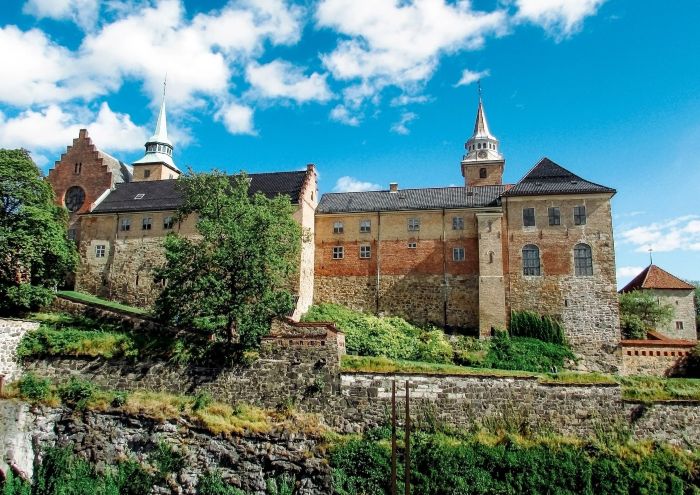 Akershus Fortress, begun in 1299 under King Håkon V
Private Tours and Guided Tours in Oslo
Central Oslo is compact: the Opera, Akershus Fortress, City Hall and the Royal Palace are within walking distance, while Bygdøy and Holmenkollen need a short ferry or metro ride. Four kinds of guided tours work well with a licensed guide:
The harbour front
The Opera, Akershus and the Nobel Peace Prize hall.
Bygdøy museums
The Fram, the Kon-Tiki and a medieval stave church.
Munch and Vigeland
The Scream and the sculpture park.
Fredrikstad and Drøbak
A fortified old town and the fortress that sank the Blücher.
The Harbour Front: the Opera, Akershus Fortress and City Hall
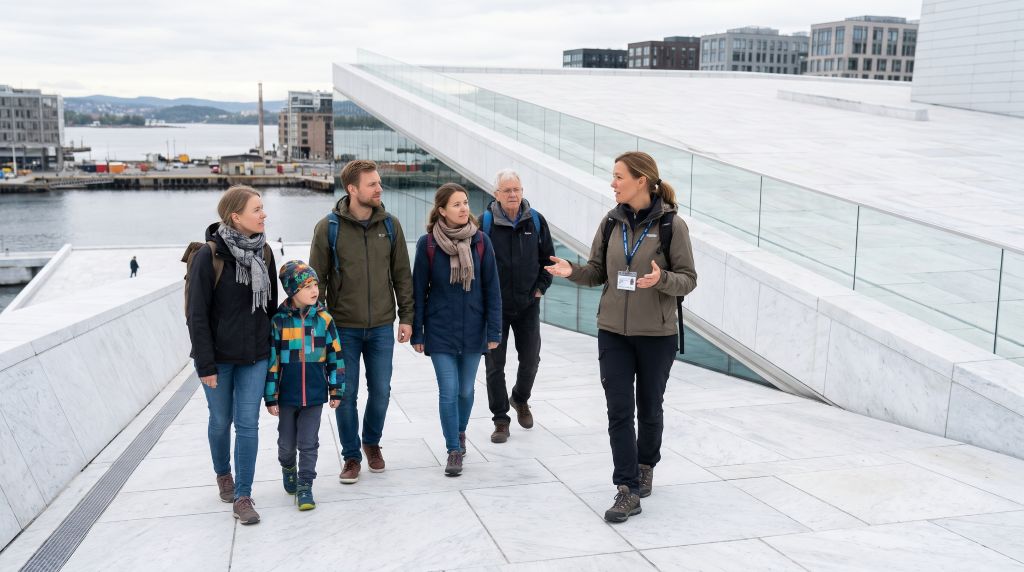
The walk starts at the Opera, designed by Snøhetta, whose sloping roof of white Carrara marble and granite is public space with a view over the harbour. Along the quay you reach Akershus Fortress, begun in 1299 under King Håkon V; the fortress grounds are free, and Kings Haakon VII and Olav V lie in the royal mausoleum. Next comes City Hall (Rådhuset), its two brick towers facing the harbour. The Nobel Peace Prize is awarded in its main hall every year on 10 December, and the murals by Per Krohg, Axel Revold and Alf Rolfsen cover Norwegian history; entry is free. The walk ends along Karl Johans gate, past the Parliament, towards the Royal Palace.
The Bygdøy Museums: the Fram, the Kon-Tiki and the Gol Stave Church
From April to October a ferry leaves City Hall pier (Rådhuskaien 4) for Bygdøy every 20 minutes; the rest of the year bus 30 goes there. The Fram Museum of polar exploration is built around the ship Fram; next door, the Kon-Tiki Museum shows Thor Heyerdahl’s Kon-Tiki raft and Ra II. At the open-air Norsk Folkemuseum, nearly 160 historic buildings from across Norway stand on the peninsula. The best known is the Gol stave church, built in the 13th century and one of the 28 stave churches left in Norway. The Viking Ship Museum on Bygdøy is closed while it is rebuilt as the Museum of the Viking Age; until it reopens, Viking objects are on show at the Historical Museum in the city centre.
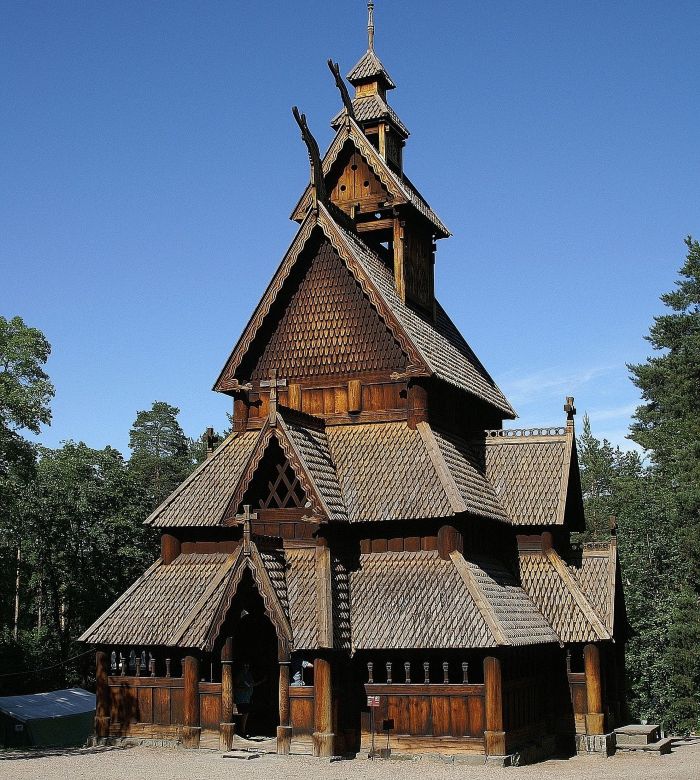 Gol, one of the 28 stave churches left in Norway
A Shorter Visit: Vigeland Park or Munch’s Scream
With only a few hours, book the guide by the hour for one place. Vigeland Park, inside Frogner Park, holds more than 200 sculptures by Gustav Vigeland in bronze, granite and cast iron, and Vigeland designed the layout of the park as well. The best known are the Angry Boy (Sinnataggen), the Monolith, carved from a single block of granite with 121 figures, and the Wheel of Life. The park is free and open around the clock. For painting, there are two addresses: the MUNCH museum in Bjørvika, and the National Museum, the largest art museum in the Nordic countries, where the first painted version of The Scream, from 1893, hangs with the Madonna in the Munch Room.
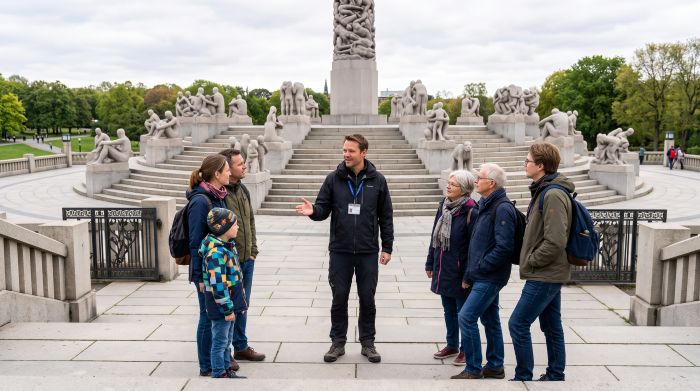 A private walk in Vigeland Park with a licensed guide (ai illustrated)
Oslo in One Day: the Centre, Vigeland Park and Holmenkollen
The full day joins the harbour walk to Vigeland Park, then takes metro line 1 up to Holmenkollen in the afternoon. The ride from Nationaltheatret takes 20 to 25 minutes, followed by a ten-minute walk uphill to the ski jump. One ticket covers the world’s oldest ski museum and the viewing platform at the top of the jump tower. Your guide can swap Holmenkollen for Bygdøy.
Day Trips From Oslo to Fredrikstad and Drøbak With a Licensed Guide
On a day trip the guide charges the full-day fee; train, boat or car costs are extra. Fredrikstad is reached by train, Drøbak by boat in summer and by bus or car the rest of the year. If you go by train or boat, your guide travels with you.
Fredrikstad: Northern Europe’s Best-Preserved Fortified Town
Fredrikstad lies about 90 km south of Oslo by road; Vy trains from Oslo S towards Halden run hourly and take about an hour. The heart of the town is Gamlebyen, founded in 1567 by King Frederick II of Denmark-Norway and regarded as the best-preserved fortified town in Northern Europe, with moats, earth ramparts and cobbled lanes. People still live in the old houses, and galleries and cafés work inside the walls. The train stops in the modern town across the Glomma river, and free city ferries take you over to the old town.
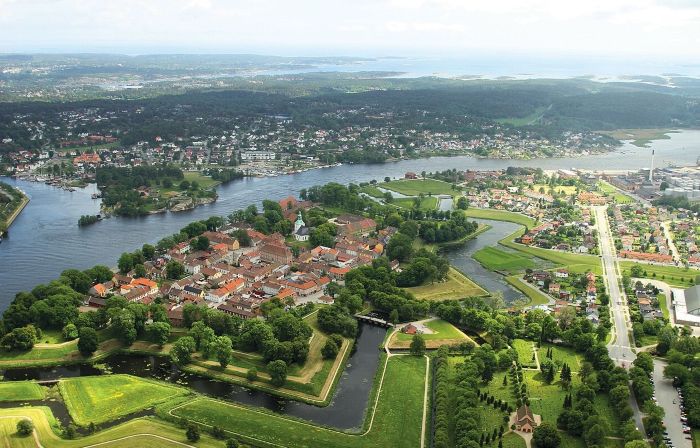 Gamlebyen in Fredrikstad, founded in 1567, about an hour from Oslo by train
Drøbak and Oscarsborg Fortress: Where the Blücher Went Down
Drøbak, about 40 km south of Oslo, is a small fjord town of white wooden houses, known for its year-round Christmas shop. The bigger story lies across the water at Oscarsborg Fortress. In the night of 8 to 9 April 1940, its guns and torpedoes sank the German cruiser Blücher as it sailed towards Oslo, delaying the invasion by several hours and giving the royal family and parliament time to leave the capital. From 15 April to 30 September a boat from Aker Brygge calls at both Drøbak and Oscarsborg; by car, Drøbak is about 40 minutes away.
Oslo Tour Guide Prices
Guiding fees in Oslo are typical figures, not set tariffs: each guide sets their own fee, and you agree the final price with the guide. Fees are per group, so a private walk costs the same for two people as for six.
| Service | Typical guiding fee (per group) |
| By the hourVigeland Park or a single museum | around €70–80 per hour |
| Half day (up to 4 hours)The harbour front, or the Bygdøy museums | around €250–350 |
| Full day (up to 8 hours)Oslo in one day, or Fredrikstad or Drøbak; train, boat or car extra | around €450–550 |
Entry tickets, meals and day-trip transport are not included; ask for a written breakdown before you confirm, and for a single quote if you book several days.
Museum Tickets and the Oslo Pass
Several of Oslo’s main sights are free: Vigeland Park, the grounds of Akershus Fortress, City Hall and the roof of the Opera. Adult museum tickets are priced in Norwegian kroner (NOK):
| Admission | Adult |
| MUNCH (10:00–18:00 / 18:00–21:00) | NOK 280 / 200 |
| National Museum (Nasjonalmuseet) | NOK 220 |
| Fram Museum or Kon-Tiki Museum | NOK 180 |
| Fram + Kon-Tiki combined ticket | NOK 325 |
| Oslo Pass, 24 / 48 / 72 hours | NOK 580 / 845 / 995 |
At MUNCH, under-18s enter free and under-25s pay NOK 100; entry is by timed ticket, so choose your slot in advance. The National Museum is free for under-18s and closed on Mondays except in summer. The Oslo Pass covers public transport and more than 30 museums, including MUNCH, the Bygdøy museums and the Holmenkollen ski museum, plus a shared two-hour group walk by Oslo Guidebureau.
Guide, Driver or Public Transport
Inside Oslo you rarely need a car: the centre is walkable, a ferry runs to Bygdøy and the metro climbs to Holmenkollen. By car, Fredrikstad is about 90 minutes away on the E6 motorway and Drøbak about 40 minutes. The fees in the table cover guiding only, so ask for the cost of a car and driver separately. Some guides in Oslo are also professional drivers. Do not confuse a private tour with the tip-based free walking tours that start at the Tiger statue outside Oslo Central Station: those are open groups.
Getting to Oslo and Around the City
From Oslo Airport Gardermoen, the Airport Express Train (Flytoget) leaves every 10 minutes during the day and reaches Oslo Central Station in about 20 minutes. Vy regional trains cover the same line in 23 to 30 minutes for about half the fare. In the city, trams, the metro (T-bane) and ferries cover every route on this page. Cruise passengers can start a private walk directly from the cruise terminal: guides in Oslo regularly meet guests there or at a downtown hotel.
When to Plan Your Oslo Tour
Oslo has short, mild summers: in July the average daytime high is about 22 °C, and in May there are around 17 hours of daylight. In winter, temperatures often fall below freezing and December has only about six hours of daylight, so walk at midday and keep the museums for after dark. Around 10 December, the day of the Nobel Peace Prize ceremony, City Hall may be partly closed.
Premium Options
For families or small groups, ask your guide about a car with a driver for the whole day, or a programme of two to three days with the same licensed guide: Oslo and Bygdøy on the first days, then Fredrikstad or Drøbak on a day of their own. With children, the Kon-Tiki and the Fram pair well with Vigeland Park.
Guides in English and Other Languages
This page is for travellers looking for a licensed guide in English. English-speaking guides are easy to find in Oslo, and many also offer Spanish, Italian, French or Russian; for less common languages, write three to four weeks ahead.
Visa for Norway
Norway is not a member of the European Union, but it is part of the Schengen area, and entry rules depend on your nationality. Check whether you need a visa, and how to apply, on the official site of the Norwegian Directorate of Immigration: udi.no.
Frequently Asked Questions
How much does a private tour guide cost in Oslo?
A typical guiding fee is around €70–80 an hour, €250–350 for a half day and €450–550 for a full day, per group. Each guide sets their own fee; tickets, transport and meals are extra.
Do tour guides in Norway need a licence?
No, Norway has no state licence for tourist guides. Authorized Oslo guides have passed the exam of a guide organisation; ask your guide which authorization they hold.
Is half a day enough for Oslo on a cruise stop?
It is enough for the centre: the Opera, Akershus Fortress and City Hall are within walking distance. With more time, add Vigeland Park or the Bygdøy museums.
Is the Viking Ship Museum open?
No, it is closed while it is rebuilt as the Museum of the Viking Age. Until it reopens, Viking objects are on show at the Historical Museum in central Oslo.
Can I visit Fredrikstad as a day trip from Oslo?
Yes, the train from Oslo S takes about an hour. The old town can comfortably be explored in a day, with time to return to Oslo in the evening.
Plan Your Days in Oslo, Fredrikstad and Drøbak
Write to a licensed guide in Oslo with your dates, group size and the places you have in mind, and agree the route in English before you arrive.
Questions Before You Book?
This page is also available in: Türkçe