Last Updated on 20/11/2026
Private Tours in Girona With a Licensed Guide: the Cathedral, the Jewish Quarter and Day Trips to Figueres and Besalú
This page explains how private walks and day trips with a licensed guide work in Girona, where the Catalan licence is required, what guides typically charge and how Figueres and Besalú fit into a day.
Girona is a walled city on the Onyar river, an hour’s drive north of Barcelona or 38 minutes by high-speed train. Its old town climbs from the coloured riverside houses to a Cathedral with the widest Gothic nave in the world, and next to it lies the Jewish Quarter, one of the best preserved in Europe. A licensed guide who works in Girona and the surrounding region can plan a walk through the old town, a morning in the Call or a day trip to the Dalí Theatre-Museum in Figueres and the medieval bridge of Besalú. Fees are set per group, not per person.
On this page: Guide licence · Private tours · Day trips · Prices · Tickets · FAQ
Yolanda U.
Guides listed on OfficialGuides for Girona work independently. You write to the guide directly, agree the route, the hours and the fee, and pay the guide; there is no booking engine or agency in between. The guide listed for Girona holds the Catalan tourist guide habilitation, so the inside of the Cathedral and the museums can be part of your route.
- Guiding fee: around €70–90 an hour, €200–250 for a half day (4 hours) and €300–390 for a full day (8 hours), per group.
- Licence: on the streets anyone may guide; inside protected monuments and registered museums only an official guide habilitated by the Generalitat de Catalunya may do so.
- Day trips: the Dalí Theatre-Museum in Figueres, the medieval town of Besalú, or the villages of the Costa Brava.
- Getting there: high-speed trains from Barcelona Sants reach Girona in about 38 minutes.
Licensed Guides in Girona: Where the Catalan Licence Is Required
In Catalonia, guiding visitors through the streets is a free activity, but inside certain sites only a habilitated guide may work. Under the Catalan tourism law and Decree 43/2020, the habilitation is required inside monuments declared a Cultural Asset of National Interest (BCIN) and inside museums on the Catalan museums register. It is issued by the Generalitat de Catalunya after a selection exam, or by recognising a guide licence from another Spanish region or EU country, and it does not need renewing.
A habilitated guide carries an ID with their name, their number in the Generalitat’s register and their two main languages. On a Girona walk this matters as soon as you go indoors: if you want your guide to explain the Cathedral nave or the collections of a museum, not just the streets around them, choose a licensed guide, one who holds the habilitation.
What the listings mean by “local” and “official”
Booking sites most often promise a “local guide”, someone who lives in Girona and knows the old town well. Others offer a “professional guide” or an “expert guide”, and some tours state that an “official guide” leads the group. Only the last points to the Catalan habilitation, which makes its holder a licensed guide; the others describe experience, not a licence. Many guides in Girona print their register number in their profile, and that number is the simplest thing to ask for.
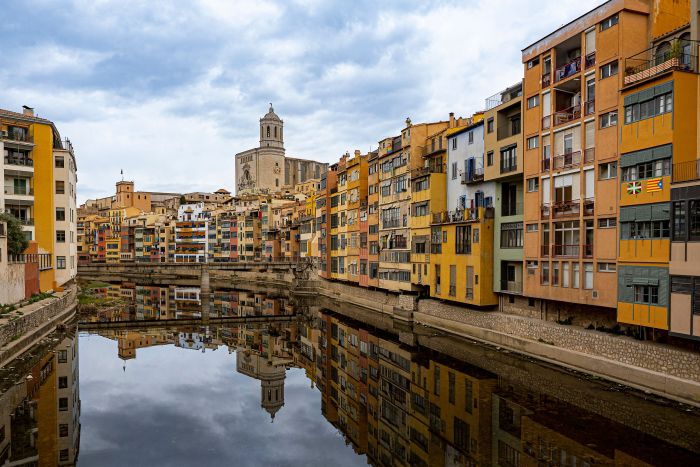 The Onyar houses and the Pont de les Peixateries Velles, built by Gustave Eiffel’s company
Private Tours and Guided Tours in Girona
Girona’s old town, the Barri Vell, is small but steep: the Cathedral, the Arab Baths, the Call and the walls are all within a few minutes of each other, linked by stairways and narrow lanes. Four kinds of guided tours work well with a licensed guide:
The old town
The Onyar houses, Sant Feliu and the Cathedral.
The Jewish Quarter
The Call and the Jewish History Museum.
Walls and film sets
The ramparts and the Game of Thrones locations.
Figueres and Besalú
Dalí’s museum and a fortified medieval bridge.
The Old Town: the Onyar Houses, Sant Feliu and the Cathedral
The walk starts on the river, with the view of the coloured houses along the Onyar and the red iron footbridge known as the Eiffel Bridge, built by Gustave Eiffel’s company before his tower in Paris. In Plaça de Sant Feliu stands the lioness on her column: tradition says that whoever kisses her backside will come back to Girona. The Basilica of Sant Feliu, the city’s cathedral until the tenth century, holds the tomb of Saint Narcissus, Girona’s patron. A long flight of steps then leads up to the Cathedral of Santa Maria, built between the eleventh and eighteenth centuries; its single Gothic nave, 23 metres wide, is the widest of its kind in the world. The walk ends at the Arab Baths, a Romanesque bathhouse from the end of the twelfth century, built by Christians on the model of Roman and Islamic baths.
The Jewish Quarter: the Call and the Jewish History Museum
Until 1492 Girona was home to the second most important Jewish community in Catalonia, after Barcelona. Its quarter, the Call, runs along Carrer de la Força and the lanes and stairways that climb from it, and it is one of the best preserved medieval Jewish quarters in Europe. In the Middle Ages scholars such as the rabbi Nahmanides made the city a centre of Kabbalistic study. The Jewish History Museum occupies the Bonastruc ça Porta centre, on the site where the synagogue and its buildings stood in the fifteenth century; its courtyard has a Star of David set into the stone floor. A guided tour of the Call usually ends on the Pujada de Sant Domènec, the stairway that links the quarter to the upper town.
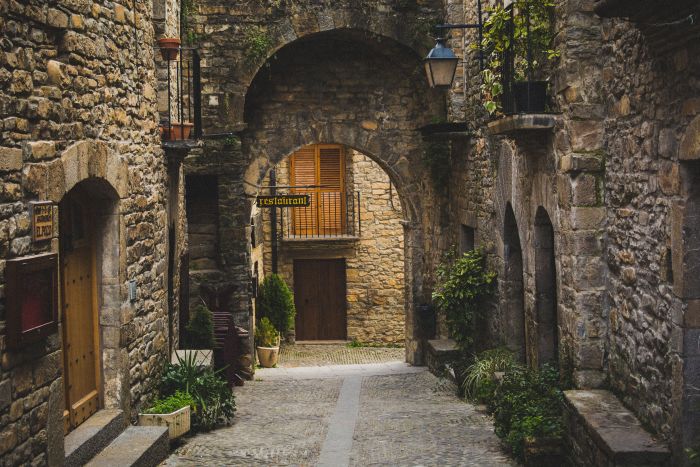 A lane in the Call, one of Europe’s best preserved Jewish quarters
A Shorter Visit: the City Walls or the Game of Thrones Locations
With only a few hours, book the guide by the hour for one theme. The city walls go back to Roman times and were extended in the Carolingian period and again in the fourteenth century. The Passeig de la Muralla runs along the top, free of charge, and from Torre Gironella, its highest point, you see the old town, the river and, on clear days, the Pyrenees. Below the walls stands the twelfth-century Benedictine monastery of Sant Pere de Galligants, now the Girona branch of the Archaeology Museum of Catalonia. Fans of Game of Thrones can follow the sixth season instead: the Cathedral steps became the Sept of Baelor, the lanes behind it the streets of Braavos, and Arya hid from the Waif inside the Arab Baths.
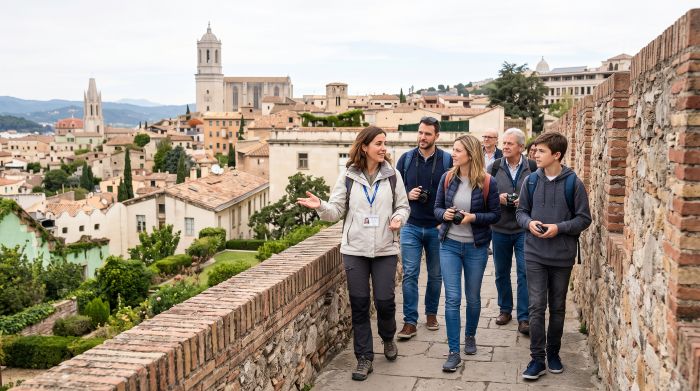 A private walk on the Passeig de la Muralla with a licensed guide (ai illustrated)
Girona in One Day: the Old Town, the Call and the Art Museum
The full day joins the old town walk and the Jewish Quarter, with lunch in between, and adds the inside of a museum. The Girona Art Museum, in the former Bishop’s Palace next to the Cathedral, is covered by the same combined ticket as the Cathedral and Sant Feliu. Your guide can swap the museum for the walls at sunset.
Day Trips From Girona to Figueres and Besalú With a Licensed Guide
On a day trip the guide charges the full-day fee; train or car costs and entry tickets are extra. Figueres is easy by train, while Besalú and the coastal villages are best reached by car. If you go by train, your guide travels with you.
Figueres: the Dalí Theatre-Museum
Figueres is Salvador Dalí’s home town, about 35 minutes from Girona by regional train; high-speed trains stop at Figueres-Vilafant, outside the centre. The Dalí Theatre-Museum, on Plaça Gala i Salvador Dalí, was designed by the artist himself, and entry is by timed ticket, so book your slot before you fix the train. From the town station the museum is a walk of about ten minutes.
Besalú and the Medieval Villages
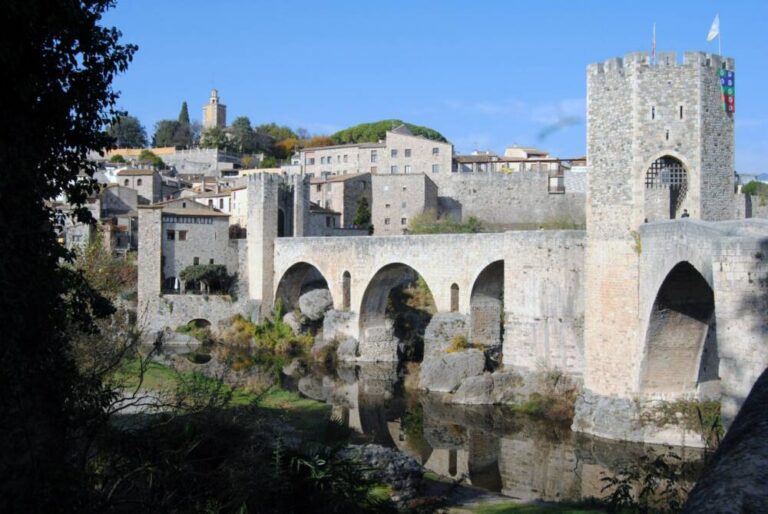
Besalú is entered over its eleventh-century fortified stone bridge across the Fluvià river. The town kept its medieval Jewish quarter, and its mikveh, a ritual bath discovered in the 1960s, is one of the very few found in Spain; it can be seen on the guided visits run by the local tourist office. With a car, the day can continue to the walled villages of Peratallada and Pals, or to the fishing village of Calella de Palafrugell on the Costa Brava.
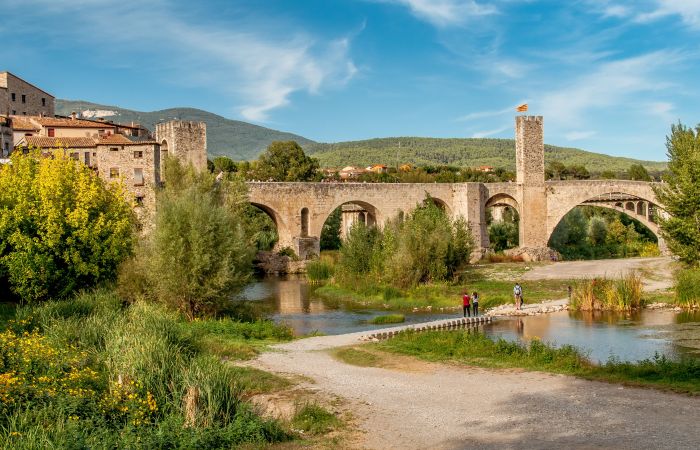 The eleventh-century bridge of Besalú, a day trip from Girona by car
Girona Tour Guide Prices
Guiding fees in Girona are typical figures, not set tariffs: each guide sets their own fee, and you agree the final price with the guide. Fees are per group, so a private walk costs the same for two people as for six.
| Service | Typical guiding fee (per group) |
| By the hourThe city walls or the Game of Thrones locations | around €70–90 per hour |
| Half day (up to 4 hours)The old town, or the Jewish Quarter | around €200–250 |
| Full day (up to 8 hours)Girona in one day, Figueres or Besalú; train or car extra | around €300–390 |
Entry tickets, meals and day-trip transport are not included; ask for a written breakdown before you confirm, and for a single quote if you book several days.
Tickets for the Cathedral and Museums
Several of Girona’s sights are free: the city walls, the Eiffel Bridge, the Onyar riverside and the streets of the Call. For the Cathedral, one ticket also covers the Basilica of Sant Feliu:
| Admission | Adult |
| Cathedral + Basilica of Sant Feliu (audio guide included) | €7.50 |
| Cathedral + Sant Feliu + Girona Art Museum | €12 |
The three-site ticket is valid for 48 hours. The Jewish History Museum is free on the first Sunday of every month; the Arab Baths and the Archaeology Museum at Sant Pere de Galligants charge their own small entry fees, and your guide can tell you the current prices.
Guide, Driver or Public Transport
Inside Girona you do not need a car: the old town is walkable, though steep, and the station is within walking distance. For Besalú and the Costa Brava villages a car is the practical choice. The fees in the table cover guiding only, so ask for the cost of a car and driver separately; some local guides in Girona drive their own vehicle, others work with a chauffeured minivan. Do not confuse a private tour with the tip-based free tours that also run in the old town: those are open groups.
Getting to Girona and Around the City
High-speed AVE and Avant trains from Barcelona Sants reach Girona in about 38 minutes, and the station is a short walk from the old town, so Girona works well as a day trip from Barcelona; see our page on private tours in Barcelona if you are staying there. Girona-Costa Brava Airport lies about 12 km from the city; it has no train station, so take the 607 bus to the bus station next to the railway station, or a taxi. Many guides meet guests at the station or at a hotel in the centre.
When to Plan Your Girona Tour
Girona has hot summers and mild winters: daytime highs reach about 29–30 °C in July and about 13 °C in January. In summer, walk the old town in the morning and keep the museums for the afternoon heat. Every May the city holds Temps de Flors, when flower installations fill courtyards, stairways and monuments across the old town for about nine days and draw hundreds of thousands of visitors; weekdays are quieter. The Fires de Sant Narcís take place in October.
Premium Options
For families or small groups, ask your guide about a car with a driver for the whole day, or a programme of two to three days with the same licensed guide: Girona on the first day, then Figueres and Besalú, or the Costa Brava, on days of their own. With children, the walls, the lioness and the film locations hold attention better than a long museum visit.
Guides in English and Other Languages
This page is for travellers looking for a licensed guide in English. English-speaking guides are easy to find in Girona, and many also work in Catalan, Spanish, French or Italian; a few offer Hebrew or Mandarin. For less common languages, write three to four weeks ahead.
Visa for Spain
Spain is part of the European Union and the Schengen area, and entry rules depend on your nationality. Check whether you need a visa, and how to apply, on the website of the Spanish Ministry of Foreign Affairs: exteriores.gob.es.
Frequently Asked Questions
How much does a private tour guide cost in Girona?
A typical guiding fee is around €70–90 an hour, €200–250 for a half day of up to four hours and €300–390 for a full day of up to eight hours, per group. Each guide sets their own fee; tickets, transport and meals are extra.
Do tour guides in Girona need a licence?
Only to guide inside protected monuments and registered museums. There the guide needs the habilitation issued by the Generalitat de Catalunya; on the streets no licence is required.
Can I visit Girona as a day trip from Barcelona?
Yes, the high-speed train from Barcelona Sants takes about 38 minutes. A half day covers the old town; a full day leaves time for the Jewish Quarter as well.
How long do I need for Girona’s old town?
Half a day is enough for the Onyar houses, Sant Feliu, the Cathedral and the Arab Baths. Add a few hours for the Call and the walls.
Can I combine Girona and the Dalí Museum in one day?
Yes, Figueres is about 35 minutes from Girona by regional train. Book a timed museum ticket for the morning and spend the afternoon in Girona.
Plan Your Days in Girona, Figueres and Besalú
Write to a licensed guide in Girona with your dates, group size and the places you have in mind, and agree the route in English before you arrive.