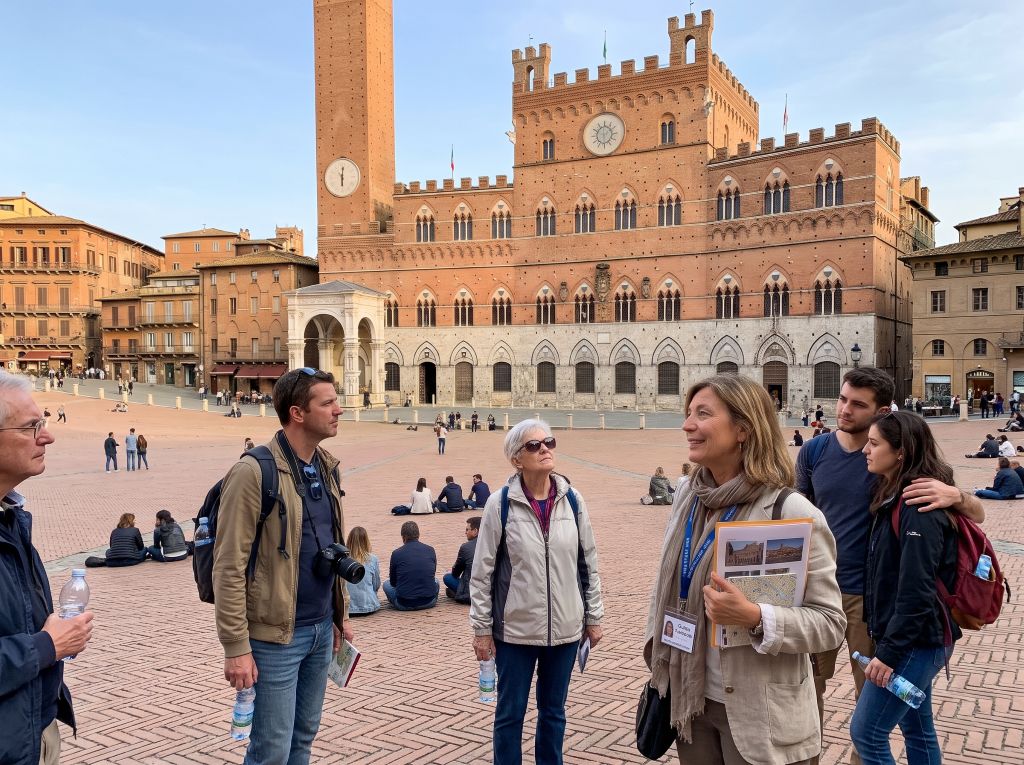
Last Updated on 20/11/2026
Private Tours in Siena With a Licensed Guide: Piazza del Campo, the Duomo and Day Trips Across Tuscany
Half-day walks through the medieval city, full-day trips to San Gimignano, Volterra, the Val d’Orcia, Chianti, Arezzo and Cortona, typical guiding fees and how guiding works in Italy.
Request an English-speaking licensed guide in Siena
Tell us your dates, group size and the places you want to see; your request goes to licensed guides working in Siena, and the guide who takes it replies to you directly in English.
OfficialGuides forwards your request to licensed tourist guides working in Siena, registered under Italian Law 190/2023 in the national register of tourist guides kept by the Ministry of Tourism. The guide who accepts it contacts you directly; you agree the route and the fee with the guide and pay the guide.
Licensed Guides in Siena: How Guiding Works in Italy
In Italy, tourist guiding is a regulated profession under Law No. 190/2023 and its implementing decree, Ministerial Decree No. 88. A guide qualifies through a national examination, or through recognition of a qualification obtained abroad, and is then entered in the national register of tourist guides (Elenco Nazionale delle Guide Turistiche) kept by the Ministry of Tourism. The licence is valid throughout Italy. For a stay in Siena that means one licensed guide can lead you in the city, in San Gimignano and Volterra, in the Val d’Orcia and in Arezzo and Cortona, without changing guide at each provincial border.
While working, the guide carries a personal identification document with photo and registration number and shows it on request. You can also check a name on the Ministry of Tourism’s national platform for tourist guides.
Driver, guide or both
Many day trips from Siena are sold as a car with a driver who shows you the towns. A driver may know the roads and the wineries well, but only a licensed and certified guide may guide you inside the Duomo, the Piccolomini Library or the Etruscan museum in Volterra. Some guides drive their own vehicle; others work with a separate driver. Ask which arrangement applies before the day.

Inside Siena Cathedral with a guide, beside the marble floor panels (ai illustrated)
Private Tours in Siena
A first visit usually spends one half day on the civic city around the Campo and another on the cathedral district. Three kinds of private day work well here:
The medieval city
Piazza del Campo, Palazzo Pubblico and the contrade.
Cathedral and museums
Duomo, Piccolomini Library and Santa Maria della Scala.
Tuscany by road
Hill towns, wine country and Etruscan sites.
Piazza del Campo, the Palazzo Pubblico and the Torre del Mangia
The shell-shaped Piazza del Campo is divided by lines of white stone into nine segments, a reminder of the Council of Nine that governed the medieval republic. Its seat, the Palazzo Pubblico, was built between 1297 and 1310. Inside, the Sala dei Nove holds Ambrogio Lorenzetti’s Allegory of Good and Bad Government, painted between February 1338 and May 1339 for the room where the Nine met; unusually for its time, the subject is civic rather than religious, with a well-run city and countryside on one wall and a ruined one on the other. Simone Martini’s Maestà is in the same palace. Beside it rises the Torre del Mangia, built between 1338 and 1348: about 87 m of brick and stone, 102 m including the lightning rod. It takes its name from the first bell-ringer, Giovanni di Balduccio, nicknamed Mangiaguadagni, “the profit-eater”, whose job ended when a mechanical clock was installed in 1360. The tower reaches the same height as the cathedral’s bell tower, a deliberate balance between city and Church. The walk continues through the streets of the contrade, past the Basilica of San Domenico with the relics of St Catherine of Siena and the palace of Monte dei Paschi, founded in 1472 and regarded as the oldest bank still in business.
The Duomo, the Piccolomini Library and Santa Maria della Scala
The Duomo is known above all for its floor: 56 panels of inlaid and engraved marble made between the 14th and the 19th century, which Giorgio Vasari praised as the most beautiful ever made. Pinturicchio was the only artist from outside Siena to design a panel. Most of the floor is covered to protect it and uncovered for part of each summer, linked to the Palio dates: roughly from late June to the end of July and from mid-August to mid-October. Off the left aisle, the Piccolomini Library was commissioned in 1492 by Cardinal Francesco Todeschini Piccolomini, later Pope Pius III, to house the books of his uncle, Pope Pius II. Pinturicchio and his workshop covered it with ten scenes from the pope’s life between 1503 and 1508, and the young Raphael is said to have worked with him; at the centre stands the Roman marble group of the Three Graces. From the terrace of the Facciatone, the unfinished façade of a planned larger cathedral, the view takes in the whole city. Opposite the Duomo, Santa Maria della Scala was a hospital for pilgrims on the Via Francigena, already recorded in a deed of 1090; its Pilgrims’ Hall is covered with a 15th-century fresco cycle, and the lower floors keep Jacopo della Quercia’s original statues from the Fonte Gaia fountain in the Campo. Beneath the city run the bottini, medieval water tunnels now shown in the Museo dell’Acqua.
Day Trips From Siena With a Licensed Guide
Siena sits at the centre of the province that holds most of Tuscany’s famous hill towns, so day trips are short drives rather than long transfers. The full-day fee covers guiding; the vehicle is arranged and charged separately. Most guides combine two places in one day.
San Gimignano and Volterra
San Gimignano, a stop on the Via Francigena in the Val d’Elsa, once had 72 towers built by rival families to show their wealth; 14 still stand, and the historic centre has been a UNESCO World Heritage Site since 1990. The local white wine is Vernaccia di San Gimignano. Volterra, about 50 km from Siena, was an Etruscan city before it was Roman. You enter through the Porta all’Arco, a gate from the 4th century BC with three carved stone heads, rebuilt in part by the Romans; in the Second World War the townspeople saved it by filling it with stones. The Guarnacci Etruscan Museum, founded in 1761, is one of the earliest public museums in Europe and holds the slender Etruscan votive figure known as the Ombra della Sera. Volterra is also the town of alabaster, still carved in workshops along Via Porta all’Arco, and has a Roman theatre from the 1st century BC funded by the Caecina family.

San Gimignano and its towers above the Val d’Elsa
The Val d’Orcia: Pienza, Montalcino and Bagno Vignoni
The Val d’Orcia, south of Siena, is a UNESCO World Heritage landscape in its own right. Pienza was the village of Corsignano, birthplace of Enea Silvio Piccolomini; as Pope Pius II he had it rebuilt between 1459 and 1462 by the architect Bernardo Rossellino as an ideal Renaissance town, so the morning in the Piccolomini Library in Siena and the afternoon in Pienza tell one story. Pienza’s historic centre is a UNESCO site in its own right, and the town is known for its pecorino cheese. Montalcino, under a 14th-century pentagonal fortress, is the home of Brunello di Montalcino, the first Italian wine to receive the DOCG label. In the hamlet of Bagno Vignoni, the main square is a thermal pool 49 m long and 29 m wide, fed by a spring at 49°C.
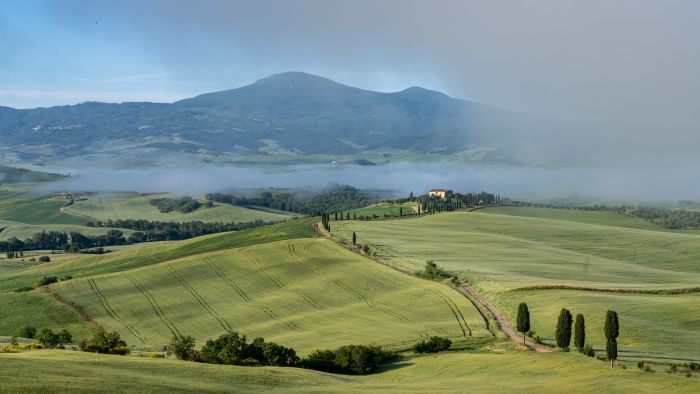
The Val d’Orcia, south of Siena
Chianti Classico: Castellina, Radda and Gaiole
The hills between Siena and Florence were fought over for centuries, and the villages of Castellina, Radda and Gaiole formed the League of Chianti around 1250; Radda became its capital in 1384. In 1716 Grand Duke Cosimo III de’ Medici defined the area allowed to produce Chianti wine, and in 1924 thirty-three growers founded the Chianti Classico consortium in Radda under the old League’s emblem, the black rooster, the Gallo Nero. Legend says Florence and Siena settled their border with a race between two riders who set off at cockcrow; the Florentine black rooster, kept hungry, crowed early, and the riders met at Fonterutoli, near Castellina and only about 12 km from Siena. The SR222, the Chiantigiana, links the villages, with Greve in Chianti further north. A guide plans the stops and the history; tastings at estates are booked and paid separately.

Vineyards in the Chianti Classico hills between Siena and Florence
Arezzo and Cortona
Arezzo, about an hour east of Siena, keeps one of the great Renaissance fresco cycles: Piero della Francesca’s Legend of the True Cross, painted between 1452 and 1466 in the Bacci Chapel of the Basilica of San Francesco. Entry is by timed reservation in small groups, so your guide books the slot ahead. The sloping Piazza Grande hosts the Giostra del Saracino, a joust held twice a year, in June and on the first Sunday of September. Cortona, about 30 km further south, was an important Etruscan centre; the MAEC museum shows its finds, and the Diocesan Museum holds Fra Angelico’s Annunciation and paintings by Luca Signorelli, who was born in the town. The two towns are close enough to see both in one day without hurrying.
Travelling on? See our pages on licensed guides in Florence and private tours in Rome.
Siena Tour Guide Prices
Guiding fees in Siena are typical figures, not fixed tariffs: each guide sets their own fee, and you agree the final price with the guide. Fees are per group.
| Service | Typical guiding fee (per group) |
| Per hour | around €60–80 |
| Half day (3–4 hours) | around €220–260 |
| Full day (incl. day trips, guiding only) | around €420–520 |
Not included: entry tickets, wine tastings, vehicle and driver, and meals. Group size and the programme affect the fee, so mention both in your first message.
Guide, Driver or Both
The guiding fee covers the guide only. Day trips need a vehicle, since the hill towns and estates are far apart and poorly served by public transport. Your guide may drive, may travel in your rental car, or may work with a professional driver; the vehicle cost is separate from the guiding fee. Settle this in your first message, together with the pick-up point.
Getting to and Around Siena
Siena has no high-speed trains. Regional trains from Florence take about an hour and a half and stop at the station in the valley, about 2 km below the centre; from the Porta Siena shopping centre opposite, a chain of escalators and moving walkways climbs to just outside Porta Camollia. Buses 131 and 131R from the coach station beside Florence Santa Maria Novella arrive at Piazza Gramsci, inside the walls, and the rapid service takes about an hour and a quarter. The whole walled city is a limited traffic zone (ZTL) with camera-controlled entry, so if you drive, park outside the walls. Inside, everything is on foot, and the streets are steep.
When to Plan Your Siena Tour
Siena is visited all year, but two dates shape the summer. The Palio is run on 2 July and 16 August: ten of the seventeen contrade race bareback three times around Piazza del Campo, the seven that did not run the previous time plus three drawn by lot. Watching from the centre of the piazza is free, but the square fills hours before the race. The days around each Palio bring trial races and processions, and the cathedral floor is usually uncovered in the same periods. Check the exact dates of the floor uncovering on the official site of the Opera della Metropolitana before you plan. For the Val d’Orcia and Chianti, late spring and the September–October harvest are good times to visit.
Premium Options
For families or small groups, ask your guide about a larger private vehicle for day trips, or a programme that combines a morning in a hill town with lunch at a Chianti or Montalcino estate. Over two or three days, one guide can cover Siena, the Val d’Orcia and Arezzo and Cortona as a single plan.
Guides in English and Other Languages
This page is for travellers who want a guide in English. If your group needs a second language, mention it in the request form, and the guide who takes the request confirms which languages they can offer.
Visa for Italy
Italy is part of the Schengen area, and entry rules depend on your nationality. Check the current requirements on the Italian Ministry of Foreign Affairs portal, Visto per l’Italia.
Frequently Asked Questions
How much does a private tour guide cost in Siena?
A typical guiding fee is around €60–80 per hour, €220–260 for a half day and €420–520 for a full day, per group. Each guide sets their own fee; tickets and transport are extra.
Can a Siena guide take me to Arezzo, Cortona or Volterra?
Yes, the Italian guide licence is valid nationwide. A guide registered under Law 190/2023 can lead you in any Tuscan town as well as in Siena.
When is the marble floor of Siena Cathedral uncovered?
For part of each summer, roughly late June to the end of July and mid-August to mid-October. The exact dates change each year and are published by the Opera della Metropolitana.
Can I see the Palio with a guide?
Yes, though the race itself is best watched rather than guided. A guide can walk you through the contrade, explain the rituals and plan your day around the trial races and the procession on 2 July or 16 August.
How do I know my guide is an official guide?
Ask to see the guide’s personal identification document. Every official guide in Italy is entered in the national register and carries a document with photo and registration number; a professional guide shows it without hesitation. If a seller cannot tell you the name of your qualified guide before the day, ask why.
Plan Your Days in Siena
Send your dates, group size and the towns you have in mind, and a licensed Siena guide will reply.
Fees, ticket prices and opening times are indicative and can change; confirm them with your guide. See our legal disclaimer and privacy policy.