Last Updated on 20/11/2026
Private Tours in Khiva With a Licensed Guide: Itchan Kala, Kalta Minor and the Desert Fortresses of Khorezm
Walking tours of the walled old town, day trips to the desert fortresses and Nukus, typical guiding fees, Itchan Kala tickets and how guides are certified in Uzbekistan.
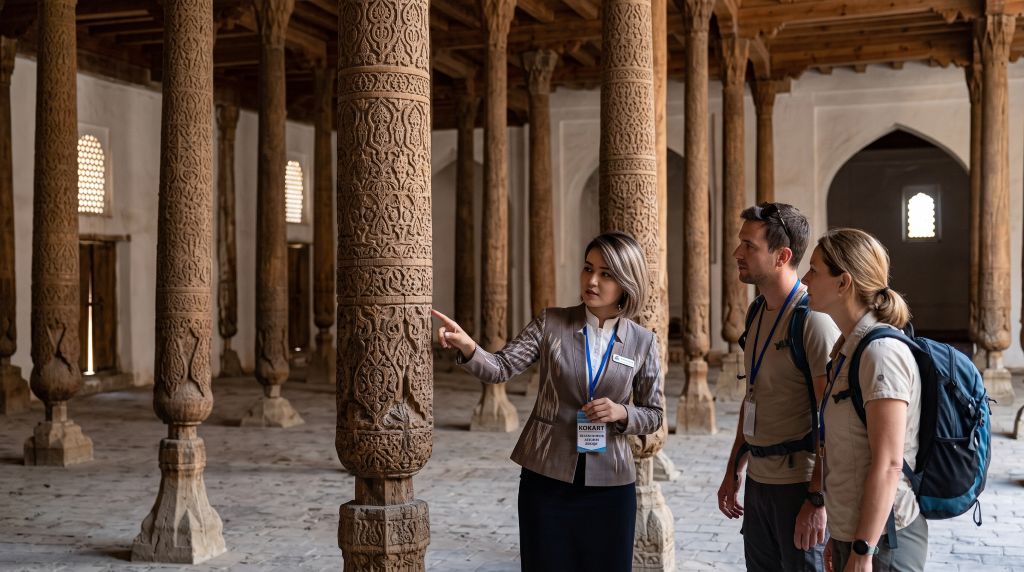
Khiva’s old town, Itchan Kala, packs more than 50 monuments and some 250 old houses into 26 hectares behind its mud-brick walls, and people still live inside them. Without someone to connect the madrasas, palaces and workshops, the walk takes two hours and explains little. An independent licensed guide plans the route around your time, from the unfinished Kalta Minor to the tiled courtyards of Tash Hauli, and takes you out on full-day trips to the desert fortresses of ancient Khorezm. Fees are set per group, not per person; typical figures are under prices.
Shahnoza S.
Guides listed on OfficialGuides for Khiva work independently under Uzbekistan’s qualification certificate for guides and guide-interpreters. You write to the guide directly, agree the route, the hours and the fee, and pay the guide.
Licensed Guides in Khiva: How Certification Works in Uzbekistan
In Uzbekistan, a guide’s licence is a state qualification certificate. Under the Law “On Tourism” (No. ZRU-549), guides and guide-interpreters may work on their own account, without setting up a company, once they hold a qualification certificate. The certificate is issued after a qualification examination together with a guide’s badge, and it does not expire. The national authority for the sector is the Tourism Committee. Tour operators need a separate business licence; a licensed guide does not.
A government resolution, Cabinet of Ministers Resolution No. 468, adds a voluntary system of qualification categories on top of the certificate: amateur guide, specialised guide, professional guide and “Golden Fund” guide, each based on the score in a professional examination. A guide without a category keeps the right to work as long as the certificate is valid.
Licensed, government-certified or local: what the listings mean
Listings for Khiva describe the same document in different words. You will read “licensed tour guide”, “licensed local guide”, “government-certified guide” or simply “local guide”. The first three refer to the state qualification certificate. “Local guide” on its own only says where the person lives, so ask whether they hold the certificate. A licensed guide in Khiva can also work in Bukhara, Samarkand or Nukus, which matters if you want one person for several days.
Guides offering tours at the gates
Around the ticket offices of Itchan Kala, people offer tours on the spot, and some ticket checkers inside the monuments do the same. Their knowledge and prices vary widely. Booking a licensed guide in advance means you know the language, the length of the visit and the fee before you arrive in Urgench or step off the train.
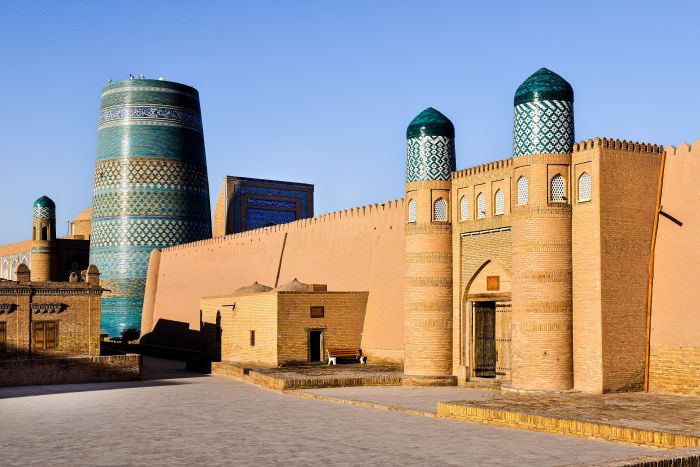
The walls of Itchan Kala, Uzbekistan’s first UNESCO World Heritage Site
Private Tours in Khiva
Itchan Kala measures about 650 by 400 metres and is flat and largely pedestrian, so every city tour is on foot. Six kinds of private tour work well with a licensed guide:
Itchan Kala highlights
Kunya Ark, the Juma Mosque, Tash Hauli and the Pakhlavan Makhmud mausoleum.
Sunrise and sunset walks
The lanes before the monuments open and after the day groups leave.
Desert fortresses
Ayaz-Kala, Toprak-Kala and Kyzyl-Kala by private vehicle.
Crafts and workshops
Wood carving, silk carpets and ceramics in former madrasa cells.
Khorezm food
The bazaar, a family kitchen and green shivit oshi noodles.
Families
Shorter stops, legends of the khanate and a minaret climb for those who want it.
Itchan Kala Essentials: Kalta Minor to Pakhlavan Makhmud
The walk starts at the western gate, Ota Darvoza, where the ticket office sells the combined pass. Right inside stands the Kalta Minor, the “short minaret”: Muhammad Amin Khan began it in 1852 to be the tallest minaret in the Muslim world, and work stopped in 1855, when the khan was killed in battle, at 29 metres on a base about 14 metres wide. Its glazed bands of turquoise and blue tiles have become the emblem of Khiva. From there your guide takes you into Kunya Ark, the khans’ old citadel and residence, then to the Juma Mosque, a flat-roofed hall carried by more than 200 carved wooden columns; the mosque is mentioned as early as the 10th century and was rebuilt in the late 18th. The route continues to Tash Hauli, the palace Allakuli Khan built in the 1830s, with its harem courtyard, carved wooden columns and walls of blue tiles, and ends at the mausoleum of Pakhlavan Makhmud, Khiva’s patron saint, where members of the Qungrat dynasty of khans are buried. This is the format to choose if Khiva is a one-night stop.
Khiva in Depth: Monuments, Workshops and the Nurullabai Palace
The full day covers the main monuments in the morning, then the smaller museums, the climb up the Islam Khodja minaret, the tallest in Khiva and one of the last monuments of the khanate, for the view over the domes, and the wood-carving and weaving workshops that now occupy madrasa cells. Lunch is in a house in the old town or near the bazaar. In the afternoon your guide leads you through the bazaar outside the walls to the Nurullabai Palace, northwest of the walls, finished for Isfandiyar Khan in the last years of the khanate. Its reception halls mix Khorezm craftsmanship with European interiors, and two of the chandeliers were a gift from Tsar Nicholas II. Many visitors skip it, although the palace is covered by the two-day ticket.
Khiva at Sunrise
A short loop in the early morning, before the monuments open and the tour groups arrive: the walls, the empty lanes, low light on the mud brick and residents opening their doors. It works on its own if you only have a morning, or as an early start before the half-day tour on the same day.
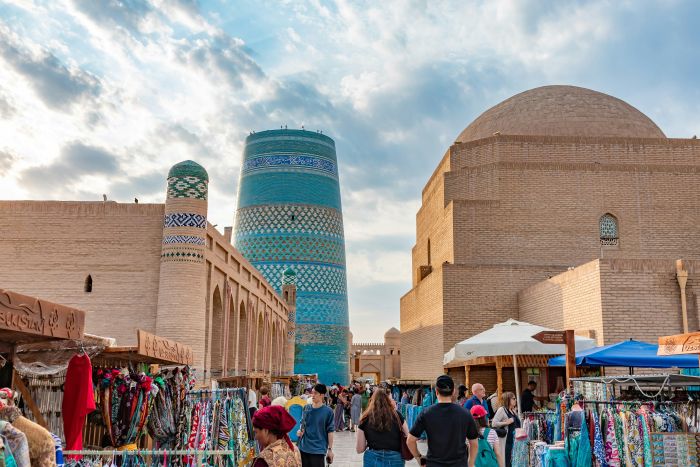
The Kalta Minor, left unfinished in 1855 and now the emblem of Khiva
Day Trips From Khiva With a Licensed Guide
Two days are enough to see Khiva properly, which leaves time for the desert. These are the trips guides run most often.
Desert Fortresses of Khorezm: Toprak-Kala, Kyzyl-Kala and Ayaz-Kala
You leave in the morning for the edge of the Kyzylkum desert, about 100 to 140 km away, roughly one and a half to two hours each way. Toprak-Kala, the “earthen fortress”, was a fortified city of the 1st and 2nd centuries AD and served as a residence and administrative centre of the Khorezm rulers. Nearby Kyzyl-Kala is thought to have been part of its defences. Ayaz-Kala is a group of three fortresses built between the 4th century BC and the 7th century AD; the upper fortress sits on a hilltop above the desert and the lake below. Lunch can be taken in a yurt camp. Each fortress charges a small entrance fee of around 2 USD. The typical fee for this day includes the vehicle and driver; ask the guide to confirm which fortresses are covered and whether lunch is included.
Nukus and the Savitsky Museum (long day): Nukus is about three hours’ drive from Khiva. The Savitsky Museum holds one of the largest collections of Russian avant-garde art in the world, assembled by the painter and collector Igor Savitsky. Entry is around 7 USD per person, and the museum is closed on Mondays. It is a long day, best for travellers with a strong interest in art.
Urgench (half day): mainly useful when a flight or train leaves you several hours between connections. The airport is about 30 minutes from Khiva.
On the way to Bukhara: the road across the Kyzylkum takes six to seven hours and can be done with a guide and a private vehicle, stopping at the fortresses on the way. An electric train also runs between Khiva and Bukhara in about four and a half hours, every day except Tuesday.
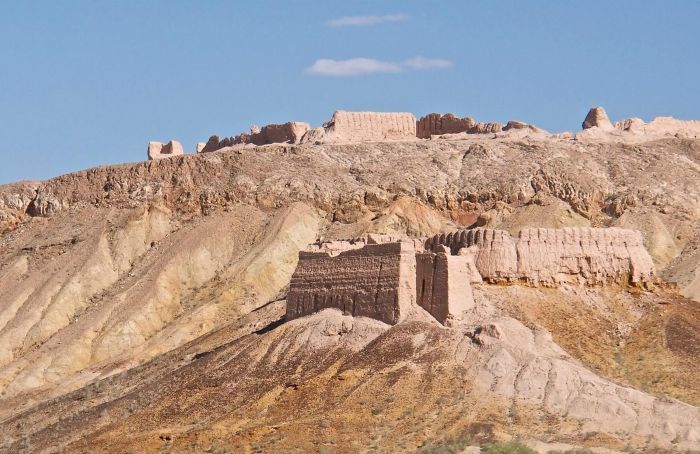
Ayaz-Kala, one of the desert fortresses of ancient Khorezm
Khiva Tour Guide Prices
Guiding fees in Khiva are typical figures, not set tariffs: each guide sets their own fee, and you agree the final price with the guide. Fees are per group, so a private tour costs the same for two people as for six.
| Service | Typical guiding fee (per group) |
| Short walk (about 2 hours) | around €50–70 |
| Half day (up to 4 hours) | around €70–100 |
| Full day (up to 8 hours) | around €120–160 |
| Full day with vehicle and driver (desert fortresses) | around €200–280 |
Not included: entry tickets and meals. Guides who work in less common languages tend to sit at the top of the range and are booked early in April–May and September–October. Ask for a written breakdown before you confirm, stating whether a vehicle is included.
Itchan Kala Tickets
Walking into Itchan Kala and around its lanes is free; the monuments and museums need a ticket. The combined ticket is sold at the ticket offices by the main gates and costs about 250,000 soums. It is valid for two days and covers more than a dozen sites, including Kunya Ark, the Juma Mosque, Tash Hauli and the Nurullabai Palace. Some places charge extra: the Islam Khodja minaret and the watchtower of Kunya Ark (about 100,000 soums) and the Pakhlavan Makhmud mausoleum (about 50,000 soums). Ticket prices have risen several times, so check at the office. If you sleep inside the walls, the two-day validity lets you return the next morning; your guide can tell you which extra climbs are worth it at that hour.
Guide, Driver or Both
For the desert fortresses, check who drives and who guides. Many fortress trips sold online are a driver with a sedan and audio-guide materials, with no guide on board. Others are run by a driver-guide who drives and explains. A licensed guide either drives or works with a separate driver; the typical fee in the price table includes vehicle and driver for this day. Inside Itchan Kala, the person walking with you should be the licensed guide.
Getting to Khiva and Around
Urgench airport, with flights from Tashkent, is about 30 minutes from Khiva by road. A high-speed train, the “Jaloliddin Manguberdi”, runs from Tashkent to Khiva in about seven and a half hours, stopping in Samarkand, Bukhara and Urgench; it runs three times a week in each direction, so book early in high season. Inside Itchan Kala everything is on foot. For the fortresses and Nukus you need a private vehicle.
When to Plan Your Khiva Tour
Khiva is a desert city. April, May, September and October are the most comfortable months, with average highs of about 20 to 30 °C. In July the average high is around 37 °C and there is little shade inside the walls, so guides plan walks for the early morning and late afternoon. Winters are cold, with January nights well below freezing, but the town is quiet and the light is clear. At the fortresses, bring water, a hat and closed shoes in any season.
Premium Options
For a family or a small group, ask your guide about a larger air-conditioned vehicle for the fortresses, or an overnight stay in a yurt camp near Ayaz-Kala to see the desert at sunset and sunrise. A private dinner in a restored house inside the walls can also be added to the day.
Guides in English and Other Languages
This page is for travellers looking for a guide in English. Most guide listings for Khiva offer English, often together with Russian. Guides who work in French, German, Italian or Spanish are far fewer, and many of them work with agencies during the high season. If you need one of those languages, write three to four weeks ahead and state the language in your first message. Each guide’s languages are listed above.
Visa for Uzbekistan
Entry rules for Uzbekistan depend on your nationality and change from time to time. Check whether you need a visa, and apply if you do, on the official e-visa portal of the Republic of Uzbekistan.
Frequently Asked Questions
How much does a private tour guide cost in Khiva?
A typical guiding fee is around €70–100 for a half day and €120–160 for a full day, per group. A desert fortress day with vehicle and driver is usually around €200–280. Each guide sets their own fee; tickets are extra.
Do tour guides need a licence in Uzbekistan?
Yes, guides work under a state qualification certificate. The Law “On Tourism” lets guides and guide-interpreters work independently once they hold the certificate, which is issued after an examination.
Is the Itchan Kala ticket included in the tour?
No, tickets are paid separately. Entering the old town is free, but the combined ticket of about 250,000 soums, valid for two days, is needed for the monuments and museums.
How many days do I need in Khiva?
Two full days work well. A half-day tour covers the main sights of Itchan Kala; a second day leaves time for the sunrise walk and a trip to the desert fortresses.
Can a Khiva guide organise the desert fortress trip?
Yes, it is the most common day trip. The guide arranges the vehicle and driver and quotes one price for the day; ask which fortresses are included and whether lunch is.
How do I know my guide is a qualified guide?
Ask to see the qualification certificate before the tour. The question is routine. Be cautious with offers made on the spot at the gates without a clear price.
Is a private tour of Khiva good for children?
Yes, Itchan Kala is compact, flat and almost entirely pedestrian. A guide can shorten the explanations, tell the legends of the khanate and plan breaks.
Plan Your Day in Khiva
Write to a licensed Khiva guide with your dates, group size and the sights you have in mind.
Questions Before You Book?
Fees, ticket prices and opening times are indicative and can change; confirm them with your guide. See our legal disclaimer and privacy policy.
This page is also available in: Français