Last Updated on 21/11/2026
Private Tours in Seville With a Licensed Guide: the Cathedral, the Real Alcázar, Córdoba, Ronda and the White Villages
This page explains how guiding is regulated in Andalusia, what a private day with a licensed guide in Seville looks like, what guides typically charge, what the Cathedral and the Alcázar cost to enter, and how Córdoba, Ronda and the white villages fit into a day trip.
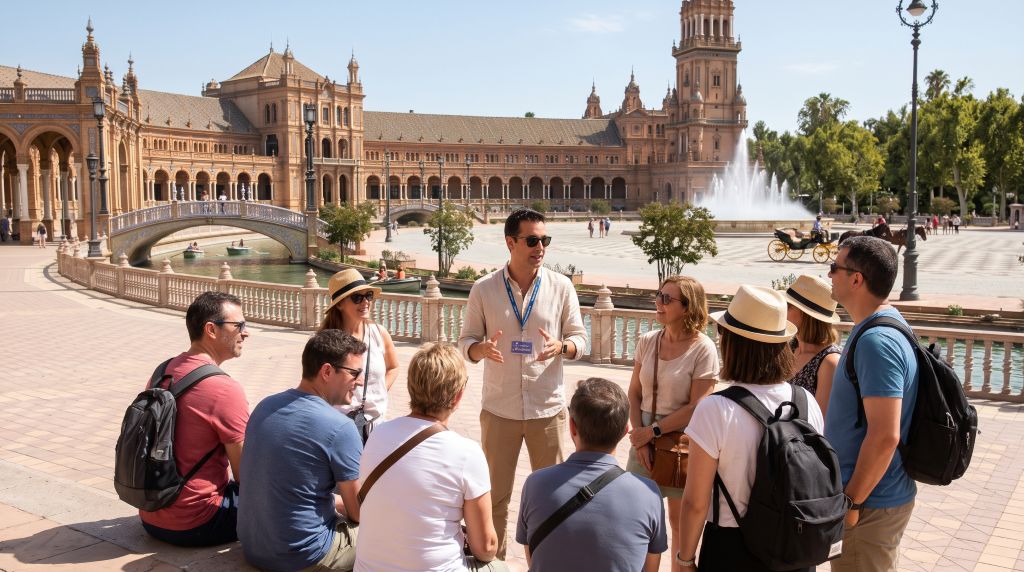
Three days in Seville leave room for the essentials: one for the Cathedral, the Giralda and the Santa Cruz quarter, one for the Real Alcázar and Plaza de España, and one outside the city in Córdoba, Ronda or the white villages of the Sierra de Grazalema. A licensed tour guide in Seville can plan those days with you, around timed tickets and the summer heat. Fees are set per group, not per person.
On this page: Guide licence · Private tours · Day trips · Prices · Tickets · FAQ
Elena J.

MARIA A.
Guides listed on OfficialGuides for Seville are tourist guides licensed by the Regional Government of Andalusia and work independently. You write to the guide directly, agree the route, the hours and the fee, and pay the guide; there is no booking engine or agency in between. OfficialGuides lists licensed guides only.
Seville at a Glance: Guide Fees, Licence and Day Trips
- Guiding fee: around €70–80 an hour, €250–350 for a half day of up to four hours and €550–650 for a full day of up to eight hours, per group.
- Licence: tourist guides in Andalusia are licensed by the Regional Government and must speak Spanish and two foreign languages.
- Day trips: Córdoba, Ronda and the white villages in full; Itálica, Carmona, Cádiz and Jerez as shorter options.
- Getting there: the EA airport bus reaches Santa Justa station in about 30–35 minutes.
Licensed Tour Guides in Seville: How Guiding Is Regulated in Andalusia
In Spain, tourist guiding is regulated by each autonomous community, and in Seville the licence is issued by the Regional Government of Andalusia (Junta de Andalucía). The rules are set out in Decree 8/2015 on tourist guides in Andalusia, amended by Decree 187/2020, under the Andalusian Tourism Act (Law 13/2011). A guide qualifies through a recognised professional qualification and must speak Spanish plus two foreign languages, one of them at B2 level and the other at least at B1. Licensed guides are entered in the Andalusian Tourism Register, and a guide licensed in another Spanish region can also work in Andalusia without further requirements.
In Spanish the profession is called guía de turismo, and in everyday speech guía oficial. Many guides note in their listings that the licence lets them guide inside the historic monuments.
Licensed, official, certified: what the listings say
Search for a guide in Seville and the first results are mostly marketplaces where each guide writes their own description: some say licensed or official, some certified, others call themselves a professional guide or simply a local guide. In Andalusia an official guide and a licensed guide are the same thing. On a private day the programme and the pace are yours, and the guide can buy timed tickets for the Cathedral and the Alcázar around your plan. Every guide listed for Seville on OfficialGuides is a licensed guide.
Private Tours and Guided Tours in Seville: Four Sample Programmes
The old centre is compact and almost flat, and the Cathedral, the Alcázar and the Archive of the Indies stand around the same square. These are the guided tours licensed guides plan most often; entrance tickets are extra.
Cathedral and Giralda
The Gothic cathedral, its bell tower and Santa Cruz.
Royal palaces
The Real Alcázar, its patios and gardens.
Plaza de España and Triana
The 1929 exhibition grounds and the ceramics quarter.
Day trips
Córdoba, Ronda and the white villages.
The Cathedral, the Giralda and the Santa Cruz Quarter
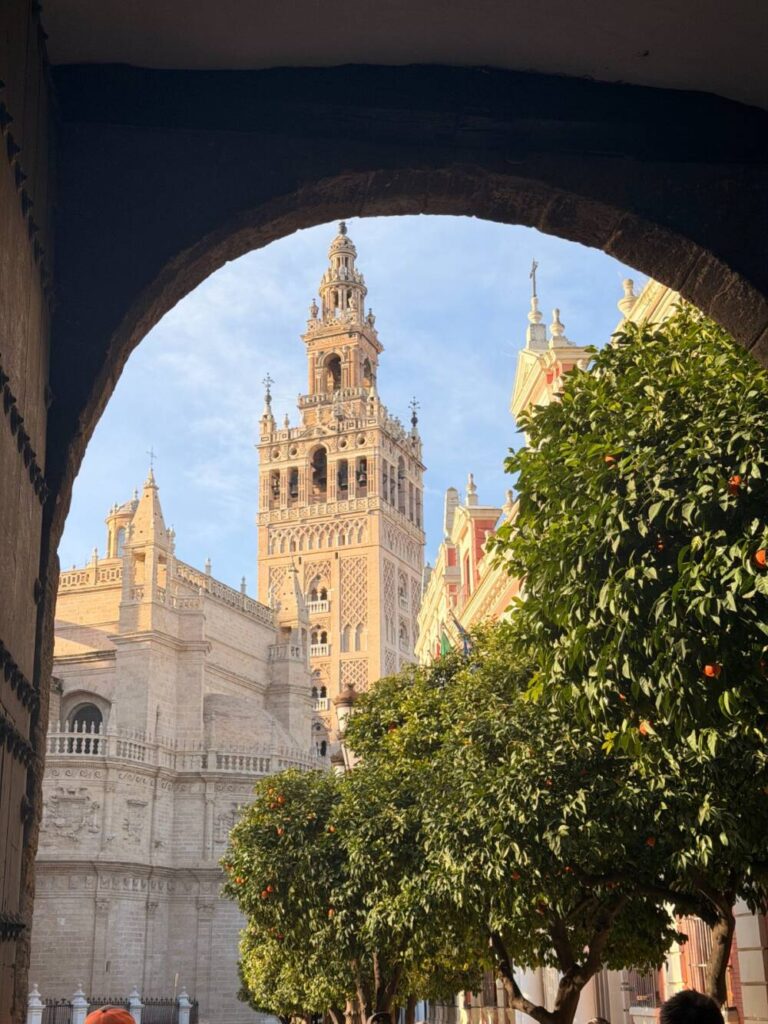
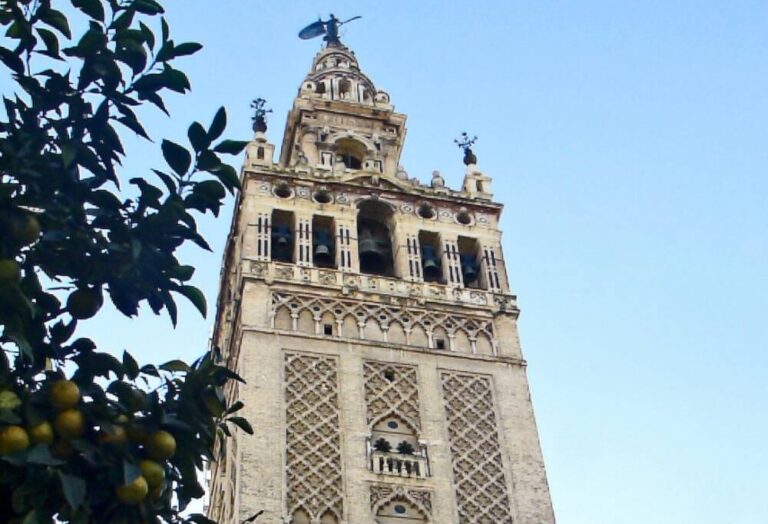
Seville Cathedral is the largest Gothic cathedral in the world, built between 1434 and 1517 on the site of the city’s great mosque; together with the Alcázar and the Archive of the Indies it has been a UNESCO World Heritage Site since 1987. Inside, your guide shows you the main altarpiece, the largest Gothic altarpiece in the world, and the tomb of Christopher Columbus, carried by four figures that stand for the kingdoms of Castile, León, Aragon and Navarre. The bell tower, the Giralda, rises 104.5 m and was built around the mosque’s minaret; it is climbed by ramps rather than stairs. The visit takes about 75 minutes. Afterwards the walk continues through the lanes of the Santa Cruz quarter, the old Jewish quarter, and past the Archive of the Indies, which is free to enter.
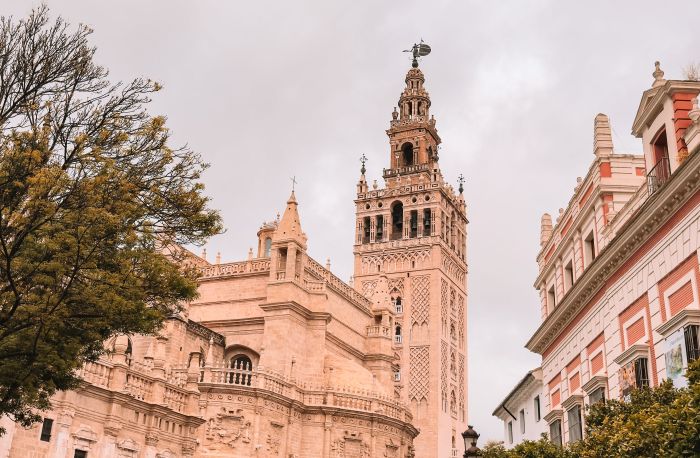 The Giralda, the cathedral bell tower built around the minaret of the great mosque
The Real Alcázar: Palaces, Patios and Gardens
The Real Alcázar is the oldest royal palace in Europe still in use: its upper floors serve the Spanish royal family when they stay in Seville. The heart of the visit is the palace of King Pedro I, built in 1364–1366 in the Mudéjar style by craftsmen from Toledo, Granada and Seville. From the Patio de la Montería your guide leads you to the Patio de las Doncellas and the Hall of the Ambassadors, then out into gardens of about 60,000 m². A visit takes around one and a half to two hours. The royal apartments on the upper floor need a separate ticket.
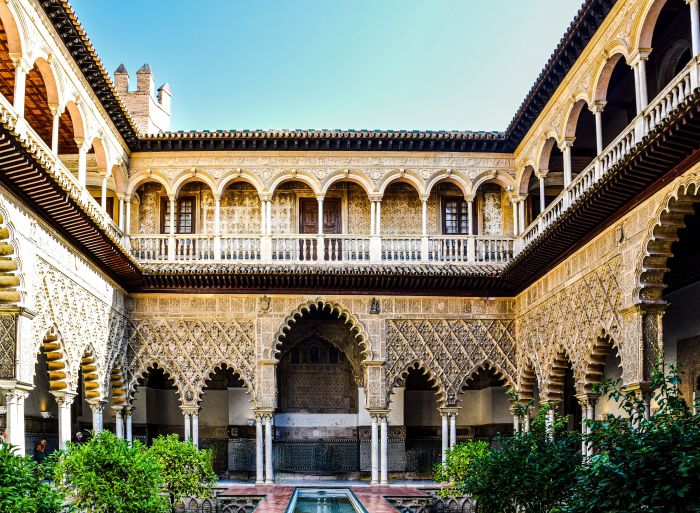 The Patio de las Doncellas in the palace of Pedro I, built in 1364–1366
Plaza de España, María Luisa Park and the Setas
Plaza de España was designed by Aníbal González and built in 1928 for the Ibero-American Exhibition of 1929. Its tiled alcoves each stand for a Spanish province, and the semicircle opens onto María Luisa Park. Two hours are enough for the square and the park; another short walk is the Setas de Sevilla, the wooden canopy over the Plaza de la Encarnación by German architect Jürgen Mayer H., with Roman and Islamic remains in the Antiquarium below and a viewing walkway on top.
Seville in One Day: Cathedral, Alcázar, Plaza de España and Triana
With only one day, the guide combines the Cathedral and the Alcázar in the morning and Plaza de España after lunch. The day ends across the river in Triana, the old potters’ and sailors’ quarter, past the 13th-century Torre del Oro, from which a chain was once stretched across the river, and the Castillo de San Jorge in Triana Market, once the seat of the Inquisition and free to visit from Tuesday to Sunday.
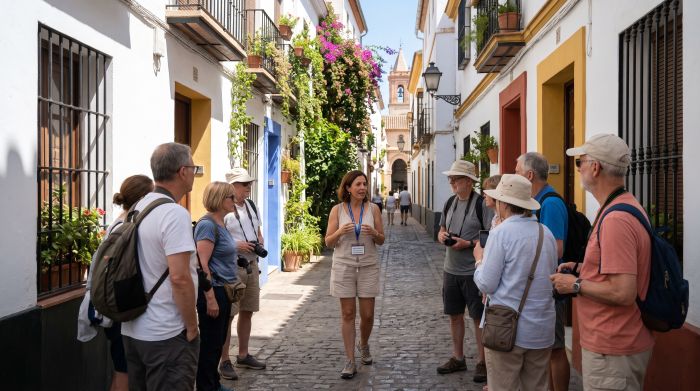 A private walk through the Santa Cruz quarter with a licensed guide (ai illustrated)
Day Trips From Seville to Córdoba, Ronda and the White Villages With a Licensed Guide
Córdoba, Ronda and the white villages each take the full-day fee, with transport and entrance tickets extra. Itálica, Carmona, Cádiz and Jerez follow in short form below.
Córdoba: the Mosque-Cathedral, the Jewish Quarter and the Roman Bridge
The high-speed train from Santa Justa reaches Córdoba in about 41 to 45 minutes. The Mosque-Cathedral was begun in 785 by Abd al-Rahman I and enlarged over the next two centuries: Abd al-Rahman III added the minaret, al-Hakam II the mihrab, and Almanzor made the last extension in 987. After the Christian conquest in 1236 it became a cathedral, and in the 16th century a Renaissance nave was built into the middle of the prayer hall. Your guide explains the double arches of red brick and white stone, many of them resting on reused Roman columns, and the Courtyard of the Orange Trees at the entrance; admission costs €13. The rest of the day goes to the lanes of the Jewish quarter, the Alcázar of the Christian Monarchs, built in 1328 by Alfonso XI, and the Roman bridge over the Guadalquivir, 331 m long with 16 arches. By car, the palace city of Medina Azahara outside Córdoba can be added.
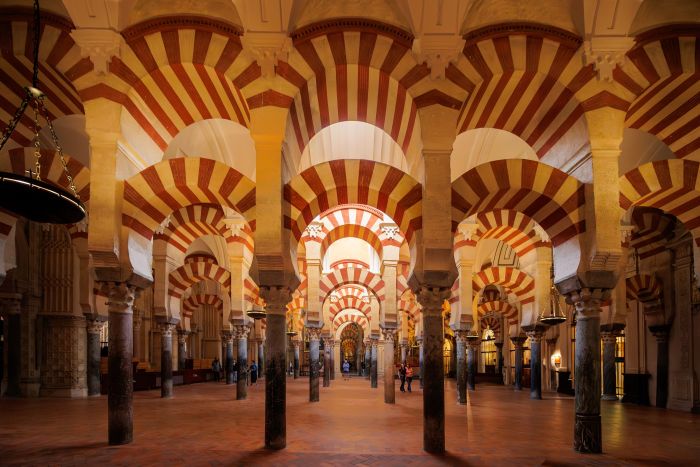 The double arches of the prayer hall in the Mosque-Cathedral of Córdoba
Ronda: the Puente Nuevo, El Tajo Gorge and the Old Bullring
Ronda is about 125 km from Seville, around 1 hour 40 minutes by car; by bus the trip takes over two hours, and the train needs a change, so most private days are by car. The town stands on both sides of El Tajo, a gorge about 120 m deep cut by the Guadalevín river. The Puente Nuevo, completed in 1793 and 98 m high, links the old town, La Ciudad, with the newer El Mercadillo quarter; the older Puente Viejo dates from the early 17th century. Your guide shows you the viewpoints over the gorge, the old town and the bullring of the Real Maestranza de Caballería, built in 1785 by José Martín de Aldehuela and one of the oldest in Spain. Adding one or two white villages makes a day of eight to ten hours, longer than the eight hours of a full day, so agree the extra time with your guide.
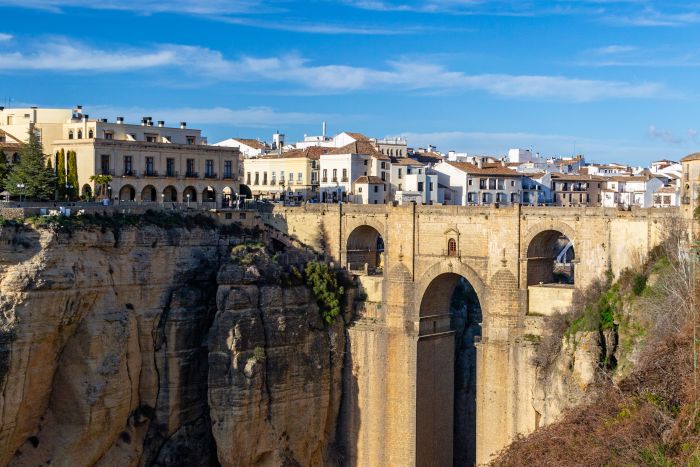 The Puente Nuevo over El Tajo gorge, completed in 1793
The White Villages: Arcos, Grazalema, Zahara de la Sierra and Setenil
The white villages, the Pueblos Blancos, are whitewashed hill towns in the north of Cádiz province and the west of Málaga province, most of them in the Sierra de Grazalema Natural Park, a UNESCO biosphere reserve since 1977 and the rainiest area in Spain. The usual gateway is Arcos de la Frontera, set on a rocky ridge. From there the road climbs to Grazalema, known for its woollen blankets and pottery and for the trail to the Pinsapar fir forest, and to Zahara de la Sierra, with a Nasrid castle above a reservoir. Setenil de las Bodegas is built into the rock along its river, so that some streets run under overhanging cliffs; Olvera, once a refuge for bandits, lies 14 km from Setenil, and Ubrique is known for leather. A typical loop from Arcos through these villages to Ronda covers about 150 km on mountain roads, so a car is the only practical way to see them. Your guide picks three or four villages for the day.
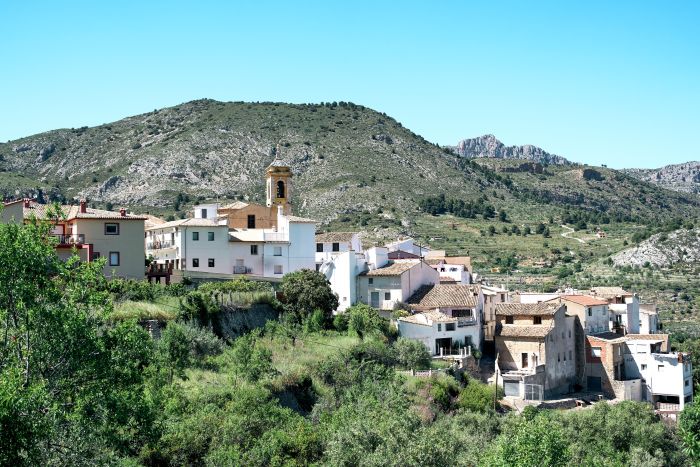 Zahara de la Sierra, with its Nasrid castle above the reservoir
Itálica, Carmona, Cádiz and Jerez
Itálica, at Santiponce 9 km from Seville, was founded in 206 BC by Scipio and was the birthplace of the emperor Trajan; its amphitheatre held about 25,000 spectators; it is closed on Mondays, and the M-170 bus from Plaza de Armas takes about 30 minutes, so a half day is enough. Carmona, about 33 km east of Seville, has the Puerta de Sevilla gate, of Carthaginian origin with Roman alterations, a Roman necropolis and the Alcázar del Rey Don Pedro, now a Parador hotel; it combines well with Córdoba on the same day by car. Cádiz is about 1 hour 24 minutes away on the fastest train, and Jerez de la Frontera, known for sherry and horses, about 47 minutes, so the two make a full day along the same line.
Seville Tour Guide Prices
Guiding fees in Seville are typical figures, not set tariffs: each guide sets their own fee, and you agree the final price with the guide directly. Because the fee is per group, a family of four pays roughly the same guiding fee as a couple.
| Service | Typical guiding fee (per group) |
| By the hourPlaza de España, the Setas or a single monument | around €70–80 per hour |
| Half day (up to 4 hours)the Cathedral and Santa Cruz, or the Alcázar | around €250–350 |
| Full day (up to 8 hours)the city, Córdoba, Ronda or the white villages | around €550–650 |
| Car with driver for day trips | quoted separately, per vehicle |
Entrance tickets, train tickets and any car with driver are paid separately, so ask what is included when you compare offers.
Tickets for the Cathedral, the Alcázar and the Mosque-Cathedral
Walking the old quarters is free, but the Cathedral and the Alcázar charge entry, and both sell tickets online. Adult prices from the official sites:
| Admission | Adult |
| Real Alcázar, general ticket (palaces and gardens; free for under-16s with an adult) | €13.50, plus €1 online |
| Seville Cathedral and Giralda, including El Salvador (free up to 13) | €13 online / €14 at the ticket office |
| Archive of the Indies | free |
| Castillo de San Jorge, Triana (Tuesday to Sunday) | free |
| Mosque-Cathedral of Córdoba | €13 |
| Itálica (free for EU citizens) | €1.50 |
The general Alcázar ticket also covers the Antiquarium under the Setas and the Triana Ceramics Centre.
Guide, Driver or Train
In the city a car is not needed, and Córdoba is easiest by train, but Ronda and the white villages need a car. Some guides in Seville drive guests in their own vehicle, while others travel with a separate driver or accompany you in a car you have hired. The vehicle is quoted separately, so ask how many hours it is booked for and whether fuel and parking are included.
Getting to Seville and Around the City
Seville airport is about 10 km from the centre. The EA bus runs every 12 to 30 minutes and reaches Santa Justa station in about 30 to 35 minutes and Plaza de Armas in about 45; the fare is €5, paid to the driver. Santa Justa is the city’s main railway station, with high-speed trains to Madrid in about 2 hours 39 minutes and to Córdoba in under an hour. Your guide can meet you at the station or your hotel.
When to Plan a Guided Tour in Seville
Seville is busy in spring and very hot in summer. In July and August average highs are around 36 °C and the hottest days reach 42–43 °C, so guided tours start early, the middle of the day goes to indoor sights or a long lunch, and day trips leave first thing. Winters are mild, with average highs of about 15–16 °C in December and January. Holy Week (Semana Santa) brings processions through the centre, and the April Fair follows about two weeks later for six days; hotels fill months ahead for both.
A More Comfortable Seville
For a slower pace, split the city into half days with the same licensed guide and keep the hot afternoons free. With children or older travellers, a car with driver makes Ronda and the white villages much easier, and four or five days give Córdoba, Ronda and the Sierra de Grazalema a day each.
Guides in English and Other Languages
This page is for travellers looking for a licensed guide in English. Because every Andalusian guide must speak two foreign languages besides Spanish, English-speaking guides are easy to find in Seville, and many also guide in French, Italian or German. Specialisms differ: some guides are art historians, others focus on Jewish heritage, wine and sherry, or the countryside of the white villages. Mention your interests in your first message.
Visa for Spain
Spain is part of the Schengen area, and whether you need a visa depends on your nationality. A Schengen visa allows up to 90 days in any 180-day period; applications go to Spanish embassies and consulates. See exteriores.gob.es for current information.
Frequently Asked Questions
Do tour guides in Seville need a licence?
Yes, tourist guides in Andalusia are licensed by the Regional Government under Decree 8/2015. They need a recognised professional qualification and must speak Spanish and two foreign languages; guides licensed in another Spanish region may also work in Andalusia.
Is an official guide the same as a licensed tour guide in Seville?
Yes, it is the same profession. In Spanish the licensed guide is called a guía oficial, so in English listings the same guides call themselves official, licensed or certified Seville guides.
How much does a private tour guide cost in Seville?
Typically around €70–80 an hour, €250–350 for a half day of up to four hours and €550–650 for a full day of up to eight hours, per group. Each guide sets their own fee; entrance tickets, train tickets and any car with driver come on top.
Can I see the Cathedral and the Alcázar on the same day?
Yes, they stand on the same square, and a guide can fit both into a full day. Book timed tickets for the morning and the early afternoon.
Which day trip from Seville should I choose?
For Islamic architecture, Córdoba and its Mosque-Cathedral, an easy trip by train. For mountain scenery, Ronda and its gorge, ideally combined with one or two white villages such as Zahara de la Sierra or Setenil de las Bodegas.
Is there an English-speaking guide for Córdoba from Seville?
Yes, many licensed guides in Seville lead Córdoba days in English, travelling with you by train or by car. Mention Córdoba in your first message, and the guide can plan the day around your train times.
Plan Your Days in Seville
Write to a licensed guide in Seville with your dates, group size and the sights you want to see, and agree the plan in English before you arrive.
Questions Before You Book?
This page is also available in: Español