Last Updated on 22/11/2026
Private Tours in Rimini and Romagna With a Licensed Guide: the Arch of Augustus, the Malatesta Temple and Day Trips to Ravenna, San Marino, Urbino and Gradara
This page explains how tourist guiding is regulated in Italy and San Marino, what a private day with a licensed guide in Rimini looks like, what guides typically charge, what the main sights cost to enter, and how Ravenna, San Marino, Urbino and Gradara fit into a day trip.
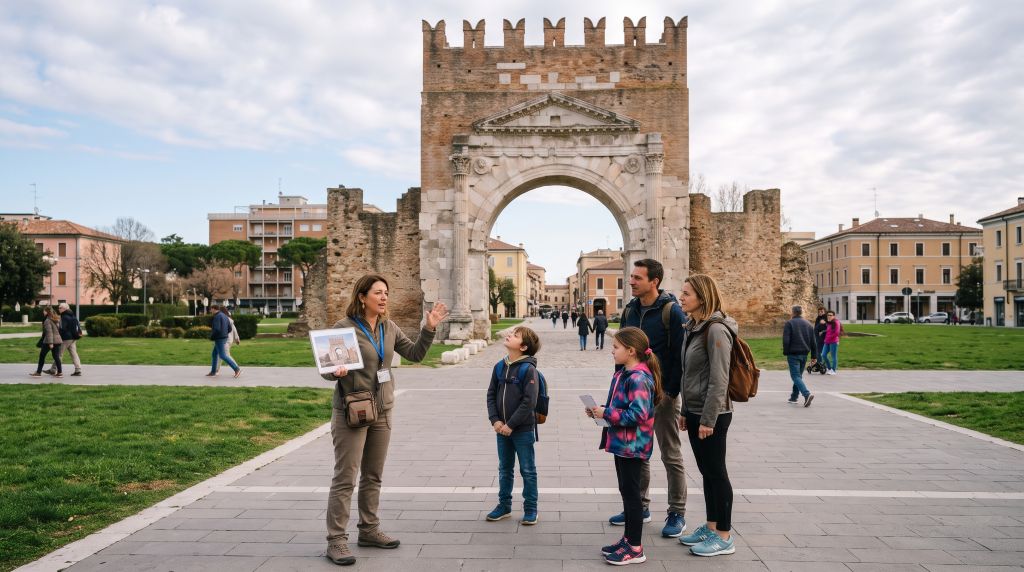
Rimini is more than a beach resort: the Arch of Augustus and the Bridge of Tiberius are among the best-preserved Roman monuments in northern Italy, and the Tempio Malatestiano is one of the key buildings of the early Renaissance. From the city, Ravenna’s mosaics, the Republic of San Marino, Urbino and the castle of Gradara are each less than two hours away. A licensed tour guide in Rimini can plan those days with you. Fees are set per group, not per person.
On this page: Guide licence · Private tours · Day trips · Prices · Tickets · FAQ
Maria M.
Guides listed on OfficialGuides for Rimini are tourist guides licensed under Italian law and work independently. You write to the guide directly, agree the route, the hours and the fee, and pay the guide; there is no booking engine or agency in between. OfficialGuides lists licensed guides only.
Rimini at a Glance: Guide Fees, Licence and Day Trips
- Guiding fee: around €80–120 an hour, €300–350 for a half day of up to four hours and €450–500 for a full day of up to eight hours, per group.
- Licence: tourist guides in Italy qualify through a national examination and are listed in the national register of the Ministry of Tourism; the licence is valid throughout Italy.
- Day trips: Ravenna, San Marino, Urbino and Gradara in full; Santarcangelo, San Leo and Verucchio as shorter options.
- Getting there: high-speed trains from Bologna take under an hour; Rimini’s own airport is about 5 km from the centre.
Licensed Tour Guides in Rimini: How Guiding Is Regulated in Italy and San Marino
In Italy, tourist guiding is a regulated profession under Law 190/2023, and since the reform the licence is national rather than regional. A guide qualifies by passing the national qualifying examination, or by having a foreign qualification recognised, and is then entered in the National Register of Tourist Guides (ENGT) kept by the Ministry of Tourism; the implementing rules are set out in Ministerial Decree 88/2024. The register is online and can be searched by the public, with each guide’s specialisations and languages. A licensed guide carries a personal photo ID with their registration number and may work anywhere in Italy, so the same guide can lead you through Rimini in Emilia-Romagna and through Urbino and Gradara, which lie in the Marche.
San Marino is an independent republic with its own rules. Tourist professions there, including tourist guiding, require a San Marino qualification and entry in the register of tourism professionals kept by the republic’s Tourism Office, which publishes the list of authorised tourist guides.
Licensed, qualified, certified: what the listings say
Search for a guide in Rimini and the first results are mostly marketplace and tour-operator listings, where each product describes its guide in its own words: a licensed tour guide wearing a visible licence badge, a fully qualified guide, a certified historical guide for San Marino, or a professional local guide. Under Italian law they all refer to the same thing, a guide entered in the national register. On a private day the programme and the pace are yours, and the guide can book timed entries in Ravenna and plan the drive into the hills. Every guide listed for Rimini on OfficialGuides is a licensed guide.
Private Tours and Guided Tours in Rimini: Sample Programmes
The historic centre is compact and flat: the Arch of Augustus and the Bridge of Tiberius mark the two ends of the Roman main street, now Corso d’Augusto, and most sights lie within a 15-minute walk of it. These are the guided tours licensed guides plan most often; entrance tickets are extra.
Roman Rimini
The Arch of Augustus, the Bridge of Tiberius and the Surgeon’s House.
Malatesta Rimini
The Tempio Malatestiano and Castel Sismondo.
Fellini’s Rimini
The Fellini Museum, the Fulgor cinema and Borgo San Giuliano.
Day trips
Ravenna, San Marino, Urbino and Gradara.
Roman and Renaissance Rimini: From the Arch of Augustus to the Bridge of Tiberius
Rimini began as the Roman colony of Ariminum, founded in 268 BC, and the walk follows its main street. The Arch of Augustus was built by the Roman Senate in 27 BC in honour of the first emperor and marked the end of the Via Flaminia from Rome; it is the oldest surviving Roman arch of its kind in northern Italy and appears on the city’s coat of arms. Halfway along, your guide stops at the Tempio Malatestiano, the city’s cathedral, which is free to enter. Around 1450 Sigismondo Pandolfo Malatesta, lord of Rimini, had Leon Battista Alberti wrap a Franciscan church in a marble shell modelled on Roman architecture; the work stopped in 1460 and the building was never finished. Inside are a crucifix by Giotto, his only work in the city, a fresco by Piero della Francesca of 1451 showing Sigismondo kneeling before Saint Sigismund, reliefs by Agostino di Duccio and the tomb of Isotta degli Atti. The walk continues through Piazza Cavour to the Bridge of Tiberius, begun under Augustus in AD 14 and completed under Tiberius in AD 21. Its five stone arches still stand after retreating German forces tried to destroy it in 1944. Across the bridge lies Borgo San Giuliano, the old fishermen’s quarter, with murals dedicated to Federico Fellini.
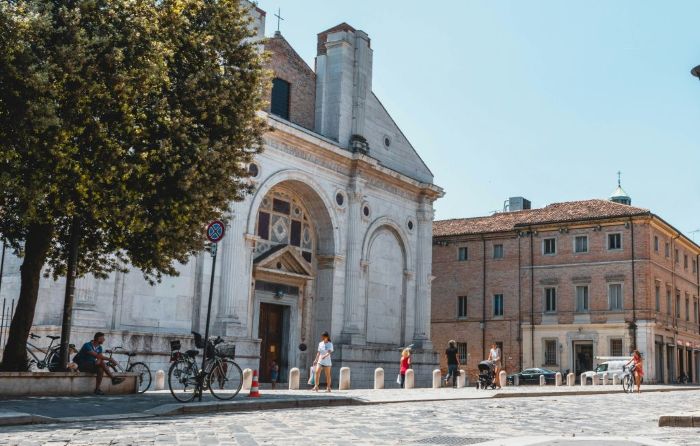 The Tempio Malatestiano, Rimini’s unfinished Renaissance cathedral by Leon Battista Alberti
The Surgeon’s House and the Fellini Museum
Under a glass structure in Piazza Ferrari lies the Domus del Chirurgo, a Roman house of the 2nd century AD found in 1989. It is named after its last owner, a surgeon, whose kit of more than 150 instruments is now displayed in the nearby City Museum. Two hours are enough for both, or for the Fellini Museum, spread over three sites: Castel Sismondo, the fortress-residence Sigismondo Malatesta began in 1437 with advice from Filippo Brunelleschi; the Palazzo del Fulgor, whose cinema is where Fellini saw his first films; and Piazza Malatesta between them, with a fountain recreating the fog of Amarcord.
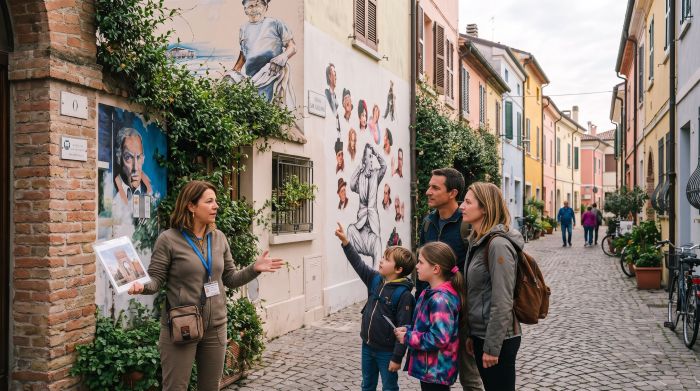 A private walk through Borgo San Giuliano with a licensed guide (ai illustrated)
Day Trips From Rimini to Ravenna, San Marino, Urbino and Gradara With a Licensed Guide
Ravenna, San Marino and the pairing of Urbino and Gradara each take the full-day fee, with transport and entrance tickets extra. Santarcangelo, San Leo and Verucchio follow in short form below.
Ravenna: Byzantine Mosaics and Dante’s Tomb
Ravenna is about 49 km north of Rimini; the fastest trains take 43 minutes. Eight of its early Christian monuments have been a UNESCO World Heritage Site since 1996. Your guide starts at the Basilica of San Vitale, completed in 547 under the Byzantine emperor Justinian, whose apse mosaics show Justinian and the empress Theodora with their courts. Next door, the small Mausoleum of Galla Placidia has the oldest mosaic cycle in the city under a starry blue vault. The day continues to the Neonian Baptistery, the Archiepiscopal Chapel of Saint Andrew and the Basilica of Sant’Apollinare Nuovo, all on one combined ticket, and ends at the tomb of Dante Alighieri, who died in exile in Ravenna in 1321 and lies beside the church of San Francesco. By car, the Basilica of Sant’Apollinare in Classe, about 5 km south-east of the centre, and the Mausoleum of Theodoric can be added on separate tickets.
 The apse of San Vitale, with the mosaic panels of Justinian and Theodora
San Marino: the Three Towers on Mount Titano
There is no railway to San Marino: the Bonelli bus from Rimini takes about 50 minutes, and a car gives more freedom. According to tradition, the republic was founded on 3 September 301 by Marinus, a stonemason from the island of Rab who had worked on Rimini’s city walls, which is the basis of its claim to be the oldest surviving republic in the world. The historic centre and Mount Titano are a UNESCO World Heritage Site. Your guide walks you from Piazza della Libertà and the Palazzo Pubblico, seat of the government, up to the three towers on the mountain’s three peaks: the Guaita, the oldest, built in the 11th century; the Cesta, on the highest summit, with a museum of weapons; and the Montale, which can be seen only from outside. With a car, the afternoon can go to San Leo or Verucchio in the Marecchia valley below.
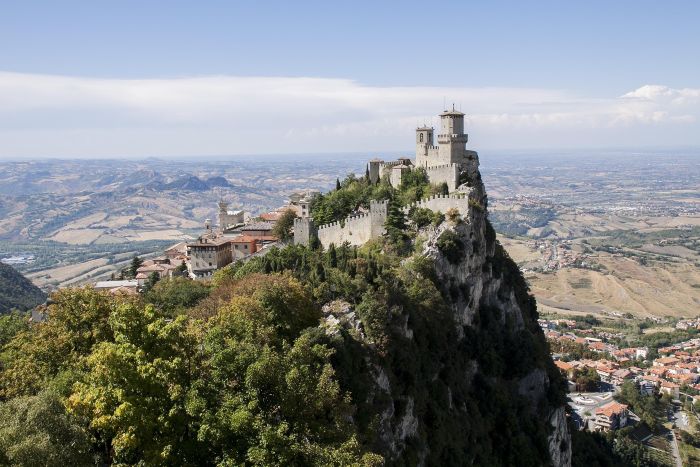 The Guaita, the oldest of San Marino’s three towers, on Mount Titano
Urbino and Gradara: a Renaissance Court and a Medieval Fortress
Gradara lies about 26 km south of Rimini, a drive of under half an hour, just across the border in the Marche. Its fortress, enclosed by two rings of walls, the outer one almost 800 m long, was built up by the Malatesta family in the 13th and 14th centuries; in 1463 Federico da Montefeltro took it, and it passed to the Sforza of Pesaro and later the Della Rovere. Tradition sets here the story of Paolo and Francesca, killed in 1289 by Francesca’s husband and placed by Dante in the fifth canto of the Inferno. Your guide walks you along the ramparts before the 32 km drive inland to Urbino, a UNESCO World Heritage Site since 1998. Under Federico da Montefeltro, duke from 1444 to 1482, the hill town became one of the courts of the Renaissance. His Ducal Palace, by Luciano Laurana and Francesco di Giorgio Martini, houses the National Gallery of the Marche, with Piero della Francesca’s Flagellation and Madonna of Senigallia, Raphael’s La Muta and the Ideal City by an unknown painter, as well as the duke’s Studiolo with its wooden inlays. Raphael was born in Urbino in 1483, and his family house is a short walk uphill.
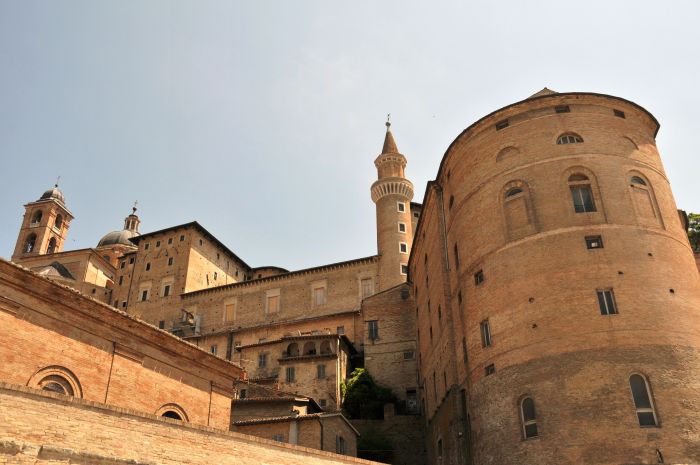 The Ducal Palace of Federico da Montefeltro in Urbino
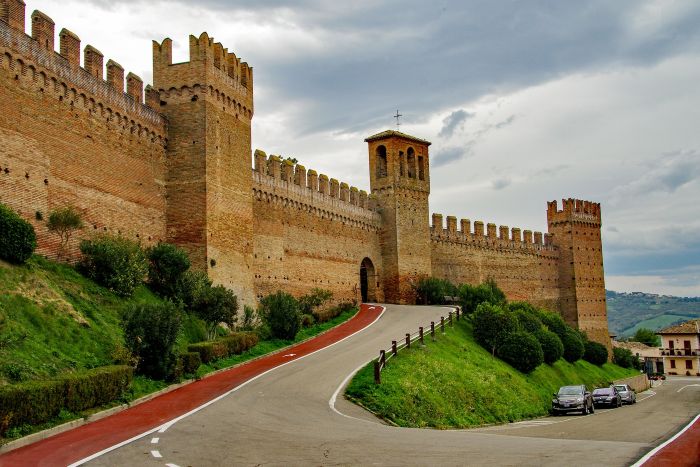
The fortress of Gradara, linked by tradition to Paolo and Francesca
Santarcangelo, San Leo and Verucchio
Santarcangelo di Romagna, 10 km along the Via Emilia and on the railway, has about 160 caves dug into Monte Giove beneath its old town and a Malatesta fortress above it. San Leo, about 30 km from Rimini, stands on a crag with a fortress that became a papal prison; Count Cagliostro died there in 1795. Verucchio, called the cradle of the Malatesta family, has their fortress and an archaeological museum of the Villanovan culture of the 9th to 7th centuries BC. A half day by car covers one or two of them.
Rimini Tour Guide Prices
Guiding fees in Rimini are typical figures, not set tariffs: each guide sets their own fee, and you agree the final price with the guide directly. Because the fee is per group, a family of four pays roughly the same guiding fee as a couple.
| Service | Typical guiding fee (per group) |
| By the hourthe Surgeon’s House or the Fellini Museum | around €80–120 per hour |
| Half day (up to 4 hours)Roman and Renaissance Rimini | around €300–350 |
| Full day (up to 8 hours)Ravenna, San Marino, or Urbino and Gradara | around €450–500 |
| Car with driver for day trips | quoted separately, per vehicle |
Entrance tickets, train or bus tickets and any car with driver are paid separately, so ask what is included when you compare offers.
Tickets for Rimini, Ravenna, San Marino and Gradara
The Tempio Malatestiano is free to enter, but museums in Rimini and San Marino and the monuments of Ravenna charge entry. Adult prices from the official sites:
| Admission | Adult |
| Fellini Museum (Castel Sismondo and Palazzo del Fulgor) | €10 |
| City Museum and Surgeon’s House | €7 |
| Rimini Art Card: City Museum, Surgeon’s House, Fellini Museum and Palazzo del Fulgor (free up to 18) | €14 |
| San Marino Multi-Museum Pass | €11 |
| Ravenna, 2 monuments (San Vitale, Sant’Apollinare Nuovo) | €10.50 |
| Ravenna, 4 monuments (adds Galla Placidia and the Neonian Baptistery) | €12.50 |
| Ravenna, 5 monuments (adds the Archiepiscopal Museum and Chapel) | €14.50 |
| Gradara fortress (free under 18) | €10 |
| Combined Gradara fortress and National Gallery of the Marche, Urbino | €12 |
Ravenna tickets are valid for seven days with one entry per monument, and pre-booked tickets get priority at the entrances.
Guide, Driver or Train
In Rimini a car is not needed, and Ravenna is easy by train, but Urbino, Gradara and the hill towns are best reached by car. Some guides drive guests in their own vehicle, while others travel with a separate driver or accompany you in a car you have hired. Urbino has no railway station: by public transport the trip combines a bus to Pesaro and a train to Rimini, at around €6–29 one way, which is why most Urbino days are by car. The vehicle is quoted separately, so ask how many hours it is booked for and whether fuel and parking are included.
Getting to Rimini and Around
Rimini’s Federico Fellini Airport is in Miramare, about 5 km south-east of the centre; the Metromare rapid bus reaches Rimini station in about 14 minutes, and city bus line 9 in about 30. Many visitors fly into Bologna instead: trains from Bologna airport take about 1 hour 20 minutes, and from Bologna Centrale the fastest trains take 53 minutes. Your guide can meet you at the station or your hotel.
When to Plan a Guided Tour in Rimini
Rimini is busiest in July and August, when the beaches fill and average highs are around 28 °C. On summer days guided tours of the city work best in the morning or early evening, and day trips inland escape the crowds on the coast. Spring and early autumn suit Ravenna, Urbino and San Marino best. Winters are quiet, with highs of about 10 °C in January, and November is the wettest month.
A More Comfortable Rimini
For a slower pace, split Rimini into half days with the same licensed guide and keep the afternoons for the beach. With children or older travellers, a car with driver makes Urbino, Gradara and San Marino much easier, and four or five days give Ravenna, San Marino and Urbino a day each.
Guides in English and Other Languages
This page is for travellers looking for a licensed guide in English. English-speaking guides are easy to find in Rimini, and many also guide in French, German or Spanish; the national register lists each guide’s languages. Specialisms differ: some guides are art historians, others focus on Roman archaeology, Fellini’s films or the food of Romagna. Mention your interests in your first message.
Visa for Italy
Italy is part of the Schengen area, and whether you need a visa depends on your nationality. See the Italian Foreign Ministry’s visa portal, vistoperitalia.esteri.it, for current information.
Frequently Asked Questions
Do tour guides in Rimini need a licence?
Yes, tourist guiding in Italy is regulated by Law 190/2023. Guides qualify through a national examination and are entered in the National Register of Tourist Guides kept by the Ministry of Tourism; the licence is valid throughout Italy.
How much does a private tour guide cost in Rimini?
Typically around €80–120 an hour, €300–350 for a half day of up to four hours and €450–500 for a full day of up to eight hours, per group. Each guide sets their own fee; entrance tickets, transport and any car with driver come on top.
Can I visit Ravenna from Rimini in one day?
Yes, the fastest trains take 43 minutes, so a full day leaves time for the main mosaic monuments. The five-monument ticket covers San Vitale, Galla Placidia, the Neonian Baptistery, the Archiepiscopal Chapel and Sant’Apollinare Nuovo.
Is San Marino a separate country?
Yes, San Marino is an independent republic surrounded by Italy, about 50 minutes from Rimini by bus. It keeps its own register of authorised tourist guides.
Can Urbino and Gradara be combined in one day?
Yes, by car: Gradara is about 26 km from Rimini and Urbino a further 32 km inland. A combined ticket covers the Gradara fortress and the National Gallery of the Marche in Urbino.
Is there an English-speaking guide for Ravenna or San Marino from Rimini?
Yes, many licensed guides in Rimini lead day trips in English, by train, by bus or by car. Mention the destination in your first message, and the guide can plan the day around your dates.
Plan Your Days in Rimini, Ravenna, San Marino, Urbino and Gradara
Write to a licensed guide in Rimini with your dates, group size and the places you want to see, and agree the plan in English before you arrive.