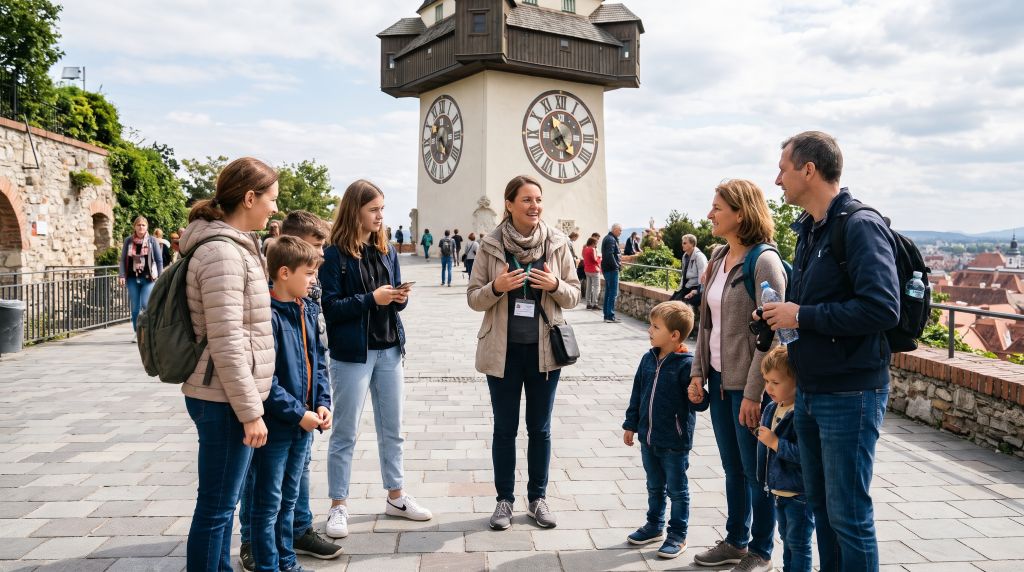
Last Updated on 24/11/2026
Private Tours in Graz With a Licensed Guide: the Old Town, the Schlossberg, Schloss Eggenberg and Day Trips to Maribor, Vienna, Klagenfurt and Southern Styria
This page explains how tourist guiding is regulated in Austria, what licensed guides in Graz charge, what the main sights cost and which day trips work from the Styrian capital, mountain walks included.
Graz is Austria’s second-largest city and the capital of Styria. Its historic centre and Schloss Eggenberg are a UNESCO World Heritage Site, and above the red roofs of the Old Town stands the Schlossberg with its Clock Tower, the city’s emblem. Maribor in Slovenia is under an hour away by train, Vienna and Klagenfurt are direct rail journeys, and the wine roads, castles and mountains of Styria begin just outside the city. A licensed tour guide in Graz can plan those days with you.
On this page: Guide licence · Private tours · Day trips · Mountains and hiking · Prices · FAQ
Werner A.
Guides listed on OfficialGuides for Graz are licensed Austrian tourist guides, known as Austria Guides, and work independently. You write to the guide directly, agree the route, the hours and the fee, and pay the guide; there is no booking engine or agency in between. OfficialGuides lists licensed guides only.
Graz at a Glance: Guide Fees, Licence and Day Trips
- Guiding fee: around €70–90 an hour, €350–400 for a half day of up to four hours and €450–600 for a full day of up to eight hours, per group.
- Licence: tourist guiding is a regulated trade in Austria, and a licence earned in Styria is valid in every Austrian province.
- Day trips: Maribor, Vienna and Klagenfurt by train; the South Styrian Wine Road, Riegersburg and Zotter, Piber and Stübing by car.
- Mountains: easy walks with any guide; mountain hikes need a guide with a separate authorisation.
Licensed Tour Guides in Graz: How Guiding Works in Austria and Styria
In Austria, tourist guiding is a regulated trade under section 108 of the Trade Regulation Act (Gewerbeordnung). Explaining the country’s heritage, museums, churches and monuments for payment is reserved for holders of the tourist guide licence. To obtain it, a candidate completes a training course of at least 250 teaching hours and passes a state qualifying examination; the preparation course in Styria runs to about 720 hours, practice included. At least one foreign language is tested in the examination.
The examination is federal, so the licence is valid throughout Austria. A licensed guide from Graz may also lead you in Vienna or Klagenfurt. Each licensed guide carries an official photo ID issued by the district authority, and it records the languages the guide works in. If your trip continues, OfficialGuides also lists guides in Vienna, Salzburg and Innsbruck.
Licensed, certified, official: what the listings say
Search for a private tour of Graz and most results are marketplace listings, each describing its guide in its own words: a certified guide on the tourist office pages, an official guide or a professional guide on the booking sites. In Austria these words point to the same thing, a guide who holds the state-examined trade licence. The listings sell a fixed route of one and a half to four hours at a set price per booking. On a tour arranged with the guide, the route, the pace and the starting time follow your plans. Every guide listed for Graz on OfficialGuides is a licensed guide.
Private Tours and Guided Tours in Graz: Sample Programmes
These are the guided tours licensed guides plan most often in Graz. Entrance tickets and public transport are extra.
The Old Town
Hauptplatz, the Landhaus courtyard, the Burg, the Cathedral and the Mausoleum.
Schlossberg and the Mur
The Clock Tower, the Kunsthaus and the Murinsel.
Eggenberg and the Armoury
The palace of the Eggenberg princes and the Styrian Armoury.
Day trips and mountains
Maribor, Vienna, Klagenfurt, the wine roads and the Schöckl.
The Old Town: Hauptplatz, the Landhaus, the Burg and the Mausoleum
Two to three hours cover the historic centre, which UNESCO listed in 1999 for its mix of styles from the Middle Ages to the 18th century. The walk starts on the Hauptplatz and follows the Herrengasse to the Landhaus, whose courtyard is framed by Renaissance arcades. From there your guide leads you through the lanes to the Burg, the former residence and today the seat of the Styrian governor, where the late Gothic double spiral staircase of 1499 can be climbed free of charge: two flights part and meet again on every floor. Opposite stand the Cathedral and the Mausoleum of Emperor Ferdinand II, begun in 1614 to designs by his court artist Giovanni Pietro de Pomis. Ferdinand ruled from Graz until he became emperor and moved his court to Vienna in 1619, and the city remained the capital of Inner Austria until 1749.
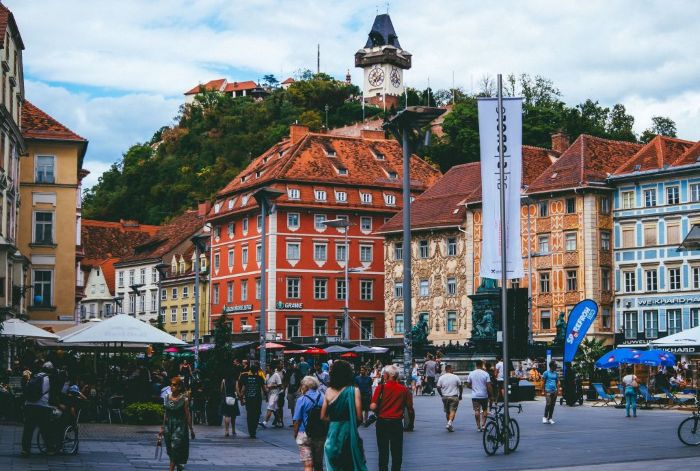 The Hauptplatz, where most walks through the Old Town of Graz begin
The Schlossberg, the Clock Tower, the Kunsthaus and the Murinsel
The Schlossberg is the hill in the middle of the city. You can go up by the funicular, which opened in 1894 and climbs a gradient of 60 per cent, by the lift inside the rock, which takes about 30 seconds, or on foot by 260 steps. At the top stands the Clock Tower (Uhrturm). A tower is recorded on this spot in the 13th century, and it took its present form when the hill was refortified in the mid-16th century. Its clockwork was built by Michael Sylvester Funck in 1712. The hands confuse most visitors: the clock originally had only the large hands for the hours, so that they could be read from far away, and the smaller minute hands were added later. Down by the river, the walk crosses to the Kunsthaus, the blue exhibition hall by Peter Cook and Colin Fournier that locals call the “Friendly Alien”, and to the Murinsel, the floating steel-and-glass platform in the Mur by the New York artist Vito Acconci. Both were built for the year in which Graz was European Capital of Culture.
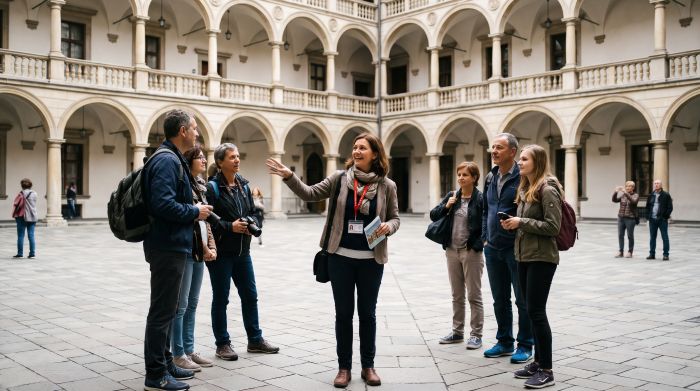 A private walk through the Landhaus courtyard with a licensed guide (ai illustrated)
Schloss Eggenberg and the Styrian Armoury
Schloss Eggenberg lies about 3 km west of the centre and was added to the UNESCO listing of Graz after the Old Town. It was built after 1625 for Hans Ulrich von Eggenberg, and its plan follows the calendar: 365 outside windows, four corner towers and 24 State Rooms around the Planetary Room, with more than 500 ceiling paintings. The State Rooms can only be seen on the museum’s own tour, which lasts about 50 minutes, so your guide books a slot and leads the park and the palace exterior. Back in the Herrengasse, the Styrian Armoury (Landeszeughaus) holds about 32,000 weapons and suits of armour on four floors and is described as the world’s largest preserved historic armoury.
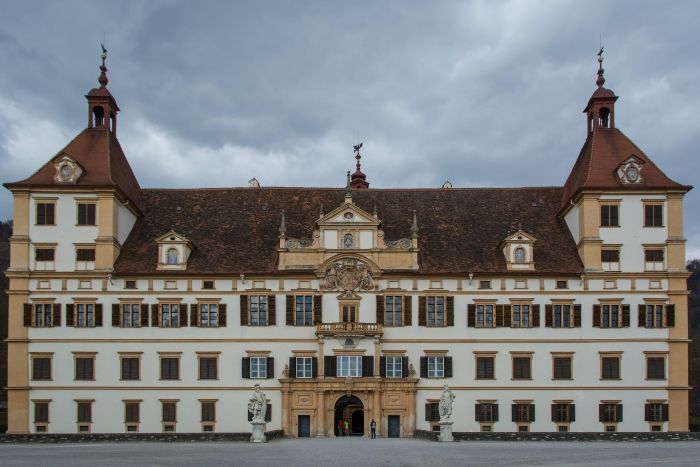 Schloss Eggenberg, part of the UNESCO World Heritage Site of Graz
A Full Day in Graz
The Old Town and the Schlossberg take the morning, and Schloss Eggenberg or the Armoury and the Kunsthaus follow after a lunch break of your choice.
Day Trips From Graz to Maribor, Vienna, Klagenfurt and Southern Styria With a Licensed Guide
Each of these day trips takes the full-day fee, with train tickets, any vehicle and entrance tickets extra.
Maribor: Slovenia’s Second City on the Drava
Direct trains reach Maribor in as little as 53 minutes, and by car the journey takes about 45 minutes. The day centres on Lent, the old riverside quarter on the Drava, where the Old Vine grows along the front of the Old Vine House. It is more than 400 years old and is listed by Guinness World Records as the oldest vine in the world that still bears grapes, of the Žametovka variety. The house is now a small museum of the region’s wine culture and offers tastings.
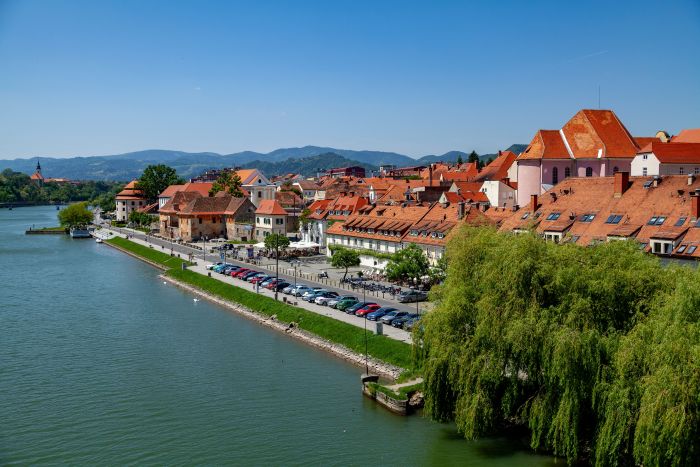 Lent, the old riverside quarter of Maribor on the Drava
Vienna: the Imperial Capital in a Day
Direct Railjet trains link Graz and Vienna almost every half hour and take about two and a half hours; by car the drive is about two hours. That makes a long day, so most visitors choose one theme: the old city around St Stephen’s Cathedral and the Hofburg, or Schönbrunn Palace and its gardens.
Klagenfurt and Lake Wörthersee
The new Koralm railway has brought Klagenfurt, the capital of Carinthia, within 41 minutes of Graz on the fastest trains, with a service every hour. The walk begins on the Neuer Platz at the Lindwurm fountain, the dragon that is the city’s emblem, and continues to the Landhaus, whose Great Hall of Arms is painted with 665 coats of arms, and to the arcaded houses of the Alter Platz. The Lend canal links the centre with Lake Wörthersee.
The South Styrian Wine Road
The wine country begins about 40 km south of Graz. The South Styrian Wine Road, Austria’s oldest wine road, has run since 1955 for about 25 km from Ehrenhausen through Gamlitz to Leutschach, and for a stretch the middle of the road is the border with Slovenia. Sauvignon Blanc is the leading grape, and the estates serve their own wine and cold dishes in the wine taverns known as Buschenschank. With a driver, everyone can taste.
Riegersburg Castle and the Zotter Chocolate Factory
Riegersburg, about 62 km east of Graz, is a castle on a volcanic rock 482 metres high, with a castle museum, a witches’ museum and a weapons museum; it closes in winter and reopens in spring. About 3 km beyond the village, the Zotter chocolate factory runs a tasting tour through its production, and the ticket includes the organic farm next door, which Zotter calls the Edible Zoo. A day ticket for an adult costs €23.90, reservation is required, and the factory is closed on Sundays and public holidays.
Piber and Stübing: Two Shorter Trips
The Lipizzaner Stud Piber at Köflach, in western Styria, has been the birthplace of the white stallions of Vienna’s Spanish Riding School since 1920, and stud tours run daily from spring to early November. The Austrian Open-Air Museum Stübing, about 15 km north of Graz, was founded in 1962 and has more than 100 historic farm buildings brought from every Austrian province and South Tyrol; it is open from spring to the end of October, a visit takes two to three hours, and adult admission is €15.50. Each fits a half day with a car.
Mountains, Hiking and Trekking Around Graz
Styria separates easy guided walks from mountain hiking, and the two need different qualifications. Walks that require no alpine skills, on terrain close to roads, lifts and staffed huts, are open to any guide. Leading mountain hikes for payment falls under the Styrian Mountain Sports Act and requires a separate authorisation as a mountain hiking leader (Bergwanderführer), which the tourist guide licence does not include. Guides who hold that authorisation say so in their profile, so look there before you plan a mountain day; with other guides the outdoor programme stays on easy terrain.
The Schöckl, at 1,445 metres the local mountain of Graz, suits that easy programme. A cable car runs from St. Radegund to the summit plateau, RegioBus 250 goes there from Jakominiplatz, and a barrier-free trail runs across the top. The Bärenschützklamm near Mixnitz is a different matter. The gorge path climbs about 350 metres in 1.3 km over more than 160 wooden bridges and ladders, the round walk takes about five hours with 760 metres of ascent, and it is not suitable for small children. It is open daily from May to the end of October, and costs €10 for adults. Above it rises the Hochlantsch, at 1,720 metres the highest summit of the Graz Highlands. Both are mountain hikes for a guide with the mountain authorisation.
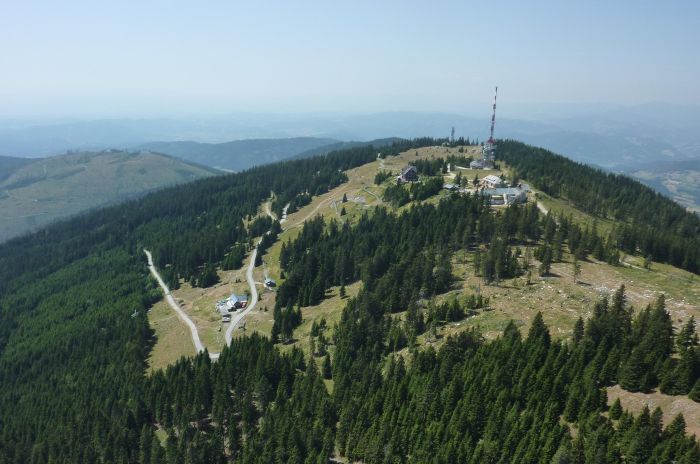 The summit plateau of the Schöckl, the local mountain of Graz
Graz Tour Guide Prices
Guiding fees in Graz are typical figures, not set tariffs: each guide sets their own fee, and you agree the final price with the guide directly. The fee is per group, so a family of four pays roughly what a couple pays.
| Service | Typical guiding fee (per group) |
| By the houran Old Town walk of two to three hours | around €70–90 per hour |
| Half day (up to 4 hours)the Schlossberg and the Mur, or Eggenberg and the Armoury | around €350–400 |
| Full day (up to 8 hours)all of Graz, or Maribor, Vienna, Klagenfurt, the wine road or Riegersburg | around €450–600 |
| Car with driver for day trips | quoted separately, per vehicle |
Tickets and Admission Prices in Graz
Most of the Old Town is free to walk, and the paid sights are inexpensive. Adult prices from the official sites:
| Admission | Adult |
| Schloss Eggenberg State Rooms, museum tour included | €20 |
| Schloss Eggenberg park | €3 |
| Styrian Armoury (Landeszeughaus) | €13 |
| Schlossberg funicular, one-hour city ticket | €3.30 |
| Schlossberg lift, one way | €2.40 |
| Funicular and lift combined | €4.90 |
The Eggenberg ticket is valid for 24 hours in the other Joanneum museums of Graz, the Armoury included, and children under six enter both free. Any valid ticket for city zone 101 is also accepted on the funicular. Groups of seven or more must book their Eggenberg tour in advance, so settle the date with your guide first.
Guide, Driver or Train
In Graz no car is needed, and Maribor, Vienna and Klagenfurt are easiest by train, but the wine road, Riegersburg and Piber call for a car. A tourist guide is not a driver: some guides work with a separate driver, while others accompany you in a car you have hired. The vehicle is quoted separately.
Getting to Graz and Around
Graz airport is about 10 km south of the centre, and the S5 suburban train reaches the main station in about 12 minutes from a stop some 300 metres from the terminal. In the centre nearly everything on this page is within walking distance, and trams stop at the Hauptplatz. Your guide can meet you at your hotel, at the main station or on the Hauptplatz.
When to Plan a Guided Tour in Graz
The Old Town and the Schlossberg work in every season, but several sights around the city are seasonal. The State Rooms of Schloss Eggenberg and the Stübing museum are closed in winter, Riegersburg Castle reopens in spring, and the Bärenschützklamm is open only from May to the end of October. Late spring to early autumn is therefore the widest window. In winter a guided tour concentrates on the city itself.
A More Exclusive Graz
For a slower pace, split the Old Town and Schloss Eggenberg into two half days with the same licensed guide. On selected evenings in the season the palace opens the State Rooms for tours by candlelight. A car with driver turns the South Styrian Wine Road into a day of estate visits and tastings.
Guides in English and Other Languages
Every Austrian guide proves at least one foreign language in the state examination, and English-speaking guides are easy to find in Graz. Mention your interests in your first message.
Visa for Austria
Austria is part of the Schengen area, and whether you need a visa depends on your nationality; a day trip to Maribor stays within the Schengen area. See the Austrian government’s visa information page for current rules.
Frequently Asked Questions
Do tour guides in Graz need a licence?
Yes, tourist guiding is a regulated trade in Austria, and guides must pass a state examination. The licence is valid in every Austrian province.
How much does a private tour guide cost in Graz?
Typically around €70–90 an hour, €350–400 for a half day of up to four hours and €450–600 for a full day of up to eight hours, per group. Entrance tickets and transport come on top.
Can my guide lead us through the State Rooms of Schloss Eggenberg?
The State Rooms can only be visited on the museum’s own tour. Your guide books the slot and leads the park and the exterior.
Can we visit Maribor from Graz in one day?
Yes, the fastest direct trains take 53 minutes, so even a half day leaves time for Lent and the Old Vine.
Can a city guide take us hiking in the mountains?
Any guide can accompany an easy walk, for example on the Schöckl plateau, but mountain hikes require a guide who is also authorised as a mountain hiking leader. Guides with that authorisation mention it in their profile.
Is there an English-speaking guide for a private tour of Graz?
Yes, many licensed guides in Graz work in English. Send your dates and group size in your first message.
Plan Your Days in Graz and Styria
Write to a licensed guide in Graz with your dates, group size and interests, and agree the plan in English before you arrive.