
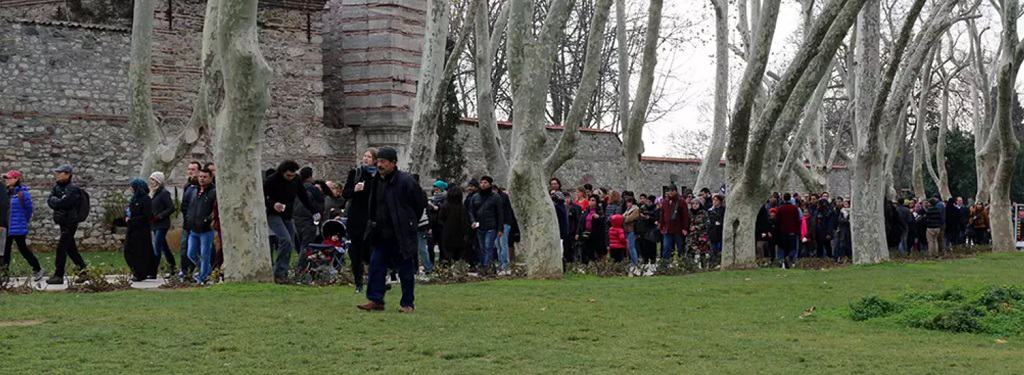
On a hill in Istanbul’s old city, where the Bosphorus meets the Sea of Marmara and the Golden Horn, stands the commanding Topkapi Palace. For around 400 years it was the residence of the Ottoman sultans and the political and cultural center from which a vast empire was run. Today it’s a world-class museum that welcomes thousands of travelers a day.
With its architecture and enormous collections, it’s an unmissable stop on any trip to Istanbul. But because it’s one of the busiest sites in the city, the box-office queues can be long: in high season, just buying a ticket eats up a lot of time. It pays to understand the entry system and plan your route before you go.
🎫 Topkapi Palace tickets: prices and entry (2026)
From 2026, Topkapi Palace runs on a single combined ticket. There is no longer a separate Harem ticket: the Harem and the church of Hagia Irene are included in standard admission. The combined price for foreign visitors is 2,750 TL (about €55) and covers the main palace, the Harem and Hagia Irene. Foreign students aged 12 to 25 with an ISIC card pay 400 TL, and children aged 0 to 6 enter free.
| Visit option | Price / Booking |
|---|---|
| Official box-office ticket Palace + Harem + Hagia Irene · bought on site | from 2,750 TL (≈ €55) |
| Skip-the-line ticket priority entry via QR, audio guide included | from €60 Book → |
| Combined 3-attraction tour Hagia Sophia + Basilica Cistern + Topkapi & Harem, guided | from €89 Book → |
| Official private guide English-speaking, priority entry, flexible route | from €160/group form ↓ |

Request an English-speaking guide
Official guides in Istanbul have priority entry at the box office, so you skip the queue. Add your dates, group size, preferred language and your mobile number with country code below.
💡 Honest note: a guide’s fee does not include entry tickets. In high season the box-office queues are very long, so the safest move is to buy your ticket yourself and in advance (see the price table above).
⏰ Opening hours and closing days (2026)
Topkapi Palace is open every day except Tuesday. The box office opens at 09:00, last entry is around 16:00, and the palace closes at 17:00. The Harem and Hagia Irene close a little earlier than the main areas, so visit them first if they’re your priority.
- Closing day: Tuesday
- Opens: 09:00
- Last entry: ~16:00
- Closes: 17:00
Public and religious holidays:
- 23 April (National Sovereignty and Children’s Day): open
- 1 May (Labor Day): open
- Eid al-Fitr (end of Ramadan) — first day: closed until noon, then open
- 19 May (Commemoration of Atatürk, Youth and Sports Day): open
- 15 July (Democracy and National Unity Day): open
- Eid al-Adha (Feast of Sacrifice) — first day: closed until noon, then open
- 30 August (Victory Day): open
- 29 October (Republic Day): open
- 1 January (New Year): open (confirm the time)

🚶♂️ Skip-the-line tickets and online booking
In high season (April to December), on cruise-ship days, on Sundays and public holidays, the box-office queues at Topkapi Palace can be very long: you often wait twice — once to buy a ticket and once to get in. The easiest fix is to book a skip-the-line ticket with an audio guide online. And if you want to see the city’s three most-visited landmarks in one day, the combined Hagia Sophia + Basilica Cistern + Topkapi tour bundles them with fast entry.
With a digital ticket on your phone, you don’t have to wait in the summer sun or winter cold — you head straight to security. Late morning and afternoon, the box office fills with groups, so booking ahead makes a real difference.

💎 Is Topkapi Palace worth it?
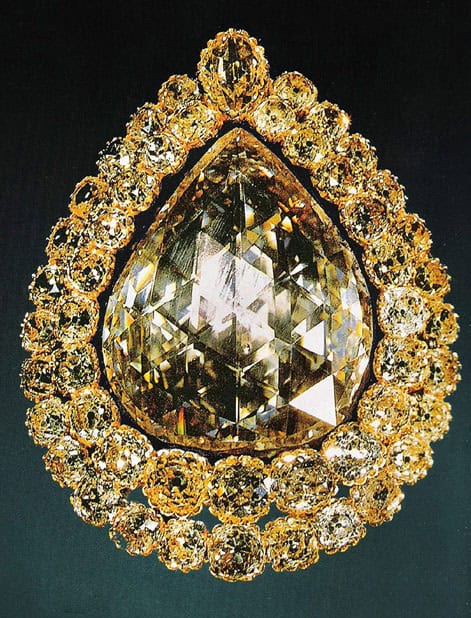 In a word: yes. Topkapi is the most important Ottoman complex in the world and, unlike Europe’s grand palaces, it impresses less through the scale of its architecture than through what it holds. The treasury alone displays the 86-carat Spoonmaker’s Diamond (Kaşıkçı Elması) and the emerald-studded Topkapi Dagger. The Chamber of the Sacred Relics keeps objects of enormous importance to the Islamic world, and from the terraces of the Fourth Courtyard you get the finest view over the Bosphorus and the Golden Horn for free.
An honest heads-up: it’s Istanbul’s priciest attraction and very busy. To make the most of it, arrive at opening and head to the treasury and Harem first, before the groups arrive. It’s also worth considering an official English-speaking guide in Istanbul, who brings each hall to life and helps you avoid the worst of the queues.
⏳ How long should you allow?
Allow 4 to 5 hours for a normal visit with the Harem. If you want to read every label, see every collection and rest on the terraces, set aside 6 to 7 hours. The two spots where people bunch up most are the treasury and the Chamber of the Sacred Relics: the best way to dodge the crowd is to visit them early.
👕 Dress code and practical tips
There’s no strict dress code in the palace grounds. But to enter the Chamber of the Sacred Relics, where the relics of the Prophet Muhammad are venerated, women may be asked to cover their hair and men in shorts to cover their knees — bring a scarf or a light jacket. The grounds are also large, with cobblestones and slopes, so wear comfortable shoes. Summers are hot with little shade — bring water. Photography is not allowed in some rooms, and strollers aren’t permitted in certain areas.
🚋 Getting there: how to reach Topkapi Palace
Topkapi Palace is in the Sultanahmet district of the old city, known as the Historic Peninsula. Istanbul spans two continents, and Sultanahmet is on the European side.
You can reach Sultanahmet Square one of these ways:
- Take the T1 tram and get off at the Sultanahmet stop. From there it’s about a 10-minute walk to the palace.
- Take the Marmaray, leave by exit 2 of Sirkeci station and walk 15–20 minutes through Gülhane Park to the First Courtyard. Part of the route is cobbled and uphill.
- Leave by exit 1 of Sirkeci station, walk 1 minute to the T1 tram and ride to the Sultanahmet stop.
🚍 City bus: no line runs right past the palace.
🚕 Taxi: the coastal road via Cankurtaran drops you near the main entrance, but in rush hour (07:00–09:00 and 16:30–19:00) traffic is heavy.

🏰 The history of Topkapi Palace
In 1453, Sultan Mehmed II conquered Constantinople and ended the Byzantine Empire. He chose the hill where ancient Byzantium was founded as his new center of power and ordered the palace built; its outer walls rose on the ruins of the walls of Byzantium — a gesture with strong symbolism. Construction began in the 1460s, and over 400 years successive sultans expanded and rebuilt it. It remained the imperial residence until the mid-19th century, when the dynasty moved to the baroque Dolmabahçe Palace. Topkapi has been a museum since 1924.

The palace was built on 700,000 m² surrounded by gardens and has about 400 rooms. Today the museum section covers 80,000 m² (for comparison, Versailles has 67,000 m² and 2,300 rooms). It isn’t as monumental as Europe’s grand palaces: Topkapi’s greatness lies in its function, its collections, its interior decoration and an unmatched location.
🗝️ Palace sections and what to see
The palace is divided into 3 main gates and 4 courtyards that grow more private the deeper you go. Anyone could enter the first courtyard; only members of the Ottoman dynasty reached the last.

First gate and courtyard
The first gate is the Bab-ı Hümayun (Imperial Gate), and the first courtyard is Alay Meydanı (Procession Square) — the only one open to the public.
Second gate and courtyard
The Gate of Salutation (Bab-üs-selam) leads to Divan Meydanı (Council Square), where the imperial council met. This gate was built in Hungarian style under Suleiman the Magnificent, during the struggle for the Mediterranean between the Ottomans and the Habsburgs of Charles V. To the right are the palace kitchens and the box office, to the left the Imperial Council. The entrance to the Harem is also off this courtyard.
The kitchens and the porcelain collection
This second courtyard holds the old imperial kitchens, which display one of the world’s largest collections of Chinese porcelain: thousands of pieces of celadon and blue-and-white ware that reached the Ottoman court along the Silk Road, whose western end was Istanbul itself. For anyone curious about East–West trade, it’s a quiet highlight most visitors rush past.
Third gate and courtyard
The Gate of Felicity (Bab-üs-saade) gave access to the Enderun courtyard (the palace school), with the audience hall, the inner treasury and the chamber that keeps the sacred relics.
Chamber of the Sacred Relics (Kutsal Emanetler)
These relics came to Istanbul after Yavuz Sultan Selim’s victory in Egypt and are displayed in the Privy Chamber (Has Oda):
- The staff of Moses
- The sword of the Prophet David (Dawud)
- The cloak of the Prophet Joseph (Yusuf)
- Relics of John the Baptist (Yahya)
- The cauldron of the Prophet Abraham (Ibrahim)
- The Prophet Muhammad’s prayer rug
- The Prophet Muhammad’s banner
- The Prophet Muhammad’s bow
- The Prophet Muhammad’s sandals, and more
The Fourth Courtyard
It was reserved for the imperial family and special guests and holds several pavilions, plus a terrace overlooking the Sea of Marmara and the Bosphorus. Here are the Baghdad, Revan, Sofa and Mecidiye pavilions, along with the Circumcision Room and the Chief Physician’s Tower.

🕌 The Harem
The Harem, a place wrapped in secrets, was in fact the sultan’s private residence. His family (his mother, the Valide Sultan, sisters, daughters and wives) lived here alongside concubines, servants, guards and eunuchs. It has about 400 rooms and, under Selim II, housed up to 1,200 people. Its halls, decorated by various sultans with Iznik tiles and gold leaf, trace the evolution of Ottoman palace architecture. Good news: from 2026 the Harem is included in the combined ticket at no extra cost.
- The Imperial Hall (Hünkâr Sofası)
- The Valide Sultan’s apartments
- The private chamber of Mehmed III

❓ Frequently asked questions
Is the Harem included in the Topkapi Palace ticket?
Yes. From 2026 there is a single combined ticket for foreign visitors covering the main palace, the Harem and Hagia Irene; you no longer need a separate Harem ticket. Note: the Museum Pass Istanbul covers only the main palace and does not include the Harem or Hagia Irene.
How much is the ticket in 2026?
The combined ticket for foreign visitors is 2,750 TL (about €55). Foreign students aged 12 to 25 with an ISIC card pay 400 TL, and children aged 0 to 6 enter free. See live prices and availability in the table above.
What are the opening hours, and when is it closed?
Topkapi Palace is open every day except Tuesday from 09:00 to 17:00, with last entry around 16:00. It also closes on the morning of the first day of the religious holidays (Eid).
Can I buy tickets online?
Yes. Booking online is the easiest way to avoid the long high-season queues. The skip-the-line ticket includes an audio guide, and you can also bundle the three most-visited sites into one tour. See the options in the price table.
How long does a visit take?
4 to 5 hours for a normal visit with the Harem; 6 to 7 hours if you want to see every collection and pavilion at a relaxed pace.
Will there be queues? How do I avoid them?
Yes — from April to December, on cruise days, Sundays and holidays the queues can be long. Arrive at opening, or book a skip-the-line ticket online. An official private guide also means faster entry thanks to priority access.
Does the Museum Pass Istanbul work at Topkapi Palace?
The Museum Pass is valid for the main palace, but does not cover the Harem or Hagia Irene. To see those sections with the pass, you’d need a separate ticket.
Is there a dress code?
There’s no strict dress code in the grounds, but in the Chamber of the Sacred Relics women may be asked to cover their hair and men in shorts to cover their knees.
Source: Istanbul’s official tourism website
This page is also available in: Español · Français · Deutsch · Italiano · Русский · 日本語 · 한국어
This page is also available in: العربية · 简体中文 · Čeština · Nederlands · Français · Deutsch · Ελληνικα · Magyar · Italiano · 日本語 · 한국어 · polski · Português · Română · Русский · Español · Svenska · Türkçe