Last Updated on 26/05/2026 by OfficialGuides Editorial Team
A standard adult ticket to the Louvre costs €22 for EU/EEA residents and €32 for non-EU visitors. Children under 18 and EU residents aged 18–25 enter free, but still need a reserved time slot. The museum is open 9:00am–6:00pm and closed every Tuesday, with late opening until 9:45pm on Wednesdays and Fridays. Booking a timed-entry (fast-track) ticket online is the single best thing you can do — walk-up queues regularly run 60–90 minutes in peak season.
↓ Compare ticket options and book online · ↓ Visit with a private guide
How to Visit the Louvre — Tickets, Skip-the-Line & Opening Hours
The Louvre is the most visited museum on earth — close to nine million people walk through it every year — and it is also one of the easiest places in Paris to get wrong. The €22 (EU/EEA) and €32 (non-EU) figures you’ll see quoted are the box-office prices, and buying at the counter means joining the standard ticket queue, which on a summer Saturday can swallow two hours before you’ve seen a single painting. Booking ahead online is what avoids that. If you want the smoothest entry, the most popular options are a guided evening tour when the museum is not full of people, a reserved-entry ticket with hosted access to the Mona Lisa or — the most economical way to have a real guide — a semi-private guided tour in certain languages (max 6 people).
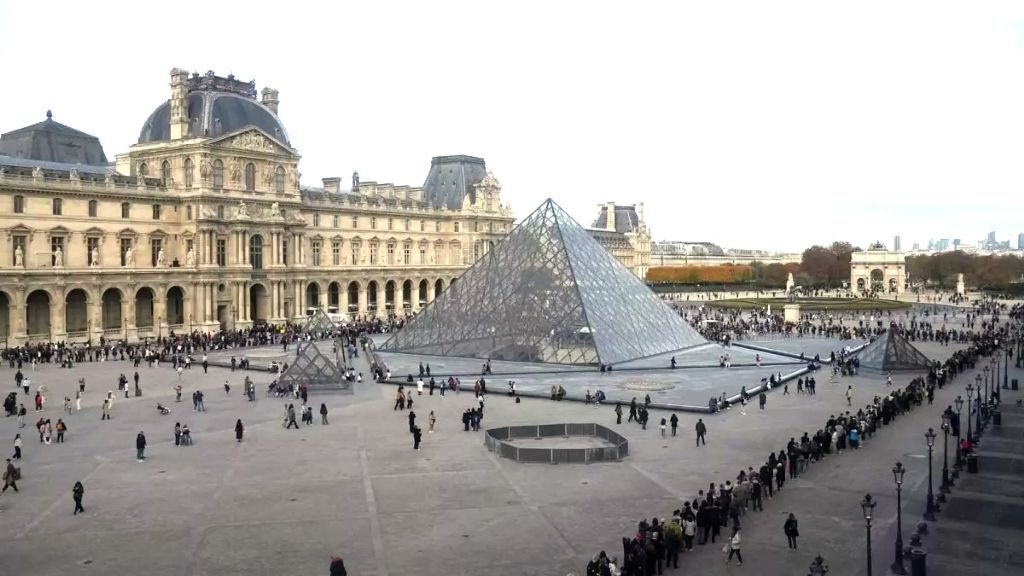 The on-site ticket line at the Louvre regularly runs 60–90 minutes in peak season. A booked-ahead time slot lets you skip straight to the entry lane.
Terms like skip-the-line, fast-track, priority access, timed entry and reserved entry all describe the same benefit: you skip the ticket-purchase queue and walk straight to your reserved lane. None of them, though, skips the mandatory security screening — every visitor goes through an airport-style check regardless of ticket type.
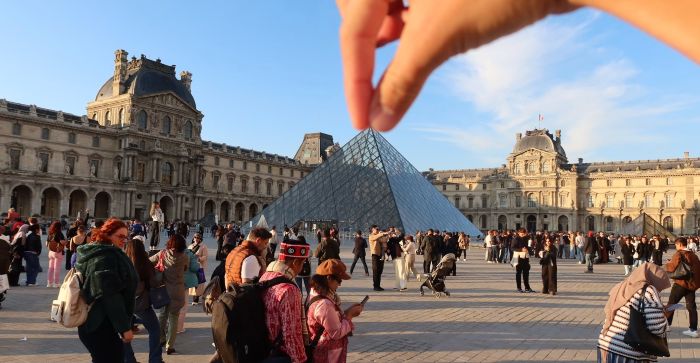 I. M. Pei’s glass pyramid is the Louvre’s main entrance. A timed ticket lets you head straight for the security check.
Louvre Museum ticket prices in 2026
The Louvre operates a two-tier pricing system introduced on 14 January 2026. EU and EEA residents pay the standard rate, while visitors from outside the European Economic Area pay a higher entry fee. The standard adult ticket covers the entire permanent collection — all three wings (Denon, Sully, Richelieu), every floor and all 35,000+ works on display — plus most temporary exhibitions inside the museum.
| Ticket type | Who it’s for | Price (2026) |
|---|---|---|
| Standard adult — EU/EEA | Residents of the EU, Norway, Iceland & Liechtenstein | €22 |
| Standard adult — non-EU | Visitors from the US, UK, China & all non-EEA countries | €32 |
| Children under 18 | Everyone, regardless of nationality | Free (slot required) |
| EU residents 18–25 | EU/EEA nationality, valid ID required | Free (slot required) |
| Fast-track + audio guide | Dedicated evening entry with guided tour & audio guide | from €74 |
| Guided highlights tour | Semi-private small-group tour with expert guide, skip-the-line included | from €149 |
A few things worth knowing before you pay. Temporary exhibitions in the Hall Napoléon usually require a separate ticket (typically €4–6 extra) and are not always included in standard or pass entry. Visitors in groups led by an accredited guide pay a reduced €28 non-EU rate. The Louvre’s own website and its authorised partners all charge the same face value for standard tickets, so be wary of resellers marking tickets up. The genuine difference between options isn’t the headline price — it’s what you skip and what’s included: a plain online ticket simply secures your slot, while a reserved-entry ticket with hosted Mona Lisa access gets you to the famous portrait without the bottleneck.
What “fast-track” really means at the Louvre
The Louvre runs a mandatory timed-entry system: every ticket — even free ones — is tied to a 30-minute arrival window. When you book online you choose that slot, and on the day you go straight to the reserved-entry lane rather than the general walk-up queue. In peak season (April–October) this saves most visitors 60–90 minutes of waiting, and on busy weekends the difference can be even larger because morning slots routinely sell out.
The one queue nobody skips is security screening. All visitors pass through an airport-style check, so even with the best ticket allow 15–20 minutes for this and arrive a little before your slot. Choosing a quieter entrance helps a lot here, which brings us to the doors most people don’t know about.
Which entrance should you use?
The glass Pyramid is the iconic main entrance — and the slowest, because everyone heads there by default. If you hold a pre-booked ticket, the Carrousel du Louvre entrance (reached from 99 Rue de Rivoli or directly from the Palais Royal–Musée du Louvre metro) almost always has a shorter security queue and is the default for most skip-the-line tours. The Porte des Lions entrance opens directly into the Denon Wing, closest to the Mona Lisa, but its hours are limited and unpredictable, so only count on it if you’ve confirmed it’s open that day.
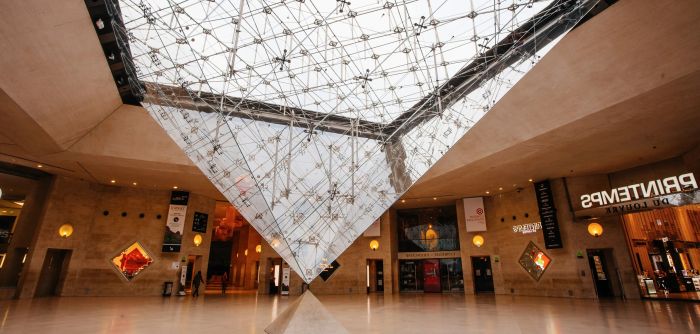 The Carrousel du Louvre entrance, reached from 99 Rue de Rivoli or the metro, usually has the shortest security queue.
Louvre opening hours & closed days
The Louvre is open every day except Tuesday. Standard hours are 9:00am to 6:00pm, with late-night opening until 9:45pm on Wednesdays and Fridays — the calmest windows of the week if you want fewer people around the Mona Lisa. Last admission is one hour before closing, and staff begin clearing the galleries 30 minutes before closing time.
| Day | Hours |
|---|---|
| Monday | 9:00am – 6:00pm |
| Tuesday | Closed |
| Wednesday | 9:00am – 9:45pm (late) |
| Thursday | 9:00am – 6:00pm |
| Friday | 9:00am – 9:45pm (late) |
| Saturday | 9:00am – 6:00pm |
| Sunday | 9:00am – 6:00pm |
The Louvre is also closed on three annual holidays: 1 January, 1 May and 25 December. Note that if a public holiday falls on a Tuesday the museum stays closed as usual. Hours occasionally change for special events, so it’s always worth a final check on the official site before you travel.
When is the Louvre free?
Beyond the always-free categories (under-18s and EU residents under 26), the Louvre opens its doors to everyone free of charge on the first Friday of each month after 6:00pm — though this is suspended in July and August. Entry is also free for all on 14 July (Bastille Day). The catch: free entry still requires a reserved time slot, and these vanish within hours of release, so book the moment they open. Expect heavy crowds on free evenings — if your priority is a calm visit, a paid timed ticket on a weekday morning is the better trade.
👥 Small Group · Your Language
Semi-private guided tour (max 6) — the economical way to have a real guide →
How to get to the Louvre
The Louvre sits on the Right Bank of the Seine in the 1st arrondissement, dead centre in Paris and very easy to reach by public transport.
🚇 By metro
Line 1 and Line 7 stop at Palais Royal – Musée du Louvre, the closest station, with a direct underground link to the Carrousel entrance. Line 14 stops at nearby Pyramides.
🚌 By bus
Lines 21, 27, 39, 68, 72, 95 and others stop within a short walk. Bus 72 runs conveniently along the Seine right past the museum.
🚕 By taxi / car
A taxi from central Paris takes around 15 minutes. There is no on-site parking; the Carrousel underground car park (entry via Avenue du Général Lemonnier) is the nearest option.
🚶 On foot
From most central districts the Louvre is a pleasant 20–40 minute walk along the Seine, passing the Tuileries Garden and Pont des Arts.
Best time to visit & how long you need
The single biggest upgrade to a Louvre visit isn’t which ticket you buy — it’s when you arrive. The crush is heaviest between 11:00am and 3:00pm, and worst on weekends from June to September. The two sweet spots are right at 9:00am opening on a Wednesday or Thursday, or the late-evening window (after about 5:30pm) on Wednesday and Friday, when day-trippers have left and the galleries breathe again. Shoulder seasons — April–May and September–October — are noticeably calmer than midsummer.
As for how long to budget: the Louvre is genuinely enormous, and seeing everything would take days. Most first-time visitors get a satisfying experience in 3 to 4 hours focused on the headline works plus one collection that interests them. If you only have a couple of hours, the three “anchors” — the Mona Lisa, the Venus de Milo and the Winged Victory of Samothrace — can be seen in under two hours if you move efficiently. Wear comfortable shoes; people routinely log 15,000–20,000 steps inside.
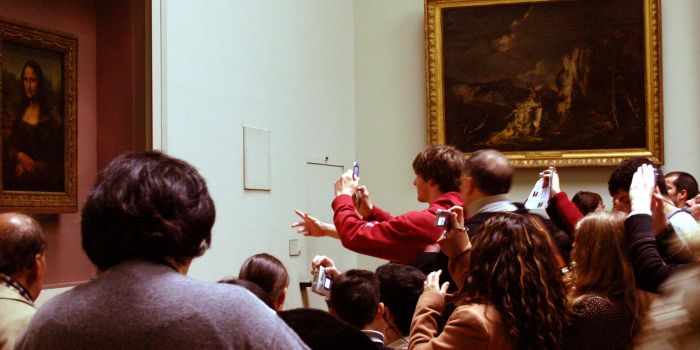
The Mona Lisa hangs in Room 711 of the Denon Wing. Crowds are thickest between 11am and 3pm — go first thing or during a late-night opening.
What to see inside the Louvre
With over 35,000 works across eight curatorial departments, the Louvre rewards a focused plan more than an attempt to see it all. A handful of pieces draw nearly everyone:
Mona Lisa
Leonardo da Vinci’s enigmatic portrait — the museum’s single most famous work, in the Denon Wing, Room 711.
Venus de Milo
The ancient Greek statue of Aphrodite, a defining image of classical beauty, in the Sully Wing.
Winged Victory of Samothrace
A Hellenistic masterpiece of motion and triumph, dramatically placed at the top of the Daru staircase.
Liberty Leading the People
Delacroix’s revolutionary icon of French painting, in the Denon Wing’s large-format galleries.
Beyond the headliners, the Egyptian antiquities in the Sully Wing, the Code of Hammurabi, the sculpture courts of the Richelieu Wing and the vast halls of French and Italian painting are all worth your time. A practical tip: download the official Louvre app before you arrive — its map alone saves a lot of wrong turns in a building that confuses even locals.
Visit the Louvre with a private licensed guide
A timed ticket gets you through the door, but a licensed private guide turns 35,000 works into the 30 that matter for you — reading the room, sequencing the route and handling skip-the-line access so you spend your hours looking at art rather than maps. As a rough guide, a private licensed guide in Paris costs around €80–100 per hour for the group (not per person), with museum entry tickets usually paid separately. Guides set their own rates and you book them directly, with no agency mark-up in between. The profiles below show licensed guides available for private bookings; message them directly to check availability and price.
No Guide Listed Yet
OfficialGuides connects independent licensed guides with travellers — directly. If you’re a licensed guide working in Paris and would like your profile listed on this page, contact here to contact here to join our platform →
Louvre tickets — frequently asked questions
How much does a Louvre ticket cost in 2026?
The box-office price is €22 for EU/EEA residents and €32 for non-EU visitors (as of 14 January 2026) — but buying at the counter means waiting in the on-site ticket queue. Children under 18 and EU residents aged 18–25 enter free. Booking online for the same price secures a time slot and skips that purchase line.
Do I need to book Louvre tickets in advance?
Yes — strongly recommended. The Louvre uses mandatory timed entry, and walk-up slots regularly sell out in peak season. Booking online secures your arrival window and lets you skip the ticket-purchase queue. Even free-entry visitors must reserve a slot.
What does “fast-track” or “skip-the-line” actually skip?
It lets you bypass the ticket-purchase queue and go straight to your reserved entry lane at the chosen time. It does not skip the mandatory security screening, which every visitor must pass through regardless of ticket type.
What are the Louvre’s opening hours?
9:00am–6:00pm most days, with late opening until 9:45pm on Wednesday and Friday. The museum is closed every Tuesday, plus 1 January, 1 May and 25 December. Last admission is one hour before closing.
When is the Louvre free to enter?
Free for everyone on the first Friday of each month after 6:00pm (except July and August) and on 14 July. Under-18s and EU residents under 26 are always free. A reserved time slot is still required, and free slots disappear quickly.
Which is the nearest metro station to the Louvre?
Palais Royal – Musée du Louvre on metro Lines 1 and 7, with a direct underground connection to the Carrousel entrance. Line 14 stops nearby at Pyramides.
How long should I spend at the Louvre?
Most first-time visitors find 3–4 hours ideal for the highlights plus one collection. The three anchor works — Mona Lisa, Venus de Milo and the Winged Victory — can be seen in under two hours if you move efficiently.
Which entrance has the shortest queue?
The Carrousel du Louvre entrance (from 99 Rue de Rivoli or the metro) usually has a shorter security queue than the main glass Pyramid, and is the default for pre-booked tickets and skip-the-line tours.
Are temporary exhibitions included in a standard ticket?
Most exhibitions inside the permanent galleries are included, but major shows in the Hall Napoléon often require a separate ticket (typically €4–6 extra) and may not be covered by the Paris Museum Pass.
Can I buy Louvre tickets on the same day?
Sometimes — same-day slots occasionally remain on the official site and authorised partners, but early-morning and weekend slots in peak season sell out first. Booking a few days ahead is far safer between April and October.
🌙 Quietest Time to Visit
Dedicated-entry guided evening tour — skip the queue and beat the crowds →
🌐 This page is also available in:
Arabic, 简体中文 (Chinese), Czech, Dutch, French, German, Greek, Hungarian, Italian, 日本語 (Japanese), 한국어 (Korean), Latvian, Polish, Portuguese, Romanian, Russian, Spanish, Swedish, Türkçe (Turkish), Ukrainian.