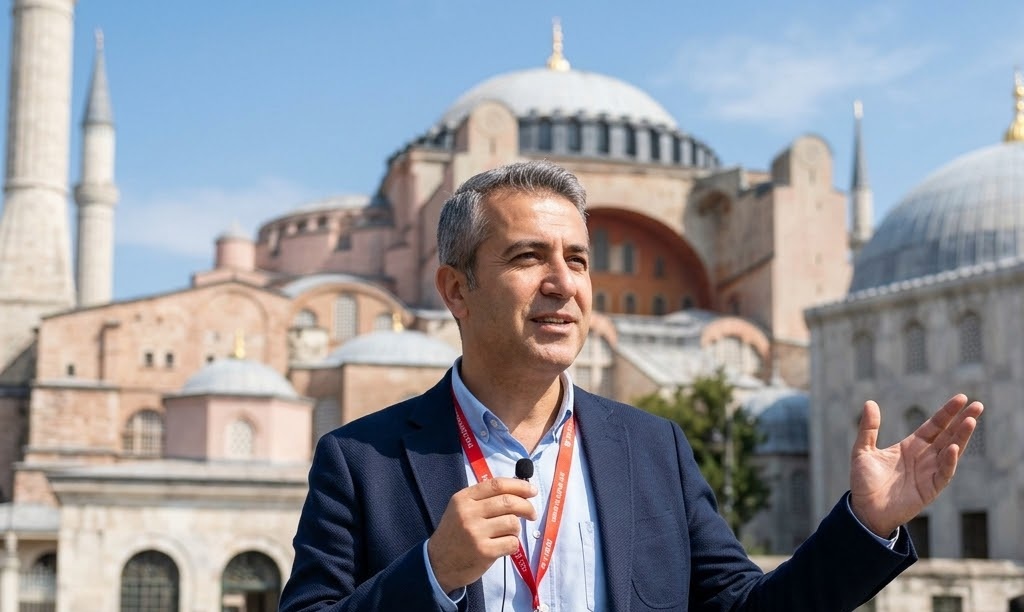
Last updated: March 2026 · By Official Guides Editorial Team
Historical Origins: From the Ottoman Empire to the Republic
The formal regulation of tourist guiding in Turkey dates back to the final decades of the Ottoman Empire. As European travel to Istanbul and the broader Ottoman territories increased throughout the 19th century, so did complaints about dishonest interpreters and self-appointed guides who exploited travellers. Contemporary travel guidebooks, such as those published by John Murray (1871) and the writings of Italian author Edmondo De Amicis (1874), explicitly warned visitors against unscrupulous guides in Istanbul.
In response to these concerns, a letter signed by Grand Vizier Kamil Pasha was sent to the Ottoman Council of State in May 1890, highlighting the urgent need for regulation. On November 10, 1890, the Ottoman government enacted the “Regulation Concerning Persons Interpreting for Travellers” (Seyyahlara Tercümanlık Edenlere Dair Nizamname), establishing one of the earliest formal legal frameworks for the tourist guiding profession anywhere in the world. This regulation required all interpreters and guides to obtain official certificates, and those found engaging in guiding activities without proper certification faced revocation of their documents and criminal penalties under the Ottoman penal code. The regulation was reaffirmed on March 11, 1895, with the same text.
Following the establishment of the Republic of Turkey in 1923, new regulations governing the profession were introduced in 1925. The period between 1925 and 1930 is widely regarded by scholars as the first golden age of professional tourist guiding in Turkey, a period that came to an end with the onset of World War II. Throughout the Republican era, the profession continued to be subject to successive legal reforms reflecting the country’s evolving tourism policies.
Modern Legal Framework: Law No. 6326
The current legal framework governing the tourist guiding profession is the Tourist Guiding Profession Law No. 6326, enacted in 2012. This law places the profession firmly under the supervision of the Republic of Turkey’s Ministry of Culture and Tourism and establishes comprehensive requirements for licensing, professional conduct, and enforcement.
Under this law, tourist guiding is recognized as a regulated profession with legally protected status. The law defines the rights and responsibilities of licensed guides, sets the framework for professional fees, and establishes penalties for unauthorized guiding activities. It also created the institutional structure through which the profession is organized and governed at both the national and regional levels.
Tourist Guiding Profession Law No. 6326 (2012)
Published in the Official Gazette on June 22, 2012. Governs all aspects of the tourist guiding profession including licensing, professional unions, fee structures, disciplinary measures, and penalties for unlicensed guiding. Supersedes all previous regulatory frameworks.
Requirements to Become a Licensed Tour Guide in Turkey
Turkey’s requirements for becoming a licensed tourist guide are among the most demanding in the world. The process involves university-level education, language certification, and practical field training — a combination that ensures guides possess deep knowledge of the country’s history, culture, archaeology, and art.
Educational Pathways
There are two primary pathways to obtain a tourist guide license in Turkey:
University Graduation Pathway
Candidates graduate from a two-year (associate degree), four-year (bachelor’s degree), or postgraduate-level tourist guidance or tourism guidance programme at an accredited Turkish university. The curriculum typically spans eight semesters and includes subjects such as Turkish and Ottoman history, the history of Seljuk principalities, the history of religions (including Christianity, Islam, and Judaism), Byzantine and Ottoman art history, archaeology, tourism law, and at least two foreign languages studied throughout the programme.
Supplementary Training Pathway
Holders of a bachelor’s degree in archaeology, art history, or Far Eastern languages may enter the profession by completing an additional training programme organized in cooperation with the Ministry of Culture and Tourism and accredited universities. These programmes are periodically announced by TUREB and participating universities, such as Cappadocia University and others.
Foreign Language Proficiency
All candidates, regardless of their educational pathway, must demonstrate proficiency in at least one foreign language. This is assessed through the YDS (Foreign Language Proficiency Examination) administered by ÖSYM (the Turkish national assessment centre), or an equivalent internationally recognized examination. A minimum score of 75 out of 100 is required. TUREB also organizes its own foreign language examinations for graduates of guidance departments, consisting of an oral examination followed by translation exercises in the field of tourist guiding.
Mandatory Educational Tour
After meeting the educational and language requirements, candidates must complete a mandatory educational tour of at least 45 days across one or more of the designated guiding zones into which Turkey is divided. These tours are organized by TUREB and cover the historical, cultural, natural, and archaeological sites within each zone. The costs of the educational tour are borne by the candidates themselves. Upon successful completion of all requirements, the candidate receives a Professional Tourist Guide License issued by the Ministry of Culture and Tourism.
Professional Organization: TUREB and Regional Chambers
The profession is nationally overseen by the Turkish Tourist Guides Union (Turist Rehberleri Birliği, TUREB), established under Law No. 6326. TUREB serves as the central professional body responsible for determining official base fee tariffs (in consultation with the Ministry and the Association of Turkish Travel Agencies — TURSAB), organizing continuing education programmes and seminars, administering supplementary foreign language examinations, managing license renewals, coordinating with travel agencies on behalf of guides, and providing legal support to its members.
TUREB is composed of 13 regional chambers (oda), each representing tourist guides in a specific geographic area. The largest of these is the Istanbul Chamber of Tourist Guides (İstanbul Rehberler Odası, İRO), which alone has over 4,900 registered members. Every licensed tourist guide in Turkey is required to be a member of their respective regional chamber.
The Hittite Sun Disc
The emblem of TUREB features the Hittite sun disc, an ancient Anatolian symbol dating back approximately 4,000 years. The choice of this symbol reflects the deep historical roots of cultural interpretation in Anatolia, connecting modern tourist guides to a millennia-old tradition of welcoming and guiding visitors through one of the world’s most historically layered regions.
Statistics and Demographics
As of the early 2020s, there were approximately 11,700 licensed tourist guides registered in Turkey. Of these, around 7,500 are certified to guide in the English language, making it by far the most common guiding language. The gender distribution shows approximately 7,841 male and 3,885 female licensed guides. The Istanbul Chamber (İRO) accounts for nearly 4,936 members, reflecting Istanbul’s dominant position as Turkey’s primary tourism destination.
Guides in Turkey operate in a wide range of languages including English, German, French, Spanish, Russian, Arabic, Japanese, Korean, Chinese, Italian, Portuguese, Dutch, Polish, Greek, Hebrew, and many others — reflecting the diverse international profile of Turkey’s tourism market.
Penalties for Unlicensed Guiding
Turkey enforces its tourist guiding regulations with significant penalties. Under Law No. 6326 and related legislation, operating as a tourist guide without a valid license is strictly prohibited. Individuals found guiding tourists without proper authorization face substantial financial fines and potential imprisonment. The penalties extend beyond individual guides: travel agencies that organize tours using unlicensed guides risk severe financial penalties and, in serious or repeated cases, the cancellation of their agency operating license.
TUREB reports that illegal guiding has become an increasing concern in recent years, with the number of unlicensed individuals operating as guides estimated to have grown to approximately one-third of the total number of certified guides, driven in part by rising international tourist arrivals. Enforcement operations are conducted by the Ministry of Culture and Tourism, TUREB, and local law enforcement agencies, particularly around major tourist sites such as Hagia Sophia, the Blue Mosque, and Topkapı Palace in Istanbul.
Turkey’s Unique Position in Global Tour Guiding
Turkey’s tourist guiding system stands out internationally for several reasons. Unlike many countries where anyone can offer guiding services without formal training or certification, Turkey requires a university-level education specifically in tourist guidance — a requirement that is rare globally. The combination of mandatory academic training in history, art, archaeology, and religion, together with rigorous foreign language testing and a 45-day field training tour, means that Turkish licensed guides are among the most comprehensively educated in the world.
The zone-based licensing system is another distinctive feature. While most countries that regulate guiding do so on a national or city level, Turkey’s division into multiple guiding zones — each requiring specific knowledge of local history, culture, and sites — ensures that guides have in-depth expertise in the regions where they operate.
Furthermore, the legal protection afforded to the profession, including criminal penalties for unlicensed guiding and the institutional framework of TUREB and its regional chambers, creates a level of professional organization that is unmatched in many tourism markets. Turkish licensed guides are often referred to as “voluntary ambassadors” of their country — a description that reflects both the pride taken in the profession and the role that guides play in shaping international visitors’ perceptions of Turkey.
University-Level Education
Turkey is one of the few countries that requires formal university education specifically in tourist guidance, with curricula covering history, art, archaeology, religion, and multiple foreign languages.
Zone-Based Licensing
Guides are licensed for specific geographic zones and languages, ensuring deep local expertise — a system that is uncommon internationally.
Legal Protection
The profession is protected by law, with criminal penalties for unlicensed guiding and a comprehensive institutional framework under TUREB.
Historical Depth
With formal regulation dating to 1890, Turkey’s guiding profession has over 135 years of institutional history — one of the longest in the world.
How long does it take to become a licensed tour guide in Turkey?
The minimum pathway involves completing a two-year associate degree programme in tourist guidance, passing a foreign language exam with a score of at least 75/100, and completing a 45-day educational tour. A four-year bachelor’s degree pathway is more common and provides broader career opportunities. In total, the process typically takes 2 to 5 years.
Can foreign nationals become licensed tourist guides in Turkey?
Under current legislation (Law No. 6326), candidates must be citizens of the Republic of Turkey and be over 18 years of age. Foreign nationals are not eligible for a Turkish tourist guide license, which further distinguishes Turkey’s system from more open markets.
What languages can Turkish tour guides operate in?
Licensed guides in Turkey operate in a wide range of languages including English, German, French, Spanish, Russian, Arabic, Japanese, Korean, Chinese, Italian, Portuguese, Dutch, Polish, Greek, Hebrew, and others. The most common guiding language is English, with approximately 7,500 of 11,700 licensed guides certified in English.
What happens if I use an unlicensed guide in Turkey?
Using an unlicensed guide carries risks for both the guide and the travel agency. Unlicensed individuals face substantial fines and potential imprisonment. Travel agencies that arrange tours with unlicensed guides risk severe financial penalties and cancellation of their operating license. Tourists themselves are not penalized, but may have a lower quality experience and have no legal recourse in case of problems.
How can I verify that a guide is licensed?
Every licensed tourist guide in Turkey carries a professional identification card (kimlik kartı) issued by the Ministry of Culture and Tourism. This card displays the guide’s name, photograph, license number, authorized guiding zones, and certified languages. You may ask to see this card before beginning a tour. You can also verify a guide’s registration through TUREB’s official website.
What is TUREB and what does it do?
TUREB (Turist Rehberleri Birliği) is the Turkish Tourist Guides Union, the national professional body overseeing the tourist guiding profession. It consists of 13 regional chambers and is responsible for setting official fee tariffs, organizing training programmes, administering exams, managing license renewals, and representing guides’ interests before government institutions and travel agencies.
Find Your Licensed Private Tour Guide
Browse certified, professional tour guides across Turkey and 30+ countries in over 30 languages. Every guide on our platform holds an official license issued by their country’s tourism authority.