Last Updated on 20/05/2026 by OfficialGuides Editorial Team
Licensed tour guides in Tunis
Below are the licensed private tour guides currently active in Tunis. Each one is officially registered with Tunisia’s Ministry of Tourism and works directly with travellers — no agency markup, no middlemen.
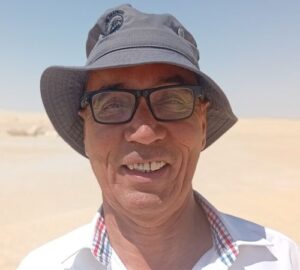
Alí Mouelhi - En
Why hire a licensed guide in Tunis
In Tunisia, the title of tour guide is regulated by the Ministère du Tourisme. To work legally, a guide must complete formal training (most go through the Institut National du Tourisme in Sidi Dhrif), pass a national examination, and hold a Guide Touristique Agréé card. The credential covers history, archaeology, religious heritage and at least one foreign language at a working level. It is the same system that licenses guides at major sites like Carthage, the Bardo and El Jem.
That matters in Tunis more than it might in some other capitals. The city has a strong informal economy around tourism, and at busy spots like the Medina, La Goulette cruise terminal or Sidi Bou Said you will be approached by people offering tours, shop tours and “private guides” who are not licensed. The reviews on Tripadvisor and Cruise Critic for Tunis include a fair number of stories about aggressive taxi drivers, surprise carpet-shop stops and unposted prices — almost always involving unlicensed operators.
A licensed guide gives you three concrete things: verified knowledge of Tunisian history (Punic, Roman, Arab-Islamic, Ottoman and French colonial layers), language competence in English, French, Italian, German or Spanish, and a transparent fee agreed in advance. They are also the only category of guide officially recognised inside ticketed sites like Carthage and the Bardo Museum.
One detail worth knowing before you book: in Tunisia, many licensed professionals work as driver-guides — the same person handles both the commentary and the wheel, in their own private vehicle. For couples and small families this is usually the most efficient setup. Larger groups (6+) are typically split into a guide plus a separate driver, with a minivan or small bus arranged for the day. When you message a guide, it is worth saying upfront how many people you are and whether you prefer a single driver-guide or a guide-plus-driver pairing.
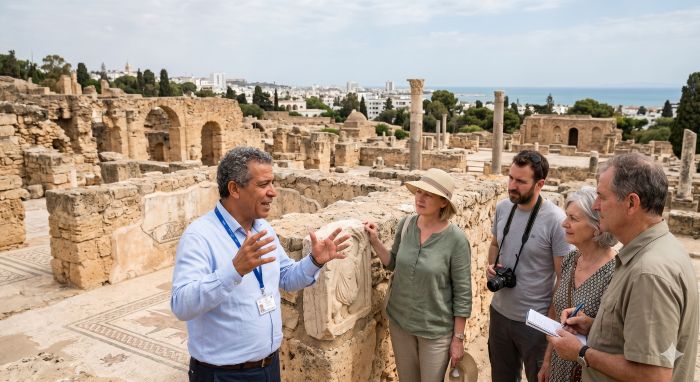 A licensed Tunisian guide at Carthage — small private groups get the context that makes the ruins come alive. (Editorial illustration)
Sample private tour itineraries in Tunis
These are not fixed packages — they are the most common itinerary patterns our guides arrange. Each one can be adjusted in length, pace and stops. Prices listed are typical guide fees only (transport, entries and meals separate unless noted).
Tunis Medina & Bardo Museum — half-day walking tour
A classic 4-hour walking tour through the UNESCO-listed Medina of Tunis, starting at Bab el Bahr (the French Gate), continuing past the Zitouna Mosque and the souks of perfume, copper and chechia, and ending at the Bardo National Museum to see the world’s largest collection of Roman mosaics. Best done early morning, before the souks get crowded. Guide fee: around €90–€120.
Carthage, Sidi Bou Said & Tunis — full-day classic combination
The single most popular itinerary in Tunisia. A full day covering the ruins of ancient Carthage (Byrsa Hill, the Antonine Baths, the Punic Ports), the white-and-blue village of Sidi Bou Said for lunch and a stroll, and the Medina of Tunis in the afternoon. Around 8–9 hours with a private vehicle and driver included. Guide fee: €180–€240; expect another €60–€100 for the car.
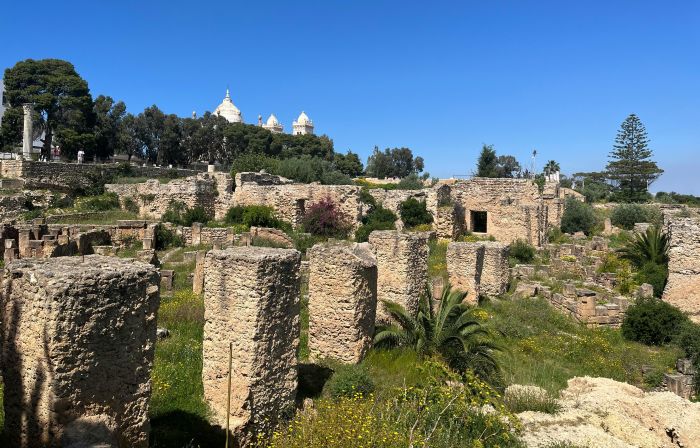 Antonine Baths at Carthage — the largest Roman baths built outside Rome, overlooking the sea. (El Jem Roman amphitheatre Tunisia — UNESCO day trip from Tunis with licensed guide.
 La Goulette cruise shore excursion — Tunis highlights in 4 to 6 hours
Designed specifically for cruise passengers docking at La Goulette port. A licensed driver-guide meets you at the terminal and takes you, in a private vehicle (sedan for couples, minivan for families, small bus for groups of 8 or more), through the essentials: Carthage (Antonine Baths and Byrsa Hill), Sidi Bou Said (45 minutes of free time), and either a quick Medina walk or the Bardo Museum depending on time. Returns you to the ship well before sailing. Guide fee: €140–€200 for 4–6 hours; vehicle separate.
El Jem & Kairouan — full-day UNESCO heritage trip
A long but rewarding 10–11 hour day trip south of Tunis. El Jem holds the third-largest Roman amphitheatre in the world, almost intact and dramatically isolated in a modern town. Kairouan, founded in 670 AD, is the fourth-holiest city in Sunni Islam — its Great Mosque and Aghlabid pools are extraordinary. Around 6 hours total driving. Guide fee: €260–€340; private vehicle €120–€160.
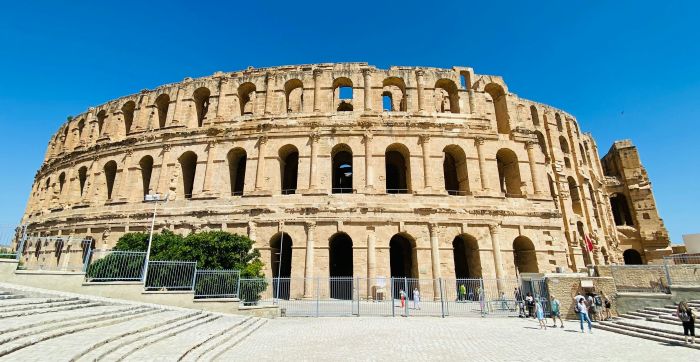 The Roman amphitheatre at El Jem — third-largest in the world, two hours south of Tunis. (Editorial illustration)
Dougga & Bulla Regia — Roman ruins specialist day
For travellers who want the Roman side of Tunisia at depth. Dougga is the best-preserved Roman small town in North Africa, set on a hilltop overlooking olive groves; Bulla Regia is unusual for its underground Roman villas, built half-buried to escape the heat. A full 9–10 hour day with a knowledgeable guide; far less crowded than Carthage. Guide fee: €220–€300; vehicle €120–€160.
Sahara overnight from Tunis — desert & Star Wars locations
An ambitious 2-day overnight tour from Tunis down to the Sahara: Matmata’s troglodyte houses (used as Luke Skywalker’s home in Star Wars), the chott el Jerid salt lake, Douz on the edge of the dunes, and an optional camel ride into the desert at sunset. Returns next day via El Jem. Long driving days, but the only way to see the Sahara without flying to Djerba. Guide fee: €420–€560 for the two days; transport and overnight separate.
- This page is also available in the following languages: German, Spanish, Portuguese
Average guide fees in Tunis
Prices below are guide fees only, in euros, for the guide’s professional service. Transport (private car or van with driver), site entries, museum tickets and meals are charged separately. Tunis is significantly cheaper than European capitals, but licensed guide rates are similar to other Mediterranean destinations because the credential itself is recognised internationally.
| Tour type | Duration | Guide Fee (EUR) |
|---|---|---|
| Medina walking tour | 3–4 hours | €80 – €120 |
| Half-day Tunis + Bardo | 4–5 hours | €100 – €150 |
| Cruise shore excursion (La Goulette) | 4–6 hours | €140 – €200 |
| Full-day Carthage + Sidi Bou Said + Tunis | 8–9 hours | €180 – €240 |
| El Jem & Kairouan day trip | 10–11 hours | €260 – €340 |
| Dougga & Bulla Regia day trip | 9–10 hours | €220 – €300 |
| Sahara overnight (2 days) | 2 days, 1 night | €420 – €560 |
Fees vary by guide seniority, language, group size and season. For groups larger than 6 the rate is usually flat, not per person. Tipping is appreciated but not mandatory; €10–€20 per day is normal.
Practical tips for booking a private tour in Tunis
Currency and payment. Tunisia uses the Tunisian Dinar (TND), which is a closed currency — you cannot legally export it. Most licensed guides accept payment in euros for their fee, paid directly at the start or end of the tour. Site entries (Carthage 10 TND, Bardo 13 TND, etc.) are paid in dinars on the spot; bring some cash.
Cruise passengers. If you arrive at La Goulette, book your guide in advance and ask them to meet you inside the port terminal, not outside. The taxi rank just outside the terminal is the most common source of cruise-day complaints, with reports of agreed prices being raised mid-journey. A licensed guide with their own car or arranged driver removes that risk entirely.
Dress code. Tunisia is a moderately conservative Muslim country. For mosque visits (the Zitouna in the Medina, the Great Mosque of Kairouan) cover shoulders and knees; women should bring a scarf for the head if entering. Carthage and the beach areas are relaxed — normal summer clothing is fine.
Bardo Museum status. The Bardo reopened in September 2023 after a two-year closure and has remained open since. It shares an entrance complex with the Tunisian Parliament, so security is heavy but routine. Closed on Mondays. Allow at least 2 hours for a proper visit.
Language. Most licensed guides speak French at a high level (Tunisia’s second language) and English, Italian, German or Spanish at a working level. Confirm the language before booking — fluency varies, especially in less-common languages like Russian, Polish or Japanese.
Best time to visit. March to May and September to early November are ideal. July and August can hit 38–40°C inland; coastal Tunis stays milder but the Medina becomes uncomfortable in the afternoon. Winter is mild (12–18°C) and quiet, but desert tours are best between October and April.
When to visit Tunis
Spring (mid-March through May) and autumn (late September through early November) are the most comfortable seasons. Daytime temperatures sit around 22–27°C, evenings are cool, and the light over Carthage and Sidi Bou Said is at its best. These are also the most popular cruise months at La Goulette, so book guides well in advance — the city sees several thousand cruise passengers on peak arrival days.
Summer (June–August) is hot but manageable in Tunis itself thanks to the sea breeze; inland sites like Dougga and El Jem are punishing in midday heat. Winter (December–February) is genuinely mild, with very few crowds — a good time for museum-heavy itineraries and Roman ruins, though some southern Sahara routes are weather-dependent. Ramadan affects opening hours of restaurants and some sites; ask your guide in advance how it overlaps with your trip.
Frequently asked questions
Do I need a guide to visit Tunis, or can I do it independently?
You can visit Tunis independently — taxis are cheap, the Medina is walkable, and the TGM suburban train connects La Goulette to Sidi Bou Said and Carthage in under 30 minutes. But a licensed guide makes a real difference at Carthage (where the ruins are spread over several kilometres and largely unmarked), at the Bardo (where labelling is in Arabic and French only), and inside the Medina (which is genuinely a maze). For first-time visitors with limited time, a guide for at least one day is the smartest investment.
Is Tunis safe for tourists in 2026?
Yes. Tunis has been politically stable in recent years and tourist areas — the Medina, Carthage, Sidi Bou Said, La Goulette — are well policed. The Bardo Museum reopened in 2023 and the cruise industry has returned strongly. As anywhere, basic precautions apply: keep an eye on belongings in the souks, agree on taxi prices before getting in, and avoid late-night walking in unfamiliar neighbourhoods. Booking through a licensed guide removes most of the small frictions travellers report online.
What languages do private tour guides in Tunis speak?
French is the working second language of nearly every licensed guide. English is widely spoken, especially among guides who work with cruise passengers and Anglo travellers. Italian and Spanish are common — both have strong historical ties to Tunisia. German is available but less common. Less-frequent languages (Russian, Polish, Japanese, Mandarin) are possible but you may need to book further in advance.
How does the cruise shore excursion compare to the ship’s official tour?
Ship-organised excursions run in groups of 40–50 passengers in large coaches, with fixed timing and forced shopping stops at carpet or ceramic shops. A private licensed guide with their own car takes 1–6 people on a custom route, with no shopping pressure, and can usually fit more sites in less time. Private tours typically cost less per person for couples and small groups; ship tours are competitive for solo travellers.
Can a private guide arrange entry tickets to Carthage, the Bardo and El Jem?
Yes. Most licensed guides will buy the entry tickets for you on arrival (cash, in dinars) and add them to your final bill, or have you pay directly at the gate. Tickets for Carthage (a single pass covering all sites, around 10 TND) and the Bardo (around 13 TND) are inexpensive and rarely sell out. El Jem requires a separate ticket bought at the amphitheatre entrance. There is no “skip the line” system in Tunisia — queues are short except on cruise days.
Is food included in a private tour, and what should I expect to eat?
Lunch is not normally included in the guide fee — you stop at a restaurant of your guide’s recommendation, and everyone pays for their own meal. A good lunch in the Medina or Sidi Bou Said is around €15–€25 per person. Try brik (a thin pastry with egg and tuna), couscous (best on Friday), ojja (a spicy egg-and-tomato stew), grilled fish in La Goulette, and Tunisian sweets like makroudh and baklawa. Wine is widely available; Tunisia has produced wine since Roman times.
Do I need to tip my Tunis tour guide?
Tipping is not mandatory but is appreciated for good service. €10–€20 per day for the guide is normal, and €5–€10 for the driver if separate. Some travellers tip more for a half-day they especially enjoyed; the guide will never ask. If you pay your guide directly in euros, you can simply round up the total.
How far in advance should I book?
For peak cruise dates (April–June, September–October) and for less-common languages, book 4–6 weeks ahead. For standard English- or French-speaking tours outside cruise season, 1–2 weeks is usually enough. For the Sahara overnight tour, book at least 2–3 weeks ahead so the guide can confirm the desert camp and driver. Last-minute requests in low season can sometimes be arranged within 24–48 hours.
Get in touch with a licensed guide in Tunis
Browse the guide profiles at the top of this page and message any guide directly. There is no booking fee, no commission and no middleman — you talk to the guide, agree on the itinerary, and pay them directly on the day. If you are not sure which guide is the best fit, contact us and we will help match you with someone based on your language, dates and interests.
Note: OfficialGuides is a directory connecting travellers with independent licensed tour guides. We do not operate tours ourselves; bookings and payments are made directly with the guide.